
NEWS
🇺🇸 TRUTH CHECK: Trump–Vance Propose Nationwide Voter ID for Federal Elections…

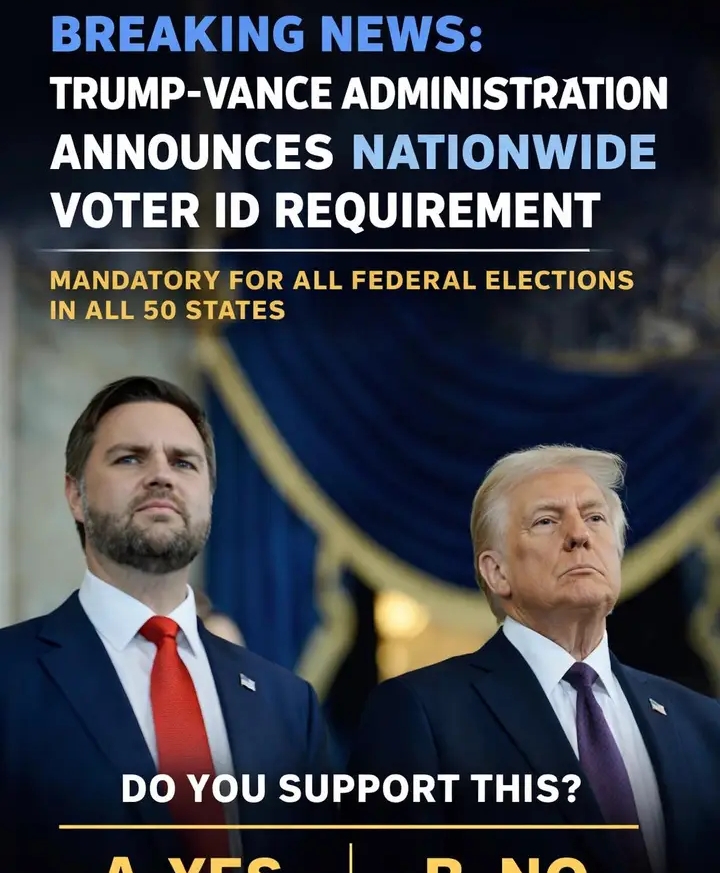
A sweeping election proposal from Donald Trump and Vice President JD Vance is igniting national debate after the administration announced plans to require voter identification for all federal elections in all 50 states.
Supporters say it’s a long-overdue step to restore confidence in U.S. elections.
Critics argue it could reshape voting access and face major legal challenges…
Here’s what we actually know.
🗳️ WHAT THE PROPOSAL DOES.
The Trump–Vance administration says the goal is uniform rules and clear national standards for federal elections.
Key elements include:
• A nationwide voter ID requirement for federal elections
• Consistent standards across all states
• A requirement that states provide free voter ID options
• An emphasis on election integrity without voter exclusion
Source: White House policy briefings; administration statements (2026)
🔐 WHY SUPPORTERS BACK IT.
Supporters argue voter ID is a baseline safeguard, not a barrier.
They point out:
• ID is already required for air travel, banking, employment, and government services.
• Most developed democracies require voter identification.
• A lack of uniform rules fuels public distrust regardless of who wins
Backers say clear, national standards reduce confusion, limit inconsistent state practices, and strengthen transparency.
Sources:
• National Conference of State Legislatures (voter ID overview)
• Pew Research Center (public confidence in elections)
• Heritage Foundation election integrity reports
📬 CONTEXT: WHY THIS IS HAPPENING NOW.
The administration frames the proposal as a response to:
• Expanded mail-in voting after 2020
• Ballot collection (“ballot harvesting”) disputes which a lot of us saw some of this on video
• Differing state rules that create uneven standards.
Officials argue that without consistent federal rules, skepticism about election outcomes will continue no matter which party wins.
And that’s fair.
Sources:
• Congressional Research Service (election administration reports)
• Bipartisan Policy Center (post-2020 election reforms)
⚠️ WHAT OPPONENTS ARGUE..
Democrats and voting-rights groups warn the mandate could:
• Disproportionately affect low-income voters, elderly voters, and rural communities
• Create administrative burdens for states
• Invite legal challenges over federal authority and voting access
They argue that access, not fraud, remains the primary challenge in U.S. elections.
Sources:
• Brennan Center for Justice
• American Civil Liberties Union
• NAACP Legal Defense Fund
🧾 ADMINISTRATION RESPONSE TO ACCESS CONCERNS.
The Trump–Vance administration counters that:
• States will be required to offer free voter IDs
• ID access must be easy and geographically available
• The policy is designed to secure elections without disenfranchisement
Officials emphasize the proposal is about verification, not suppression.
Sources:
• White House election policy statements
• Department of Justice voting access guidance.
⚖️ WHAT HAPPENS NEXT.
• Legal challenges are expected
• Congressional debate over federal vs. state authority will intensify
• Courts may be asked to weigh election security against access.
The issue is quickly becoming one of the most defining election policy debates of the moment.
📌 WHY THIS MATTERS.
At its core, this proposal forces a national conversation about:
• Election security vs. election access
• Standardization vs. state control
• Public trust vs. administrative burden
Regardless of where you land, this debate isn’t going away.
You don’t have to agree with voter ID to acknowledge why millions of Americans support it.
That’s the conversation the country is now being forced to have openly.
And it is needed. 🇺🇸
Faith. Family. Freedom.

FAIRNESS FIGHT: The International Olympic Committee announcing a groundbreaking change to protect female athletes and women’s sports as a whole — a ban on biological males competing in women’s events.

Breaking News: Trump Administration Moves to Add President’s Signature to U.S. Currency in Unprecedented Shift

Afternoon Update | America… right now… in the middle of this afternoon… while most of us are on lunch break… Karoline Leavitt just finished facing every camera and every difficult question in the world.click the link below

President Trump’s signature will be added to future U.S. paper currency, the Treasury Department announced Thursday

Breaking News: First $100 Bills Bearing Trump and Bessent Signatures Set for June Release click the link below

Just In : U.S. INTERCEPTED UKRAINE MESSAGES OF PLOT TO ROUTE MONEY TO BIDEN CAMPAIGN

Just In : Here’s the Average Social Security Benefit at Ages 62 to 80 — What You Can Expect at Every Stage

BREAKING: U.S President Donald Trump Has Just Been Confirmed… See More

Just In: “NO ONE UNDERSTOOD WHY Donald Trump PAUSED HIS SPEECH… UNTIL THE NEXT MORNING.”CLICK. THE LINK BELOW

REALITY CHECK IN WASHINGTON: A tense exchange has sparked fresh debate over the true cost—and purpose—of recent escalation.

Breaking News:Millions of Americans Receive Social Security Payments Today — Here’s Who Qualifies for March 25 Disbursement
