
NEWS
LINE DRAWN: President Trump Has Placed America’s Adversaries on Notice

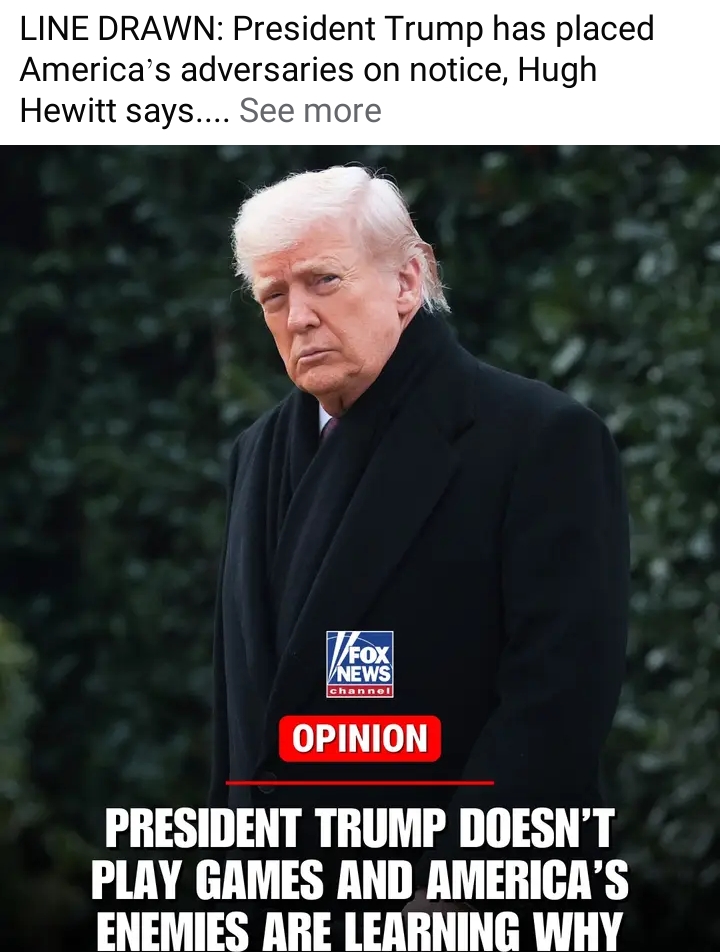
“When President Trump makes a demand or issues a warning, the recipients must take it seriously,” argues commentator Hugh Hewitt—a statement that captures a defining feature of Donald Trump’s approach to foreign policy.
Whether praised as decisive or criticized as confrontational, Trump’s presidency established a clear pattern: public, unmistakable lines drawn toward America’s adversaries, backed by a willingness to act.
From the outset, Trump rejected the cautious, diplomatically layered language that often characterizes international relations.
Instead, he favored direct statements—sometimes delivered through speeches, press conferences, or social media—that left little ambiguity about American expectations.
For supporters, this bluntness restored credibility to U.S. deterrence.
For critics, it risked escalation. Either way, the message was unmistakable: warnings issued by the Trump White House were not rhetorical exercises.
One of the most visible examples of this approach was toward North Korea. In 2017, amid escalating missile tests, Trump warned of “fire and fury” if threats continued.
While the language shocked allies and adversaries alike, it also marked a sharp departure from years of strategic patience.
The result was not immediate conflict, but a dramatic pivot toward direct engagement, culminating in unprecedented leader-to-leader summits.
Regardless of how one evaluates the long-term outcomes, the episode reinforced Hewitt’s point: Trump’s warnings commanded attention.
A similar posture defined Trump’s dealings with Iran.
The administration’s withdrawal from the Iran nuclear deal was paired with explicit demands for broader behavioral changes and severe economic sanctions.
These moves were framed as consequences, not negotiations for their own sake.
Trump’s message was that agreements perceived as weak would not be preserved out of habit, and adversaries would face tangible costs for defiance.
The killing of Iranian General Qassem Soleimani further underscored this doctrine—demonstrating that U.S. red lines, once crossed, could trigger swift action.
China, too, found itself confronted with a clearer set of American expectations. Through tariffs, technology restrictions, and public criticism of trade practices, Trump signaled that the United States would no longer tolerate what it viewed as structural imbalances.
While the methods were contentious, the intent was plain: economic and strategic competition would be addressed openly, not quietly managed behind closed doors.
Hewitt’s assertion rests on the concept of credibility. In international relations, deterrence depends less on words alone and more on the belief that words will be followed by deeds.
Trump sought to strengthen that belief by reducing the gap between warning and action.
Supporters argue that this reduced uncertainty for adversaries—clear demands paired with clear consequences. In their view, unpredictability in style was balanced by predictability in resolve.
Critics counter that such an approach risked miscalculation.
Diplomacy, they argue, often relies on nuance, patience, and the ability to de-escalate without public confrontation.
Trump’s willingness to personalize disputes and issue public ultimatums could box adversaries into corners, making compromise politically harder.
Yet even critics acknowledge that foreign leaders adjusted their behavior in response to Trump’s signals, if only to avoid provoking a response.
Ultimately, the legacy of Trump’s foreign policy posture lies in its emphasis on drawing lines—and meaning them.
Hewitt’s statement reflects a broader assessment shared by many observers: adversaries learned that dismissing a Trump warning as posturing carried real risk.
Whether one views that as strength or hazard depends on one’s philosophy of leadership, but its impact is difficult to deny.
In an era marked by shifting power dynamics and renewed great-power competition, Trump’s approach reintroduced a stark principle to global affairs: clarity backed by consequence.
The lines he drew may continue to be debated, but during his presidency, they were unmistakably visible—and rarely ignored.

BREAKING:UK Grants U.S. Limited Access to Bases for Hormuz Operations Amid Rising Energy Crisis. Click the link for full detail.

BREAKING:Immigration, Power, and Pressure: Trump’s Airport Enforcement Threat Raises New Questions.

BREAKING:Viral Claim of U.S. Aircraft Carrier Downing Sparks Alarm — But Evidence Remains Unverified.

SHOCKING:Trump Issues 48-Hour Ultimatum to Iran, Threatens Strikes on Power Plants Over Hormuz Crisis.

BREAKING:U.S. Admiral’s Early Exit Sparks Controversy Over Deadly Caribbean Military Strikes.

BREAKING:Israel Confirms Killing of Iran’s Intelligence Minister Esmaeil Khatib in Targeted Airstrikes.

Breaking News: POLITICAL EARTHQUAKE: 47 REPUBLICANS BREAK RANKS AS TRUMP IMPEACHMENT SURGES TO 212 VOTES

Update: Simulation Chaos: Viral ARMA 3 Scenario Falsely Claims Destruction of U.S. Warships in Strait of Hormuz

Breaking News: Trump Breaks Down in Tears, Urges World to Stop Iran’s Attacks March 20, 2026

NEWSJust In: 2 Mins Ago! Sign from GOD? Biggest Tragedy JUST Happened in The USA! The World is Shocked and Scared Read the full story here:

Just In: 2 Mins! End Is Near? Biggest Tragedy JUST Happened in the USA! The Whole World is Shocked and Scared It happened fast—too fast for anyone to fully process,FULL DETAILS ABOUT BIGGEST TRAGEDY IN THE LINK BELOW
