
NEWS
Breaking News:Trump Hails $600 Billion Tariff Windfall as Trade Strategy Reshapes U.S. Economy

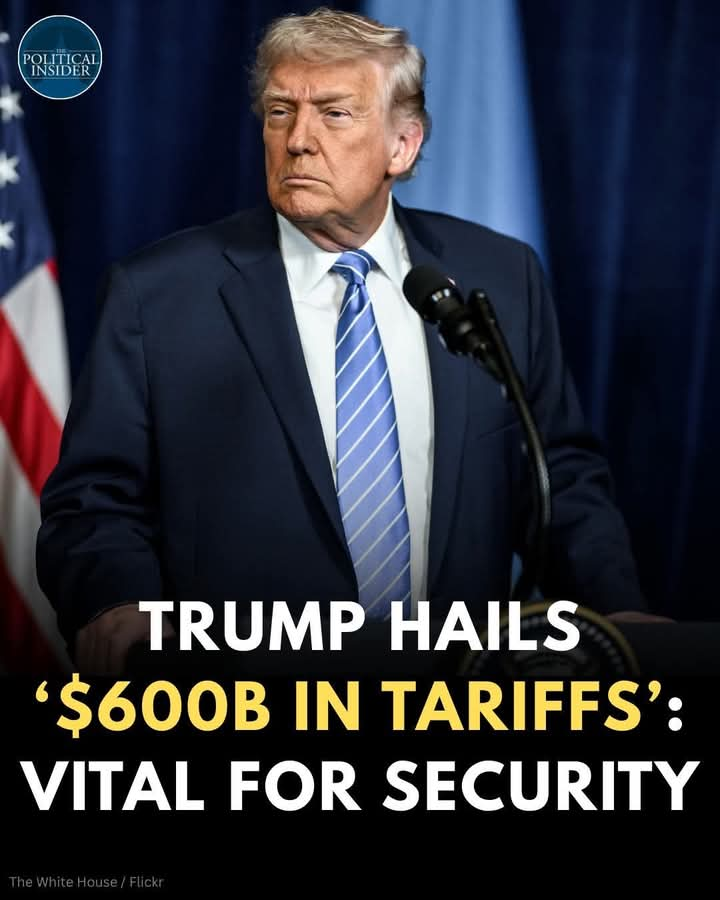
News: President Donald Trump has once again put global trade at the center of his economic message, boldly declaring that the United States is on track to receive more than $600 billion in tariff revenue a figure he describes as a major victory for American workers, national security, and economic independence.
Speaking to supporters, Trump framed the projected revenue as proof that his aggressive trade policies have “turned the tables” on foreign competitors who, in his view, benefited for decades from unfair trade practices at America’s expense.
By imposing tariffs on imported goods, the administration argues it has forced trading partners to renegotiate terms, protected domestic industries, and redirected billions of dollars back into the U.S. economy.
A Shift in Trade Philosophy
Trump’s approach marked a sharp departure from traditional free-trade orthodoxy.
Rather than prioritizing low tariffs and global integration, his administration embraced economic pressure as a tool of leverage—linking trade directly to manufacturing jobs, supply-chain resilience, and national security.
Supporters say the strategy is paying off.
Tariff revenues, they argue, help offset tax burdens at home while discouraging reliance on foreign manufacturing, particularly in strategic sectors such as steel, technology, and energy.
Media Skepticism and Political Divide
Trump has criticized what he calls the “fake news media” for downplaying the impact of tariff revenue and focusing instead on potential downsides such as higher consumer prices or trade retaliation.
His allies counter that the broader picture—stronger domestic production, leverage over competitors, and long-term security—outweighs short-term costs.
Critics, however, remain unconvinced. They argue tariffs function as indirect taxes on consumers and businesses and warn that escalating trade disputes could strain global markets.
Economists remain divided over whether tariff revenue represents sustainable growth or a temporary boost tied to trade friction.
Supreme Court Review Adds Stakes
Adding to the significance of Trump’s claims, the Supreme Court is currently reviewing aspects of tariff authority and trade policy, a development that could shape the future scope of executive power in economic matters.
For Trump and his supporters, the review underscores how central tariffs have become to national policy—and how consequential the outcome could be.
National Security and Self-Reliance
Beyond economics, Trump has repeatedly linked tariffs to national security arguing that a country dependent on foreign supply chains is inherently vulnerable.
By encouraging domestic production and reducing exposure to geopolitical rivals, the administration says its trade strategy strengthens America’s ability to withstand global shocks.
A Defining Economic Legacy?
Whether the $600 billion figure ultimately meets projections or not, Trump’s tariff-driven strategy has undeniably reshaped the conversation around trade.
For supporters, it represents a long-overdue correction that prioritizes American workers and sovereignty.
For critics, it remains a risky experiment with uncertain long-term consequences.
As legal challenges move through the courts and the political debate intensifies, one thing is clear:
Trump’s trade policies have transformed tariffs from a technical trade tool into a defining pillar of modern U.S. economic strategy—one that continues to polarize the nation and shape its future.

JUST BREAKING: Some Retirees to Receive Over $5,000 Monthly in Social Security by 2026 — Eligibility Criteria Revealed

¡Esta es la extraordinaria valentía de Irán 🇮🇷! 🔥 9:00 am: “Toda una civilización terminará esta noche”, dijo Trump. 9:10 a. m.: La gente común de Irán ha formado una cadena humana en el puente blanco. 🔥🔥 Si no tienen miedo a morir, no pueden ser derrotados. ¡Qué coraje increíble! 🔥

Pro-Iranian accounts on Twitter are flooding the platform tonight with AI-generated videos mocking Trump, including one showing him stepping off Air Force One waving a white flag after announcing a ceasefire deal critics say was so bad he appeared to negotiate with himself.

A major political shockwave just hit Washington as 24 members of Congress declare an EMERGENCY and demand the UNPRECEDENTED removal of President Trump from office.

BREAKING: Trump’s Shocking Revelation Sparks Viral Frenzy and Raises Questions About His Political Future

Is “getting the job done” more important than having a “nice” president?

Just In :Trump Sends Clear Message to Iran as B-52 Bombers Lift Off from UK Bases. See what happens next

Breaking News:Trump Suspends Planned U.S. Strikes on Iran for Two Weeks Amid Diplomatic Push. Full details here
Today I witnessed something because of Trump that I will never forget for the rest of my life. And that is exactly why I want to show you Trump’s real face today. Click here for full details

At a Monday press conference, Trump brought up past comments by North Korea’s Kim Jong Un about Joe Biden while discussing US troop deployment in South Korea.

Breaking Claim Sparks Concern: Viral Report Alleges Attack on U.S. Warships Near Strait of Hormuz. See what happens next
