
NEWS
BREAKING NEWS:Trump Announces Halt to Federal Payments for Sanctuary Cities Starting February 1.

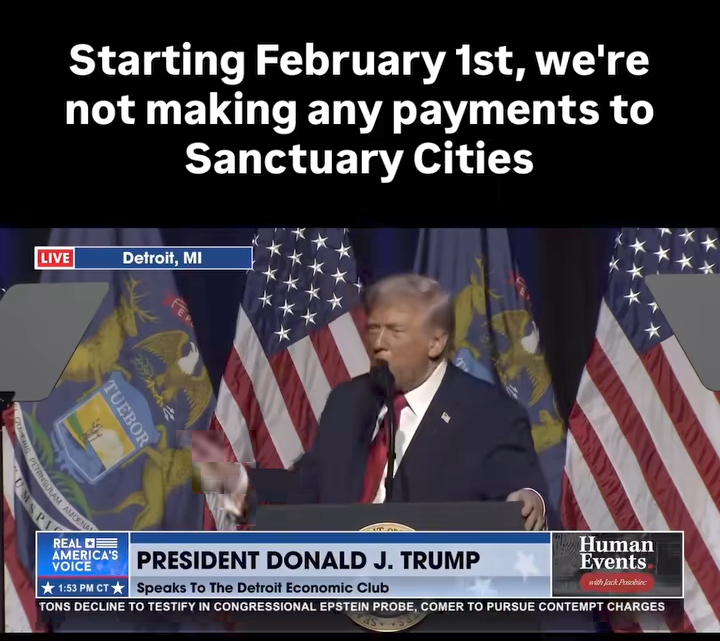
President Donald Trump has announced that, beginning February 1, his administration will stop making federal payments to states and cities that maintain so-called “sanctuary” policies, escalating a long-running national debate over immigration enforcement and local autonomy.
In a statement, Trump said the decision targets jurisdictions he argues are undermining public safety by limiting cooperation with federal immigration authorities.
“Starting February 1st, we’re not making any payments to Sanctuary Cities or states having Sanctuary Cities because they do everything possible to protect criminals at the expense of American citizens, and it breeds fraud and crime,” the president declared.
Sanctuary cities are municipalities or states that restrict how local law enforcement interacts with federal immigration agencies, often limiting compliance with immigration detainers or information-sharing requests.
Supporters of these policies argue they help build trust between immigrant communities and local police, encouraging crime reporting and cooperation without fear of deportation.
Critics, including Trump, contend they shield individuals who have committed crimes and weaken national immigration laws.
The president’s announcement signals a renewed push to use federal funding as leverage to compel compliance with immigration enforcement priorities.
While Trump has previously threatened similar actions, the February 1 deadline suggests a more immediate and concrete policy shift.
Legal experts note that efforts to withhold federal funds from sanctuary jurisdictions have historically faced court challenges.
Federal judges in past cases have ruled that broad funding cutoffs may violate constitutional limits on executive power, particularly if Congress has already appropriated funds for specific purposes.
Any new implementation is expected to be closely scrutinized and could trigger fresh legal battles between the federal government and affected states and cities.
Local leaders in sanctuary jurisdictions have already pushed back against such measures in the past, arguing that immigration enforcement is a federal responsibility and that punitive funding cuts could harm public services such as transportation, housing, and public safety—services that benefit all residents, regardless of immigration status.
The announcement is likely to energize Trump’s political base, which has consistently supported tougher immigration enforcement, while intensifying opposition from Democratic leaders and immigrant-rights advocates.
As February 1 approaches, attention will focus on how the administration defines “sanctuary” status, which federal funds could be affected, and whether the policy can withstand the legal challenges that are expected to follow.

ANDES STRAIN HANTAVIRUS: 3 DEAD, PASSENGERS SCATTERED — EXPERTS SLAM US FOR REPEATING COVID MISTAKES HANTAVIRUS OUTBREAK SPIRALS: SPAIN ORDERS 6-WEEK LOCKDOWN — BUT AMERICA’S LAX RESPONSE SPARKS PANIC..�

JUST BREAKING: Here’s Why Some Americans Will Receive Huge $5,108 Social Security Direct Deposits Within 10 Days

Middle East tensions continue to rise as Israel reportedly views Turkey as its next major regional challenge, with some officials referring to Ankara as “the new Iran.”

Breaking News: Missouri Supreme Court Hands Republicans a 7-1 House Map Victory for 2026 see what happens next

Elon Musk is joining President Trump on a major trip to Beijing, signaling a notable shift after the pair’s well-documented falling out in 2025.

BREAKING:Reza Pahlavi Declares Iran’s Leadership Weakening, Urges End to Islamic Republic.

VIRAL: Donald Trump’s Glamorous AI-Generated Proposal to Melania Trump Inside a Luxurious Met Gala Ballroom Has the Internet Buzzing

JUST NOW | This morning I woke up and started crying. And the reason is this photograph of JD Vance.

BREAKING : Here’s Who Will NOT Receive a Social Security Payment on Wednesday, May 13, 2026….

JUST BREAKING: Maximum Social Security Benefits for May 2026 Revealed by Retirement Age

REPORT: Elon Musk Could Join President Trump’s China Delegation — But No Official Confirmation Yet
