
NEWS
BREAKING NEWS:“Help Is on the Way”: Trump’s Message to Iranians, the Biblical Call to Rescue, and Strategic Next Steps.

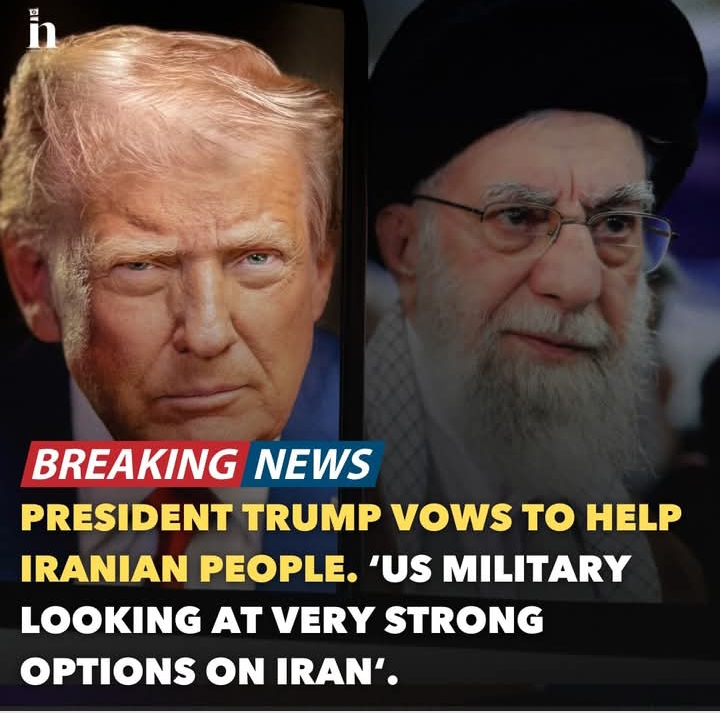
In a striking development amid one of the most intense moments in Middle East politics in years, U.S. President Donald Trump has publicly urged Iranians to “keep protesting” and declared that “help is on its way” as Tehran’s security forces continue a brutal crackdown on nationwide protests.
Trump also stressed that all options — including military responses — are being weighed by his administration.
A Message in the Midst of Crisis.
President Trump’s comments come as Iran grapples with widespread public unrest and reports of thousands of deaths in violent clashes between protesters and security forces.
Trump posted on his social media platform, Truth Social:
“Iranian Patriots, KEEP PROTESTING — TAKE OVER YOUR INSTITUTIONS!!! Save the names of the killers and abusers.
They will pay a big price … HELP IS ON ITS WAY.”
He also canceled all scheduled talks with Iranian officials until Tehran stops the “senseless killing” of demonstrators but did not provide specifics about what form this help would take.
At the same time, White House officials confirmed that while diplomatic avenues remain open, the U.S. is considering “very strong options,” including military action if the situation deteriorates further.
Biblical Echo: A Call to Rescue the Perishing.
Your reference to Proverbs 24:11.
“Rescue those being led away to death; hold back those staggering toward slaughter” brings a moral and humanitarian dimension to this moment.
The passage is a stark reminder that in moments of mass suffering — especially when civilians are violently repressed — there is a moral imperative to act.
Whether one interprets this literally, politically, or spiritually, the verse challenges global leaders to consider not simply geopolitical interests, but the human cost of inaction.
Why This Matters Geopolitically.
Iran is not just a regional power; it has deep ties to global politics and security dynamics.
For years, it has been at odds with the U.S. over nuclear ambitions, sponsored militias throughout the Middle East, and involvement in conflicts in Iraq, Syria, Lebanon, and Yemen. Any escalation could have far-reaching consequences for:
Regional stability.
Energy markets.
Global diplomatic alignments.
Even the threat of military options reverberates in capitals from Riyadh to Moscow — each calculating risks and consequences.
How Israel and the U.S. Should Respond.
Considering the urgency of the protests and the moral weight of the current moment, here’s a strategic framework anchored in both humanitarian concern and geopolitical reality for how Israel and the United States might respond constructively:
1. Prioritize Non-Lethal Support for Civilians.
Rather than immediate military intervention, support for civil society and information access could make a real impact.
This includes:
Satellite internet access and communication tools to counter state censorship and blackouts.
Humanitarian aid delivered with international partners to protect vulnerable groups.
Documentation of abuses to support future accountability mechanisms.
This approach aligns with the spirit of Proverbs 24:11 — seeking to protect innocent lives without immediately turning to force.
2. Build a Broad Coalition for Pressure and Protection.
An effective response should not be unilateral.
The U.S. and Israel — alongside EU nations and U.N. partners — could:
Increase targeted sanctions on Iranian leadership and security forces responsible for civilian deaths.
Coordinate diplomatic pressure to isolate hardliners in Tehran while offering negotiated pathways for reform.
Support U.N. investigations into alleged human rights violations.
Global unity reduces the risk of unilateral escalation and increases leverage over a regime under intense internal and external pressure.
3. Clarify the Limits of Military Options.
Trump’s assertion that military options remain on the table sends a powerful signal, but ambiguity can be dangerous.
If force is contemplated, it must be justified, limited, and internationally guided.
Potential principles for any military consideration:
Clear humanitarian objectives.
Strict rules of engagement to protect civilians.
Regional consultations to avoid unintended escalation.
These criteria remember that soldiers may be able to stop killing, but modern warfare often brings more suffering unless extremely circumscribed.
4. Support Transitional Governance and Reconciliation
If the Iranian protest movement continues to grow and internal dissent within the military and security forces increases, Israel and the U.S. can:
Back transitional councils or non-violent leadership structures that reflect popular aspirations.
Encourage inclusive dialogues that involve moderate voices within Iran.
Offer security guarantees against external aggression if peaceful transitions occur.
This strategic patience prioritizes stability while respecting the agency of the Iranian people.
A Moment of Moral Reckoning.
President Trump’s declaration that “help is on the way” resonates deeply with countless Iranians risking life and liberty on the streets.
It also echoes the ancient moral call to rescue the perishing — not with rhetoric alone, but with actions that protect lives, uphold dignity, and seek just outcomes.
The real test for Israel, the United States, and their allies will be whether they can act in ways that save lives without plunging the region into a wider war — honoring both humanitarian imperatives and strategic realities.

ANDES STRAIN HANTAVIRUS: 3 DEAD, PASSENGERS SCATTERED — EXPERTS SLAM US FOR REPEATING COVID MISTAKES HANTAVIRUS OUTBREAK SPIRALS: SPAIN ORDERS 6-WEEK LOCKDOWN — BUT AMERICA’S LAX RESPONSE SPARKS PANIC..�

JUST BREAKING: Here’s Why Some Americans Will Receive Huge $5,108 Social Security Direct Deposits Within 10 Days

Middle East tensions continue to rise as Israel reportedly views Turkey as its next major regional challenge, with some officials referring to Ankara as “the new Iran.”

Breaking News: Missouri Supreme Court Hands Republicans a 7-1 House Map Victory for 2026 see what happens next

Elon Musk is joining President Trump on a major trip to Beijing, signaling a notable shift after the pair’s well-documented falling out in 2025.

BREAKING:Reza Pahlavi Declares Iran’s Leadership Weakening, Urges End to Islamic Republic.

VIRAL: Donald Trump’s Glamorous AI-Generated Proposal to Melania Trump Inside a Luxurious Met Gala Ballroom Has the Internet Buzzing

JUST NOW | This morning I woke up and started crying. And the reason is this photograph of JD Vance.

BREAKING : Here’s Who Will NOT Receive a Social Security Payment on Wednesday, May 13, 2026….

JUST BREAKING: Maximum Social Security Benefits for May 2026 Revealed by Retirement Age

REPORT: Elon Musk Could Join President Trump’s China Delegation — But No Official Confirmation Yet
