
NEWS
BREAKING NEWS:Tensions Escalate: U.S. Adjusts Military Posture at Largest Base in Middle East as Trump Weighs Strike on Iran.

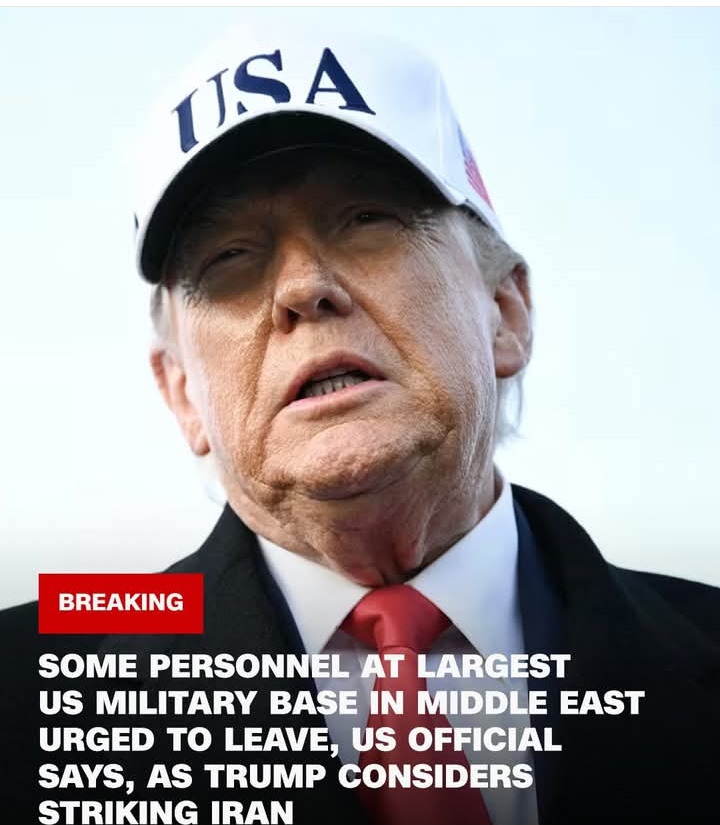
Amid one of the most volatile spikes in U.S.–Iran tensions in recent years, some U.S. military personnel at the Al Udeid Air Base in Qatar—the largest American military installation in the Middle East—have been advised to leave the base by Wednesday evening, U.S. diplomats and officials told Reuters.
The move comes as President Donald Trump considers military action against Iran in response to Tehran’s brutal crackdown on widespread anti-government protests.
A Precautionary ‘Posture Change’, Not Full Evacuation.
Officials emphasize that this development is a “posture change” and not an ordered evacuation, and there are no immediate signs of a mass withdrawal akin to last year’s partial movements before Iranian missile strikes on the base.
The advisory appeared to apply to specific personnel rather than an entire force, and authorities have not publicly detailed which roles or units are affected.
Al Udeid Air Base, located southwest of Doha, Qatar, is a strategic hub for U.S. Central Command operations across the region and hosts around 10,000 troops along with aircraft, surveillance assets, and command infrastructure.
Regional Tensions Drive the Shift.
The adjustment follows intensified warnings from Iran amid escalating diplomatic conflict.
A senior Iranian official told Reuters that Tehran has warned neighboring states hosting U.S. forces—including Qatar, Saudi Arabia, the UAE, and Turkey—that American military bases would be targeted if Washington attacks Iran.
This statement comes as retaliation threats grow alongside Washington’s repeated warnings that it could intervene militarily if Iranian authorities continue harsh crackdowns on protestors.
In recent weeks, President Trump has issued increasingly strident rhetoric, warning Tehran it could face “very strong action” and publicly contemplating military options to support Iranian protesters in the face of a deadly government crackdown.
The United States has not confirmed any specific strike plans or targets, and senior U.S. officials have declined extensive comment on operational details.
However, the move at Al Udeid suggests at least a heightened defensive posture amid rising threat assessments.
Historical Context: Base Under Threat Before.
Last year, prior to a major U.S. airstrike on Iran’s nuclear facilities, some personnel and families were relocated from U.S. installations in the Middle East.
Shortly thereafter, Iran retaliated with a missile attack on Al Udeid Air Base, though it caused minimal damage and no U.S. casualties.
That episode demonstrated how quickly tensions between Washington and Tehran can escalate into direct military exchanges, making the current advisory at least a cautious nod to previous conflict dynamics.
Broader Regional and Domestic Context.
The Pentagon’s adjustment at Al Udeid is unfolding against a backdrop of severe unrest inside Iran, where anti-government protests have drawn international condemnation and sparked debates in Washington over how forcefully the U.S. should respond.
Figures on protester deaths vary widely amid internet blackouts and conflicting reports, but the crisis is widely regarded as one of the most significant internal challenges to Iran’s clerical leadership in decades.
Meanwhile, global responses range from cautionary calls for diplomacy to political pressure from some U.S. lawmakers for forceful retaliation.
Arab and other regional governments are also reportedly concerned that any direct U.S. military action against Iran could destabilize the broader Gulf region.

ANDES STRAIN HANTAVIRUS: 3 DEAD, PASSENGERS SCATTERED — EXPERTS SLAM US FOR REPEATING COVID MISTAKES HANTAVIRUS OUTBREAK SPIRALS: SPAIN ORDERS 6-WEEK LOCKDOWN — BUT AMERICA’S LAX RESPONSE SPARKS PANIC..�

JUST BREAKING: Here’s Why Some Americans Will Receive Huge $5,108 Social Security Direct Deposits Within 10 Days

Middle East tensions continue to rise as Israel reportedly views Turkey as its next major regional challenge, with some officials referring to Ankara as “the new Iran.”

Breaking News: Missouri Supreme Court Hands Republicans a 7-1 House Map Victory for 2026 see what happens next

Elon Musk is joining President Trump on a major trip to Beijing, signaling a notable shift after the pair’s well-documented falling out in 2025.

BREAKING:Reza Pahlavi Declares Iran’s Leadership Weakening, Urges End to Islamic Republic.

VIRAL: Donald Trump’s Glamorous AI-Generated Proposal to Melania Trump Inside a Luxurious Met Gala Ballroom Has the Internet Buzzing

JUST NOW | This morning I woke up and started crying. And the reason is this photograph of JD Vance.

BREAKING : Here’s Who Will NOT Receive a Social Security Payment on Wednesday, May 13, 2026….

JUST BREAKING: Maximum Social Security Benefits for May 2026 Revealed by Retirement Age

REPORT: Elon Musk Could Join President Trump’s China Delegation — But No Official Confirmation Yet
