
NEWS
BREAKING NEWS:All Diplomatic Communications Between the United States and Iran Suspended Amid Rising Tensions.

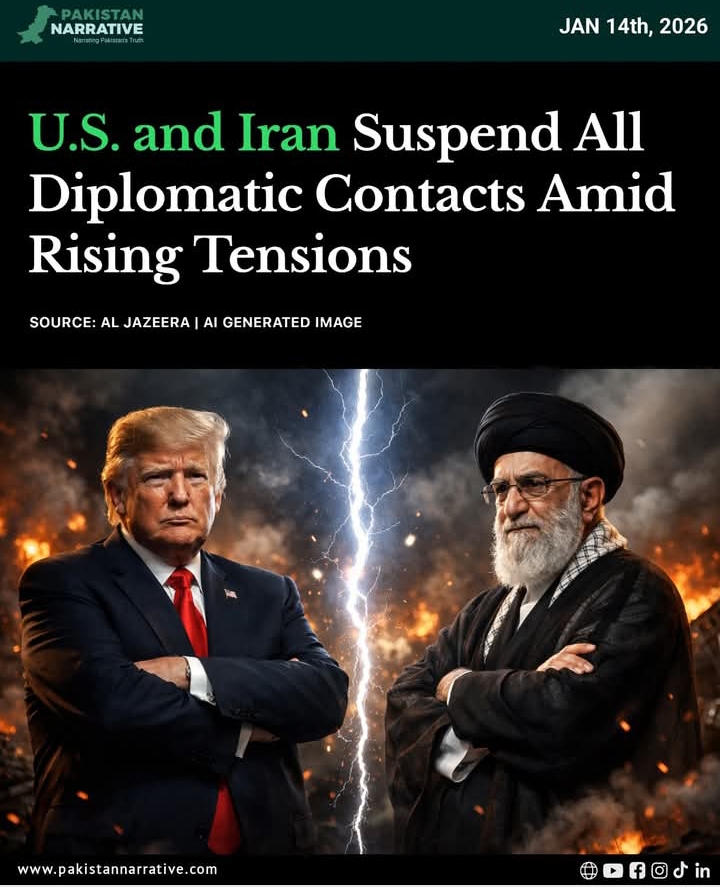
All diplomatic communications between the United States and Iran have been officially suspended, marking a significant deterioration in relations between the two long-standing adversaries.
The decision includes a complete halt to direct talks as well as previously planned engagements, signaling what analysts describe as one of the most serious breakdowns in dialogue in recent years.
According to diplomatic sources, the suspension affects both formal and informal channels that had been used to manage tensions, exchange messages, and prevent misunderstandings.
While communication between Washington and Tehran has often been limited and indirect, especially in recent years, the current move underscores a sharp escalation in the standoff and raises concerns about the absence of crisis-management mechanisms.
The development comes at a time of heightened regional instability across the Middle East. Ongoing conflicts, shifting alliances, and increased military activity have created a volatile environment in which even minor incidents carry the risk of rapid escalation.
The lack of diplomatic engagement between the United States and Iran further amplifies these risks, as both sides now lack established avenues to de-escalate potential flashpoints.
Political pressure on both governments has also intensified. In the United States, domestic debates over foreign policy, security, and regional commitments have grown sharper, while Iran continues to face economic challenges, internal pressures, and international scrutiny.
These dynamics have made compromise increasingly difficult, pushing both sides toward more rigid positions.
Observers warn that the suspension of diplomatic communications could have far-reaching consequences beyond bilateral relations.
The U.S. and Iran play influential roles in several regional theaters, and a prolonged breakdown in dialogue could affect maritime security, energy markets, and the stability of neighboring countries.
Allies and partners of both nations are closely watching the situation, concerned about the potential for miscalculation in the absence of direct communication.
Despite the current impasse, some analysts note that past periods of extreme tension between Washington and Tehran have eventually given way to limited engagement, often through third-party intermediaries.
Whether such channels will remain open or emerge again remains uncertain.
For now, the suspension of diplomatic communications represents a troubling moment in international relations, highlighting the fragility of dialogue in times of crisis.
As global attention remains fixed on the Middle East, the international community continues to urge restraint, warning that further escalation could have consequences well beyond the region.


ANDES STRAIN HANTAVIRUS: 3 DEAD, PASSENGERS SCATTERED — EXPERTS SLAM US FOR REPEATING COVID MISTAKES HANTAVIRUS OUTBREAK SPIRALS: SPAIN ORDERS 6-WEEK LOCKDOWN — BUT AMERICA’S LAX RESPONSE SPARKS PANIC..�

JUST BREAKING: Here’s Why Some Americans Will Receive Huge $5,108 Social Security Direct Deposits Within 10 Days

Middle East tensions continue to rise as Israel reportedly views Turkey as its next major regional challenge, with some officials referring to Ankara as “the new Iran.”

Breaking News: Missouri Supreme Court Hands Republicans a 7-1 House Map Victory for 2026 see what happens next

Elon Musk is joining President Trump on a major trip to Beijing, signaling a notable shift after the pair’s well-documented falling out in 2025.

BREAKING:Reza Pahlavi Declares Iran’s Leadership Weakening, Urges End to Islamic Republic.

VIRAL: Donald Trump’s Glamorous AI-Generated Proposal to Melania Trump Inside a Luxurious Met Gala Ballroom Has the Internet Buzzing

JUST NOW | This morning I woke up and started crying. And the reason is this photograph of JD Vance.

BREAKING : Here’s Who Will NOT Receive a Social Security Payment on Wednesday, May 13, 2026….

JUST BREAKING: Maximum Social Security Benefits for May 2026 Revealed by Retirement Age

REPORT: Elon Musk Could Join President Trump’s China Delegation — But No Official Confirmation Yet
