
NEWS
BREAKING NEWS:Trump’s Gesture at Michigan Auto Plant Sparks Debate Over Presidential Conduct.

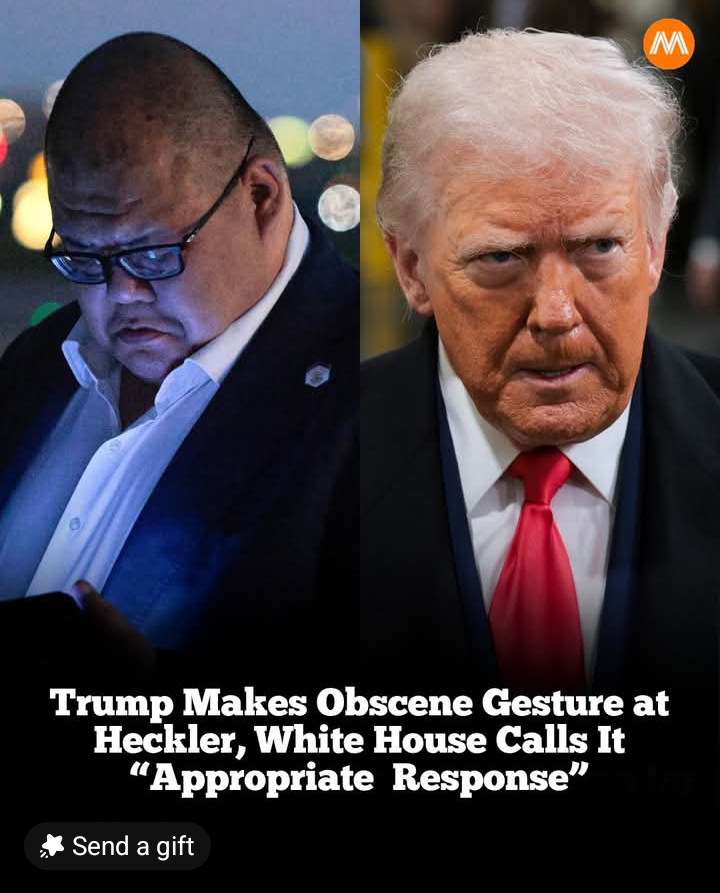
President Donald Trump ignited fresh controversy on Tuesday following an exchange with a heckler during his visit to the Ford River Rouge plant in Dearborn, Michigan.
The incident, captured on video and later published by TMZ, shows the president appearing to mouth an expletive and raise his middle finger in response to shouted insults from an off-camera individual identified as a Ford employee.
In the footage, Trump can be seen continuing to walk through the facility as the heckling occurs.
As the shouting intensifies, the president appears to say “f— you” twice while briefly gesturing with his hand.
The moment, though lasting only seconds, quickly circulated online and drew strong reactions from supporters and critics alike.
The White House moved swiftly to defend the president’s response.
Communications Director Steven Cheung described Trump’s actions as an “appropriate and unambiguous response” to what he characterized as someone “wildly screaming expletives in a complete fit of rage.”
According to Cheung, the president was responding to provocation in a loud industrial setting where tensions flared unexpectedly.
Ford Motor Company confirmed that the individual responsible for the heckling was an employee at the plant.
The worker was subsequently suspended pending an internal investigation, a move that underscored the company’s desire to distance itself from the incident and maintain workplace standards during a high-profile presidential visit.
The episode has renewed debate over presidential decorum and the evolving norms of political behavior in the public sphere.
Supporters of Trump argue that his reaction reflects authenticity and a refusal to tolerate personal abuse, even as president.
Critics, however, contend that such gestures undermine the dignity of the office and set a troubling example, particularly during official events.
Trump’s visit to the historic River Rouge plant was intended to highlight manufacturing, American industry, and his administration’s economic messaging.
Instead, the brief confrontation has overshadowed much of the visit’s policy focus, becoming another flashpoint in an era marked by intense polarization and heightened scrutiny of presidential conduct.
As the video continues to circulate and commentary intensifies, the incident serves as a reminder of how quickly unscripted moments can dominate the national conversation—especially when they involve the president of the United States.

ANDES STRAIN HANTAVIRUS: 3 DEAD, PASSENGERS SCATTERED — EXPERTS SLAM US FOR REPEATING COVID MISTAKES HANTAVIRUS OUTBREAK SPIRALS: SPAIN ORDERS 6-WEEK LOCKDOWN — BUT AMERICA’S LAX RESPONSE SPARKS PANIC..�

JUST BREAKING: Here’s Why Some Americans Will Receive Huge $5,108 Social Security Direct Deposits Within 10 Days

Middle East tensions continue to rise as Israel reportedly views Turkey as its next major regional challenge, with some officials referring to Ankara as “the new Iran.”

Breaking News: Missouri Supreme Court Hands Republicans a 7-1 House Map Victory for 2026 see what happens next

Elon Musk is joining President Trump on a major trip to Beijing, signaling a notable shift after the pair’s well-documented falling out in 2025.

BREAKING:Reza Pahlavi Declares Iran’s Leadership Weakening, Urges End to Islamic Republic.

VIRAL: Donald Trump’s Glamorous AI-Generated Proposal to Melania Trump Inside a Luxurious Met Gala Ballroom Has the Internet Buzzing

JUST NOW | This morning I woke up and started crying. And the reason is this photograph of JD Vance.

BREAKING : Here’s Who Will NOT Receive a Social Security Payment on Wednesday, May 13, 2026….

JUST BREAKING: Maximum Social Security Benefits for May 2026 Revealed by Retirement Age

REPORT: Elon Musk Could Join President Trump’s China Delegation — But No Official Confirmation Yet
