
NEWS
Just In: Trump Proposes $1.5 Trillion U.S. Military Budget for 2027, Sparking Debate Over Defense and Spending

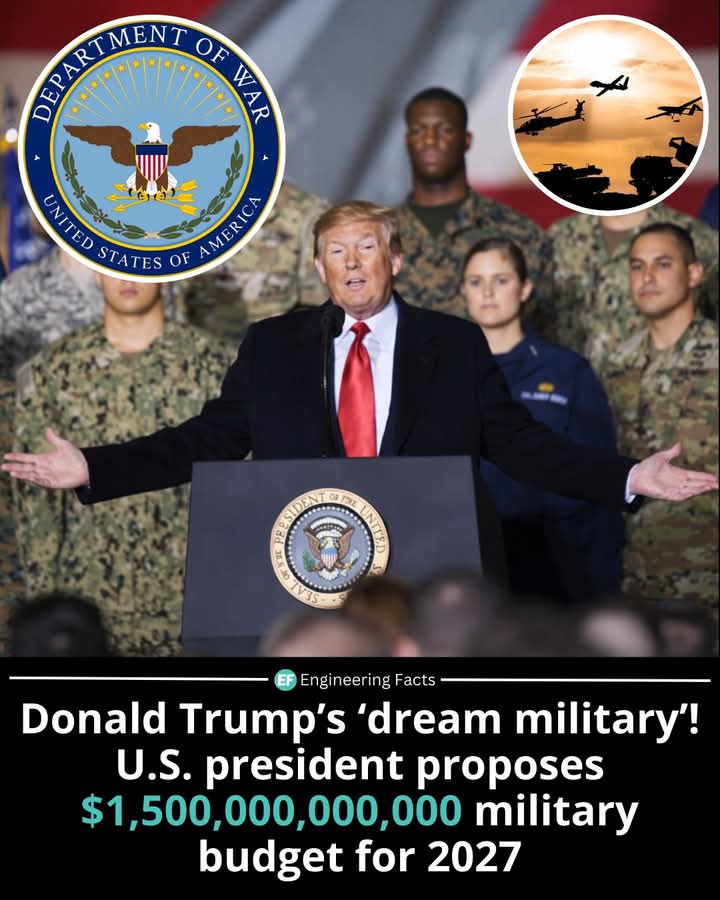
U.S. President Donald Trump has proposed setting the United States’ 2027 military budget at $1.5 trillion, a dramatic increase from the current level of roughly $1 trillion.
If enacted, the proposal would represent one of the largest defense budgets in American history and would significantly reshape the national conversation around military priorities, government spending, and global security.
According to Trump, the proposal emerged after discussions with lawmakers and senior national security officials, amid what he described as rising global threats and an increasingly unstable international environment.
He argued that the current pace of geopolitical competition requires a level of military investment that goes beyond traditional increases.
Building a “Dream Military”
Trump framed the proposed budget as essential to creating what he called a “dream military”one defined by maximum readiness, technological superiority, and overwhelming deterrence.
He emphasized that the additional funding would strengthen the U.S. armed forces across multiple domains, including conventional capabilities, advanced weapons systems, cyber defense, and emerging technologies.
“The goal is simple,” Trump said, according to aides familiar with the discussions.
“Strength that prevents war, readiness that deters adversaries, and a military that no nation dares to challenge.”
Supporters argue that such investment would help maintain America’s military edge at a time when rivals are rapidly modernizing their forces and expanding their global reach.
Tariffs and Revenue Claims
Trump also linked the proposed defense increase to higher government revenues generated through tariffs imposed on other countries, suggesting that trade policy could help offset the massive rise in military spending.
He has long argued that tariffs not only protect American industries but also generate funds that can be redirected toward national priorities such as defense.
Economists and budget analysts, however, remain divided on whether tariff revenues could sustainably support such a large and long-term expansion in military spending without increasing deficits or placing additional pressure on consumers.
Renewed Debate in Washington
The proposal has already reignited long-standing debates in Washington.
Supporters view the plan as a necessary response to global instability, pointing to conflicts, strategic competition, and emerging threats that they say demand unmatched military strength.
Critics, on the other hand, warn that a $1.5 trillion defense budget could come at the expense of domestic priorities such as infrastructure, healthcare, and education.
Fiscal conservatives have also raised concerns about long-term debt and the challenge of maintaining such spending levels year after year.
“This is not just a defense question—it’s a budgetary and strategic one,” said one policy analyst.
“How the money is spent matters as much as how much is spent.”
Global Implications
Internationally, the proposal is likely to draw close scrutiny. A U.S. military budget of this scale could influence global defense spending, prompting allies to reassess their own commitments and adversaries to accelerate their military programs.
Some analysts warn that such a move could intensify global arms competition, while others argue it would reinforce deterrence and stability by reaffirming U.S. military dominance.
What Comes Next
At this stage, Trump’s proposal remains a policy vision rather than an approved budget, and it would require congressional approval to move forward.
Lawmakers are expected to debate not only the size of the increase but also how the funds would be allocated and whether alternative approaches to national security might achieve similar goals at lower cost.
As discussions continue, the proposal has ensured that defense spending—and the role of American military power in the world—will remain at the center of U.S. political debate heading toward 2027.

ANDES STRAIN HANTAVIRUS: 3 DEAD, PASSENGERS SCATTERED — EXPERTS SLAM US FOR REPEATING COVID MISTAKES HANTAVIRUS OUTBREAK SPIRALS: SPAIN ORDERS 6-WEEK LOCKDOWN — BUT AMERICA’S LAX RESPONSE SPARKS PANIC..�

JUST BREAKING: Here’s Why Some Americans Will Receive Huge $5,108 Social Security Direct Deposits Within 10 Days

Middle East tensions continue to rise as Israel reportedly views Turkey as its next major regional challenge, with some officials referring to Ankara as “the new Iran.”

Breaking News: Missouri Supreme Court Hands Republicans a 7-1 House Map Victory for 2026 see what happens next

Elon Musk is joining President Trump on a major trip to Beijing, signaling a notable shift after the pair’s well-documented falling out in 2025.

BREAKING:Reza Pahlavi Declares Iran’s Leadership Weakening, Urges End to Islamic Republic.

VIRAL: Donald Trump’s Glamorous AI-Generated Proposal to Melania Trump Inside a Luxurious Met Gala Ballroom Has the Internet Buzzing

JUST NOW | This morning I woke up and started crying. And the reason is this photograph of JD Vance.

BREAKING : Here’s Who Will NOT Receive a Social Security Payment on Wednesday, May 13, 2026….

JUST BREAKING: Maximum Social Security Benefits for May 2026 Revealed by Retirement Age

REPORT: Elon Musk Could Join President Trump’s China Delegation — But No Official Confirmation Yet
