
NEWS
Ukraine 2022. Venezuela 2026. Elon Musk Once Again Deploys Starlink as Conflict Shuts Down a Nation 🧠 Is Tech Neutrality Officially Dead? Read and Decide

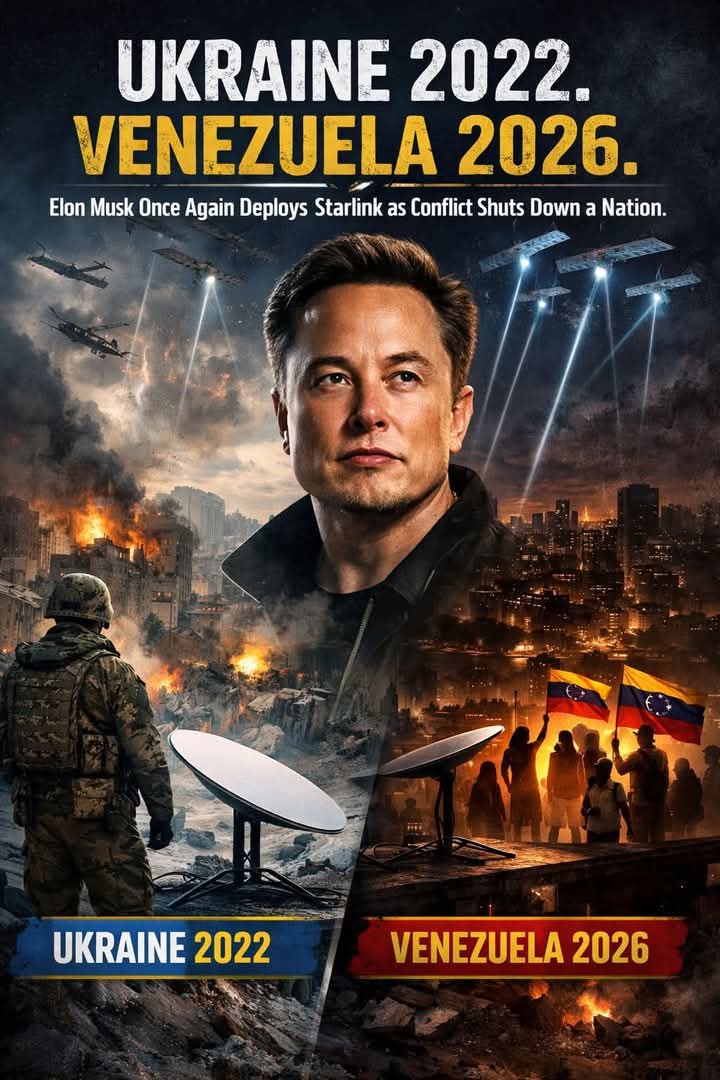
In the early months of 2022, as Russia’s full-scale invasion of Ukraine shattered communications infrastructure across the country, Elon Musk’s SpaceX deployed its satellite internet constellation, Starlink, to provide critical connectivity where terrestrial networks had failed.
For many in Ukraine — civilians, journalists, first responders, and even military units Starlink became a vital communication lifeline amid rolling blackouts and battlefield disruptions.
Fast forward to January 2026 and a strikingly similar pattern has unfolded not in Europe, but in Venezuela, after an extraordinary geopolitical shock rocked the South American nation.
Starlink Activated Amid Venezuelan Turmoil
On 3 January 2026, elite United States forces launched a surprise military operation in Venezuela that resulted in the capture of President Nicolás Maduro and his wife, triggering widespread instability and infrastructure outages across the country.
Shortly thereafter, SpaceX announced that its satellite internet service would provide free broadband access to people across Venezuela through 3 February 2026, ensuring connectivity amid the disruptions.
The service credits were automatically applied to both active and inactive Starlink accounts, theoretically allowing Venezuelans with Starlink hardware to stay online during a period when traditional internet and telecom services were compromised.
In a post amplified on X (formerly Twitter), Musk framed the move as “in support of the people of Venezuela.”
Echoes of Ukraine
Starlink’s role in Venezuela mirrors its earlier impact in Ukraine:
Infrastructure bypass: In both contexts, Starlink filled gaps left by failing or targeted communications networks during conflict.
Private tech as de facto public utility: Where national infrastructure faltered, a Silicon Valley-driven starship of low-Earth-orbit satellites provided the only reliable link to the outside world.
Rapid, unilateral deployment: Starlink activation came swiftly after the onset of hostilities, underscoring its agility in crisis response compared to traditional telecommunications frameworks.
But the implications go beyond crisis support.
The New Geopolitics of Connectivity
Starlink’s Venezuelan activation raises profound questions:
1. Whose interests are served?
Musk’s announcement coincided with heavy U.S. involvement in Venezuela’s political transition a juxtaposition that critics argue blurs lines between humanitarian aid and geopolitical strategy.
2. Tech neutrality or geopolitical leverage?
Historically, internet infrastructure has been tied to sovereign control or regulated by states.
SpaceX’s deployment of Starlink in conflict zones authorized or not — challenges that norm.
When a private company can unilaterally sustain or restore national connectivity, does that company wield power comparable to a state? And if so, **what rules govern its actions?
3. Precedent and dependency
Venezuela’s free service is temporary, ending on 3 February 2026 unless renewed.
Yet even a short window of connectivity can create dependencies: users bring devices, companies lock markets, and information flows through systems controlled by entities outside traditional national jurisdictions.
Is Technology Neutral?
The idea of *tech neutrality that technology should serve people impartially, free of political influence is increasingly difficult to sustain.
The Starlink story in Venezuela echoes broader trends:
Technological capabilities influence outcomes: Whoever controls communications infrastructure often shapes narratives, access to information, and even economic activity in conflict zones.
Corporate decision-making intersects with policy: Musk’s public positions and ties to U.S. policymakers have led some analysts to question whether Starlink’s deployments are purely humanitarian or partially aligned with broader geopolitical aims.
Regulatory ambiguity: Countries without formal agreements with Starlink see spontaneous service activation during crises — raising legal and sovereignty questions about who gets to authorize such coverage.
Conclusion: A New Frontier of Power
Starlink’s interventions in Ukraine in 2022 and Venezuela in 2026 show how commercial tech platforms have become more than tools — they are now strategic infrastructure with global implications.
Whether viewed as lifelines or leverage, these deployments underscore a stark shift: internet connectivity is no longer just a utility it’s a geopolitical asset.
As the world watches how Venezuela’s political transition unfolds and whether connectivity persists beyond February, one question remains urgent and unresolved:
In an era where private companies can override state control of national communications, can technology ever truly be neutral — or has that era already passed?

ANDES STRAIN HANTAVIRUS: 3 DEAD, PASSENGERS SCATTERED — EXPERTS SLAM US FOR REPEATING COVID MISTAKES HANTAVIRUS OUTBREAK SPIRALS: SPAIN ORDERS 6-WEEK LOCKDOWN — BUT AMERICA’S LAX RESPONSE SPARKS PANIC..�

JUST BREAKING: Here’s Why Some Americans Will Receive Huge $5,108 Social Security Direct Deposits Within 10 Days

Middle East tensions continue to rise as Israel reportedly views Turkey as its next major regional challenge, with some officials referring to Ankara as “the new Iran.”

Breaking News: Missouri Supreme Court Hands Republicans a 7-1 House Map Victory for 2026 see what happens next

Elon Musk is joining President Trump on a major trip to Beijing, signaling a notable shift after the pair’s well-documented falling out in 2025.

BREAKING:Reza Pahlavi Declares Iran’s Leadership Weakening, Urges End to Islamic Republic.

VIRAL: Donald Trump’s Glamorous AI-Generated Proposal to Melania Trump Inside a Luxurious Met Gala Ballroom Has the Internet Buzzing

JUST NOW | This morning I woke up and started crying. And the reason is this photograph of JD Vance.

BREAKING : Here’s Who Will NOT Receive a Social Security Payment on Wednesday, May 13, 2026….

JUST BREAKING: Maximum Social Security Benefits for May 2026 Revealed by Retirement Age

REPORT: Elon Musk Could Join President Trump’s China Delegation — But No Official Confirmation Yet
