
NEWS
BREAKING: Trump Fires Back After Bernie Sanders Introduces Bill to Ban Presidents From Naming Federal Buildings After Themselves

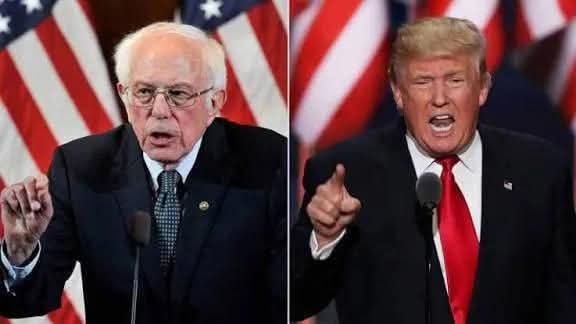
In a fiery political clash that has Washington buzzing, former President Donald Trump erupted in response to a newly introduced bill by Senator Bernie Sanders aimed at barring presidents from naming federal buildings and other government assets after themselves while in office.
The legislation—officially titled the Stop Executive Renaming for Vanity and Ego (SERVE) Act was introduced on January 13 by Sanders (I-Vt.) and co-sponsored by Democratic Senators Chris Van Hollen and Angela Alsobrooks.
The bill would prohibit any sitting president from naming, renaming, designating, or redesignating federal buildings, land, or other assets in their own name, and would apply retroactively to recent changes like the renaming of the Kennedy Center and the U.S. Institute of Peace.
Sanders denounced the practice as a dangerous break with democratic norms , asserting that Trump’s efforts to affix his own name to iconic American institutions reflect “arrogance” and a drift toward authoritarian self-glorification.
He argued that federal landmarks belong to the American people—not to individual office-holders seeking to burnish their personal legacy.
“Donald Trump doesn’t get to slap his name on any public institution he chooses,” said one of the bill’s sponsors, making clear that the legislation is meant to slam the brakes on what Democrats describe as personality-driven branding of government property.
Trump Pushes Back Vigorously
Trump, who has previously expressed pride over buildings and programs bearing his name, reacted strongly to news of the legislation.
In comments circulated online and through his political channels, he characterized the Sanders bill not as an ethics measure but as a partisan attack aimed at undermining his legacy.
Supporters of Trump argue that honoring presidents with named federal assets is a long-standing tradition in American history, pointing out that aspects of Washington, D.C. were named during George Washington’s own presidency and that other leaders have seen infrastructure bear their names before.
Trump’s response framed the bill as an effort by political opponents to “erase history” and penalize his achievements, insisting that building names celebrate contributions to the nation rather than serve personal vanity.
The former president used especially sharp language in defending his record and denouncing what he described as overreach by opponents in Congress.
Why the Debate Matters
The clash taps into broader questions about tradition, legacy, and the symbolic power of public landmarks. Naming federal buildings after presidents has often been a posthumous honor or one bestowed after long public service.
Critics like Sanders contend that allowing sitting presidents to assign their own names to national assets crosses a line — blurring the distinction between public service and personal branding.
Supporters of Trump’s approach argue that his actions reflect popular recognition of accomplishments during his administration, and that efforts to constrain presidential prerogatives could set troubling precedents.
Where the Bill Stands
The SERVE Act has been formally introduced but has yet to clear committee hurdles.
Its future in Congress remains uncertain, especially given the deeply polarized political environment.
If passed, it would not only prohibit future self-naming but could also trigger debates over whether some existing rename decisions should be reversed.
As both sides dig in, the dispute has swiftly become a high-profile flashpoint in the broader culture wars—raising larger questions about presidential power, institutional legacy, and how Americans choose to commemorate their leaders.

ANDES STRAIN HANTAVIRUS: 3 DEAD, PASSENGERS SCATTERED — EXPERTS SLAM US FOR REPEATING COVID MISTAKES HANTAVIRUS OUTBREAK SPIRALS: SPAIN ORDERS 6-WEEK LOCKDOWN — BUT AMERICA’S LAX RESPONSE SPARKS PANIC..�

JUST BREAKING: Here’s Why Some Americans Will Receive Huge $5,108 Social Security Direct Deposits Within 10 Days

Middle East tensions continue to rise as Israel reportedly views Turkey as its next major regional challenge, with some officials referring to Ankara as “the new Iran.”

Breaking News: Missouri Supreme Court Hands Republicans a 7-1 House Map Victory for 2026 see what happens next

Elon Musk is joining President Trump on a major trip to Beijing, signaling a notable shift after the pair’s well-documented falling out in 2025.

BREAKING:Reza Pahlavi Declares Iran’s Leadership Weakening, Urges End to Islamic Republic.

VIRAL: Donald Trump’s Glamorous AI-Generated Proposal to Melania Trump Inside a Luxurious Met Gala Ballroom Has the Internet Buzzing

JUST NOW | This morning I woke up and started crying. And the reason is this photograph of JD Vance.

BREAKING : Here’s Who Will NOT Receive a Social Security Payment on Wednesday, May 13, 2026….

JUST BREAKING: Maximum Social Security Benefits for May 2026 Revealed by Retirement Age

REPORT: Elon Musk Could Join President Trump’s China Delegation — But No Official Confirmation Yet
