
NEWS
President Trump Takes Bold Action on Semiconductor Imports to Strengthen U.S. Security and Domestic Manufacturing.

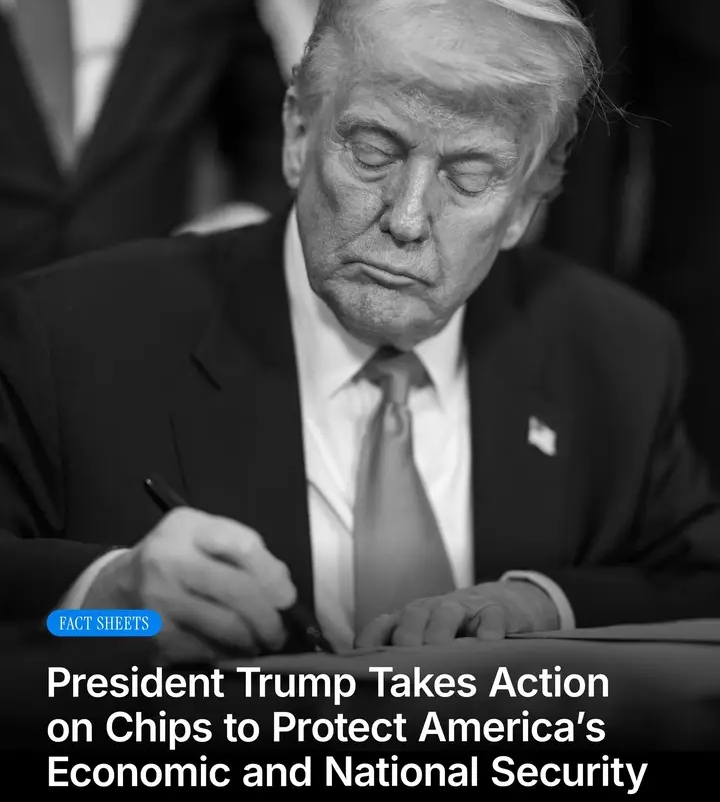
On January 14, 2026, President Donald J. Trump signed a Proclamation under Section 232 of the Trade Expansion Act of 1962 aimed at confronting what his administration describes as growing national security risks stemming from the United States’ heavy reliance on imported semiconductors and semiconductor-related products.
The move underscores a broader strategy to fortify domestic manufacturing, bolster supply chain resilience, and secure America’s technological future.
Addressing National Security Risks.
Semiconductors the tiny chips that power everything from smartphones and automobiles to advanced military systems and artificial intelligence (AI) are now widely viewed as the foundation of modern economic and defense capabilities.
According to the proclamation, current import levels and the U.S.’s limited manufacturing footprint pose a threat to national security because the country cannot currently meet its own demand.
A nine-month investigation by the Department of Commerce concluded that imports of semiconductors, semiconductor manufacturing equipment, and derivative products, under existing conditions, could impair national security.
The investigation found that the domestic industry lacks sufficient capacity to reliably support U.S. technological, industrial, and military needs.
Key Actions: Targeted Tariffs and Negotiations.
To address these concerns, President Trump’s proclamation both imposes immediate tariffs and directs the executive branch to pursue diplomatic and trade negotiations:
25% Tariff on Certain Advanced Computing Chips: The proclamation levies a 25 percent ad valorem tariff on specific advanced computing chips and certain derivative products that do not contribute to building out the U.S. technology supply chain.
These include high-performance semiconductors imported primarily for use outside domestic production roles.
The tariffs became effective on January 15, 2026.
Strategic Negotiations: The President has directed the Secretary of Commerce and U.S. Trade Representative to negotiate agreements with foreign partners to mitigate the national security threat posed by semiconductor imports.
This diplomatic effort aims to secure commitments that advance U.S. interests in technology leadership and supply chain security.
Support for Domestic Manufacturing.
A central theme of the proclamation is the intention to use trade tools not as ends in themselves but as leverage to incentivize investment in U.S. semiconductor production.
By making imports less economically attractive unless tied to domestic manufacturing expansion, the administration aims to attract capital, innovation, and employment into the United States.
The tariffs include important exceptions.
Chips imported to support research and development, data centers, startups, consumer and industrial applications (outside of high-performance re export), and other uses that help build domestic capacity are excluded.
This nuanced approach signals an effort to balance national security concerns with the practical needs of U.S. industries and innovation ecosystems.
Broader Strategic Context.
This proclamation is part of an ongoing shift in U.S. semiconductor policy that spans multiple administrations, reflecting bipartisan concern over global supply chain vulnerabilities.
While the U.S. once manufactured roughly one-third of the world’s semiconductors, today that figure has fallen to around 10–15 percent.
Much of the world’s advanced chip fabrication has migrated to East Asia, particularly Taiwan.
Concerns around dependence on foreign sources have led to recent trade deals designed to boost U.S. semiconductor leadership.
For example, a trade agreement with Taiwan linked to significant investment in U.S. chip manufacturing was announced around the same time as the tariff proclamation, with commitments estimated in the hundreds of billions of dollars to strengthen supply chains and domestic production capacity.
Potential Impact and Future Measures.
Administration officials have characterized the new tariff as a “phase one” action, signaling that broader measures may follow.
These could include expanded tariffs, tariff-offset programs to further encourage domestic investment, and additional regulatory actions.
Critics and global trading partners are already assessing the effects.
Some nations are exploring how export controls and trade policy changes might affect their own technology industries and relationships with the U.S., while domestic tech firms evaluate how the new tariffs could shift supply chains, costs, and competitive dynamics.
Conclusion.
President Trump’s January 2026 proclamation represents a significant intervention in U.S. industrial and trade policy, using national security law to reshape how the United States engages with global semiconductor supply chains.
By combining targeted tariffs with diplomatic negotiations and conditional exemptions, the administration is attempting to spur domestic innovation and manufacturing while reducing strategic vulnerabilities.
How companies, allies, and global markets respond in the months ahead will help determine whether this policy shift delivers on its promise of a more secure and competitive U.S. technology sector.

ANDES STRAIN HANTAVIRUS: 3 DEAD, PASSENGERS SCATTERED — EXPERTS SLAM US FOR REPEATING COVID MISTAKES HANTAVIRUS OUTBREAK SPIRALS: SPAIN ORDERS 6-WEEK LOCKDOWN — BUT AMERICA’S LAX RESPONSE SPARKS PANIC..�

JUST BREAKING: Here’s Why Some Americans Will Receive Huge $5,108 Social Security Direct Deposits Within 10 Days

Middle East tensions continue to rise as Israel reportedly views Turkey as its next major regional challenge, with some officials referring to Ankara as “the new Iran.”

Breaking News: Missouri Supreme Court Hands Republicans a 7-1 House Map Victory for 2026 see what happens next

Elon Musk is joining President Trump on a major trip to Beijing, signaling a notable shift after the pair’s well-documented falling out in 2025.

BREAKING:Reza Pahlavi Declares Iran’s Leadership Weakening, Urges End to Islamic Republic.

VIRAL: Donald Trump’s Glamorous AI-Generated Proposal to Melania Trump Inside a Luxurious Met Gala Ballroom Has the Internet Buzzing

JUST NOW | This morning I woke up and started crying. And the reason is this photograph of JD Vance.

BREAKING : Here’s Who Will NOT Receive a Social Security Payment on Wednesday, May 13, 2026….

JUST BREAKING: Maximum Social Security Benefits for May 2026 Revealed by Retirement Age

REPORT: Elon Musk Could Join President Trump’s China Delegation — But No Official Confirmation Yet
