
NEWS
BREAKING NEWS:Chaos Has Consequences: Vance Says Anti-ICE Unrest and Local Inaction Fueled Deadly Minneapolis Violence. Read the full story below.

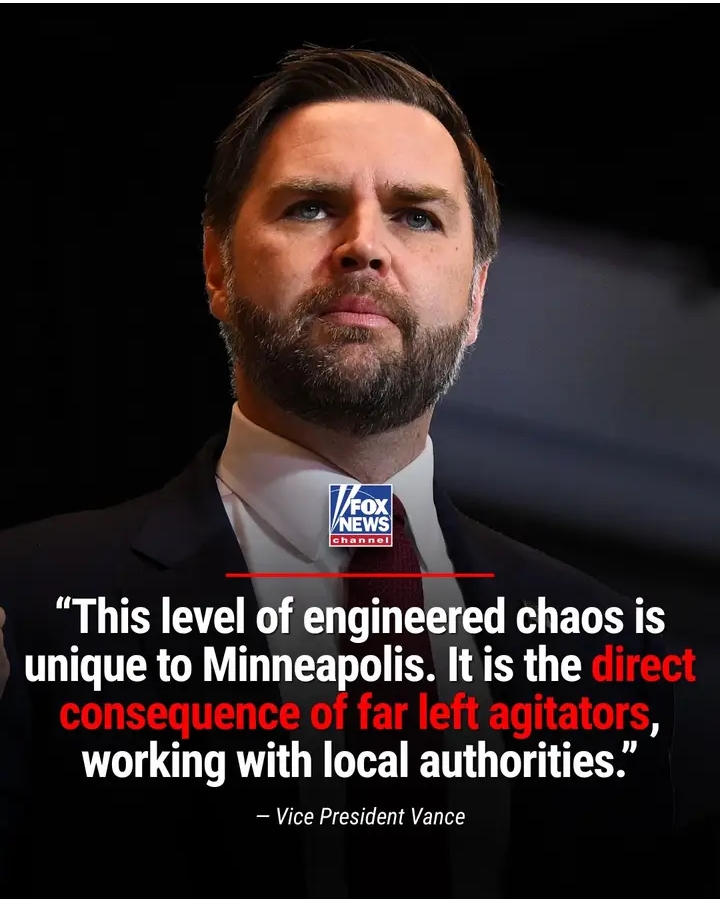
In the wake of a second fatal shooting involving federal agents in Minneapolis, Vice President J.D. Vance has placed blame squarely on what he described as sustained anti-ICE agitation and a failure of local authorities to restore order after weeks of unrest.
Speaking after the latest incident, Vance called the violence a “direct consequence” of an environment that, in his view, has normalized hostility toward federal law enforcement.
He argued that repeated demonstrations targeting Immigration and Customs Enforcement (ICE), combined with permissive responses from city and state officials, have escalated tensions to a dangerous breaking point.
According to the Vice President, federal agents have been operating under increasing threat as protests evolved from demonstrations into confrontations.
He contended that rhetoric portraying ICE as illegitimate or criminal has contributed to a climate in which attacks on agents are more likely to occur.
Vance also criticized local leadership for what he characterized as delayed or inadequate enforcement of public safety measures.
He warned that failing to intervene decisively during prolonged unrest sends a signal that disorder will be tolerated, putting both law enforcement officers and civilians at risk.
“The federal government has a responsibility to enforce the law,” Vance said, adding that local officials share a responsibility to protect those tasked with carrying it out.
He emphasized that political disagreements over immigration policy should never translate into violence or the loss of life.
The Minneapolis shootings have renewed a broader national debate over protest boundaries, the role of local governments during civil unrest, and the safety of federal personnel operating in politically charged environments.
Supporters of Vance’s position argue that restoring order is a prerequisite for any meaningful policy discussion, while critics caution against conflating protest movements with acts of violence.
As investigations continue, the administration has signaled that it may reassess security measures for federal agents in high-risk areas.
For now, the Vice President’s remarks underscore a stark message: prolonged unrest, if left unchecked, can carry deadly consequences.

KING CHARLES GIFTS PRESIDENT TRUMP THE BELL FROM WWII SUBMARINE HMS TRUMP — DELIVERS PERFECT “GIVE US A RING” PUN

ABC executives are ready to pull Jimmy Kimmel Live!, an insider has revealed.

I am absolutely fed up with Jimmy Kimmel using his platform to spew such vile, bottom-of-the-barrel insults at the President and the First Lady.

Just In : King Charles III Hails “Priceless and Eternal” U.S.–U.K. Bond in Historic Address to Congress King Charles III Hails “Priceless and Eternal” U.S.–U.K. Bond in Historic Address to Congress

First Lady Melania Trump publicly called out Jimmy Kimmel for using his late night platform to spread division and hate against half the country every single night.

Breaking News: Historic State Visit Begins as Trump Welcomes King Charles III to the White House

BREAKING NEWS: TRUMP URGES REPUBLICANS TO BYPASS DEMOCRAT OBSTRUCTION AND USE BUDGET RECONCILIATION TO END 70-DAY DHS SHUTDOWN

JUST BREAKING: When Your Social Security Payment Arrives in May 2026 — Plus the Top Benefits You Should Know

BREAKING: The Iranian ship Touska, seized by the US Navy, was carrying vital dialysis supplies and medical equipment, according to the Iranian Red Cresce

Melania’s DARK PAST Surfaces as She is OUTED by TOP WITNESS!!!

Jimmy Kimmel said this right before an armed man showed up at the actual White House Correspondents’ Dinner and tried to shoot Trump.
