
NEWS
JUSTIN:“Normalize the Badge: How the Trump Administration Can Enforce Immigration Law Without Falling for the PR Trap”.

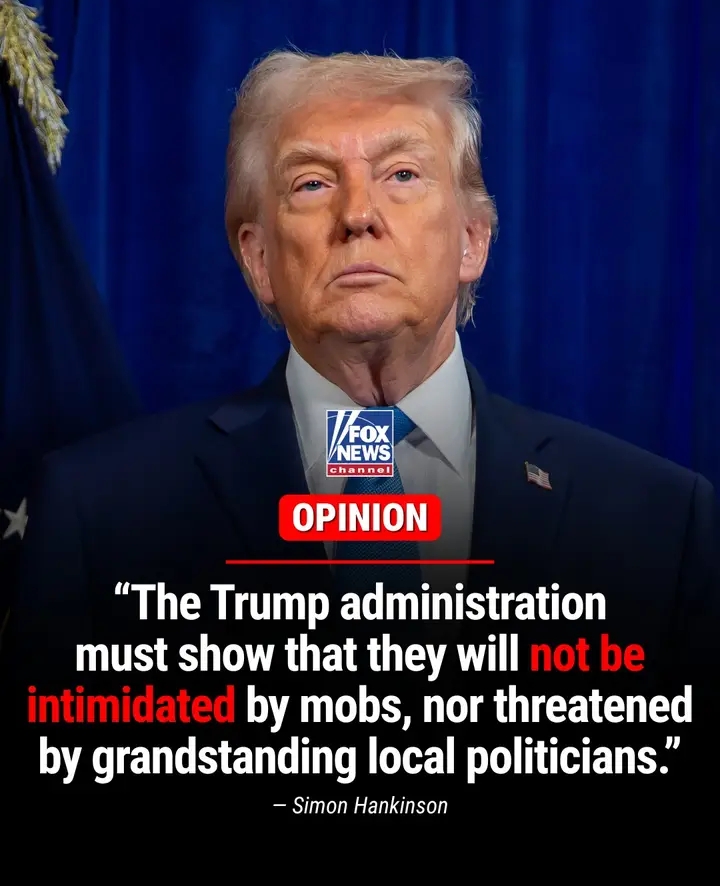
The debate over immigration enforcement has become less about law and more about optics.
In recent years, Immigration and Customs Enforcement (ICE) has been portrayed by political opponents as an aberration—an agency operating outside the bounds of normal law enforcement rather than one carrying out statutes passed by Congress.
Simon Hankinson’s argument cuts to the heart of this distortion: if the federal government wants effective immigration enforcement, it must stop playing defense in a public relations war designed to delegitimize the very idea of enforcing the law.
At its core, ICE’s mission is neither radical nor novel.
Every sovereign nation enforces its borders and immigration laws.
Yet in the United States, aggressive messaging from left-wing leaders has reframed enforcement itself as “unacceptable,” creating a climate in which routine law enforcement actions are treated as moral outrages.
The result is not just confusion among the public, but hesitation within government—hesitation that criminals are quick to exploit.
Hankinson’s central insight is that the Trump administration, or any administration serious about enforcement, must first normalize law enforcement again.
Americans need to see immigration enforcement not as a political stunt or a culture-war provocation, but as a standard, necessary function of government.
Police departments do not apologize for arresting burglars; immigration authorities should not have to apologize for arresting those who violate immigration law, particularly repeat offenders or individuals with criminal records.
One way to accomplish this is through clarity and consistency in messaging.
Too often, enforcement actions are announced defensively, as if officials expect backlash and are trying to preempt it. This posture concedes ground before the argument even begins.
Instead, the administration should speak plainly: Congress wrote the laws, the executive branch is obligated to enforce them, and ICE officers are professionals doing their jobs.
Calm repetition of this message—without anger or defensiveness—undercuts the narrative that something nefarious is taking place.
Another critical step is refusing to take the bait set by political opponents.
Left-wing leaders have learned that dramatic confrontations generate headlines, fundraising, and social media engagement.
When federal officials respond emotionally or inconsistently, they amplify the very outrage designed to discredit them.
A smarter strategy is disciplined restraint: enforce the law methodically, explain actions factually, and let results speak louder than rhetoric.
The administration should also emphasize cooperation with state and local law enforcement, rather than conflict.
When local officials obstruct ICE for ideological reasons, the focus should remain on public safety consequences, not partisan sparring.
Americans across the political spectrum care about safer communities.
Highlighting cases where cooperation removes dangerous offenders—and contrasting them with jurisdictions that knowingly release such individuals—keeps the discussion grounded in real-world outcomes instead of abstract ideology.
Transparency matters as well.
Clear data on arrests, deportations, criminal histories, and due process protections can deflate misinformation before it spreads.
When critics claim that enforcement is arbitrary or cruel, facts are the most effective rebuttal.
The goal is not to win every argument online, but to build steady public confidence that the system is lawful, fair, and necessary.
Ultimately, Hankinson’s warning is about more than ICE.
When a government allows routine law enforcement to be portrayed as illegitimate, it weakens the rule of law itself.
If enforcing immigration statutes becomes “unacceptable,” what comes next? Tax law? Environmental law? Criminal law? Selective enforcement driven by political pressure erodes trust and invites chaos.
“Americans need to see law enforcement normalized once again.”
That statement is not a call for harshness, but for maturity.
A nation governed by laws cannot function if enforcing those laws is treated as a scandal.
By refusing to fall into a manufactured PR trap and by confidently, calmly enforcing the law, the Trump administration—or any future administration—can restore clarity to the immigration debate and reaffirm a simple principle: in a constitutional republic, the law is not optional.

HIS HAND WAS TREMBLING” — THE MOMENT Donald Trump AND Melania Trump FROZE 80,000 PEOPLE IN SILENCE

BREAKING:“The President Who Never Sleeps?” Pilot’s 30-Year Claim Reveals a Different Side of Donald Trump.

Just In: The betrayal cuts deep—watching career Democrats like Pelosi whisper with their next generation while America burns.

AOC warned the South that “the North” is about to pull up.

When Donald Trump was five years old, his father Fred would wake him at dawn on Saturdays, hand him a paper bag with a bologna sandwich, and drive him to a construction site in Brooklyn. Full story

Faith Is Our Foundation”: JD Vance Calls for National Renewal Through Prayer at ‘Rededicate 250’ Event.

SPEAKER JOHNSON DEFENDS ‘IN GOD WE TRUST’ AND NATIONAL REDEDICATION AGAINST SEPARATION CRITICS

BREAKING: Lindsey Graham Warns Republicans — Opposing Donald Trump Could End Political Careers

Just In : Gates made the comments during an interview regarding his book How to Avoid a Climate Disaster.

Just In : Trump and Netanyahu Hold Urgent 30-Minute Call as Intel Warns Iran May Be Buying Time for War. See what happens next

BREAKING NEWS:Trump Issues Stark New Warning to Iran as Regional Tensions Escalate.
