
NEWS
Just In: Iranian jets challenge F_22 Raptor _The United States Responds with calculated calm

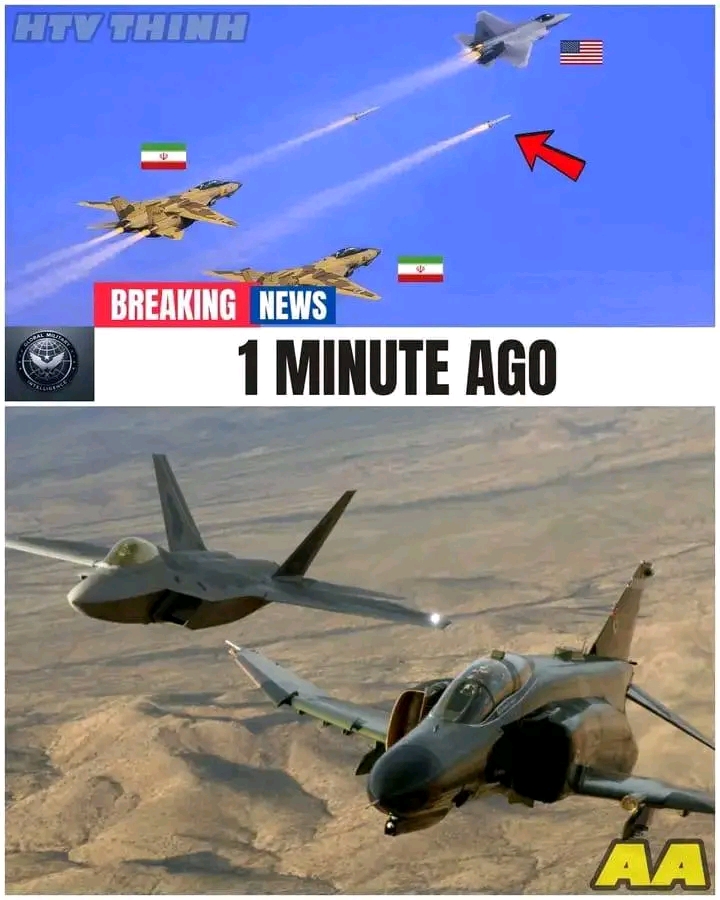
In a tense aerial encounter over contested airspace, fighter aircraft from Iran reportedly attempted to intercept and target a U.S. F-22 Raptor, triggering a high-stakes moment that underscores the fragile balance of power in the region.
According to defense sources, the incident unfolded after Iranian fighter jets scrambled to shadow the fifth-generation stealth aircraft during a routine patrol mission.
The F-22, widely regarded as one of the most advanced air superiority fighters in the world, was operating in international airspace when Iranian pilots moved aggressively to close distance.
While Iranian aircraft allegedly attempted to achieve weapons lock, U.S. officials emphasized that the F-22 maintained full situational awareness throughout the encounter.
Leveraging its stealth capabilities, superior radar systems, and electronic warfare suite, the American jet avoided escalation without firing a shot.
A Measured American Response
Rather than responding with force, the United States adopted what defense analysts described as an “ice-cold” posture — calm, disciplined, and strategically restrained.
The United States Air Force confirmed that the aircraft completed its mission and exited the area safely.
Officials stressed that the U.S. remains committed to freedom of navigation and lawful military operations in international airspace.
“Our pilots are trained for precisely these situations,” one defense spokesperson noted. “Professionalism and precision are our strongest responses.”
Strategic Signaling in the Skies
Military experts suggest the attempted challenge was less about immediate combat and more about strategic messaging. For Iran, shadowing a U.S. stealth fighter demonstrates resolve to domestic and regional audiences.
For the United States, declining to escalate reinforces confidence in technological and tactical superiority.
The F-22’s ability to evade detection and dominate beyond-visual-range engagements remains a cornerstone of American air strategy.
Even without engagement, the encounter serves as a reminder of the razor-thin margins that define modern aerial deterrence.
Rising Tensions, Controlled Outcomes
While no missiles were fired and no aircraft were damaged, the confrontation highlights the volatility of air operations in geopolitically sensitive regions.
Encounters between advanced aircraft leave little room for error — a split-second miscalculation could dramatically alter the strategic landscape.
For now, both nations appear content to let the message stand: a test was made, a signal was sent, and the response was unmistakably composed.

BREAKING🚨 RFK Jr. told Congress he never said Black children on ADHD meds should be sent to “wellness farms” to be “re-parented.” There is a recording. He still denied it.

Breaking News: Social Security Payments Set for April 22, 2026 — Who Will Receive Benefits This Week

Just In: Several States May Begin Relief Payments Around April 22, 2026 — See Who Qualified

Just In: Trade Threat Backfires? Spain Moves Anyway Donald Trump warned:

Just In : A Message of Hope: Donald Trump Shares Heartfelt Words Amid Barron’s Health Concerns

After decades of mass migration from Islamic nations, the pattern is unmistakable: cultures rooted in Sharia law are fundamentally incompatible with Western values of individual liberty, women’s rights, free speech, and religious tolerance. We’ve witnessed grooming gangs in Europe, no-go zones, honor killings, demands for Sharia courts, and repeated terrorist attacks.

Breaking News: Something is happening across the United States—and it’s leaving people shaken.see what happens next

Breaking News: FІΝАLLΥ! 7О Ѕеnаtоrѕ VОТЕ tо ЅТОР ІRАΝ WАR ЕFFЕСТІVЕ ІММЕDІАТЕLΥ ТUЕЅDАΥ?! see what happens next

Breaking News: Trump’s Reign Ends as Senate Vote Seals His Fate see what happens next

Just In: 12 States Roll Out Local Stimulus Checks on April 15, 2026 — Here’s Who Qualifies

Just In :Stewart Lee Declines U.S. Performances, Cites Disapproval of Trump’s Leadership. Full details
