
NEWS
BREAKING:Trump Announces Joint U.S.-Nigeria Operation That Killed ISIS Deputy Leader Abu-Bilal al-Minuki.

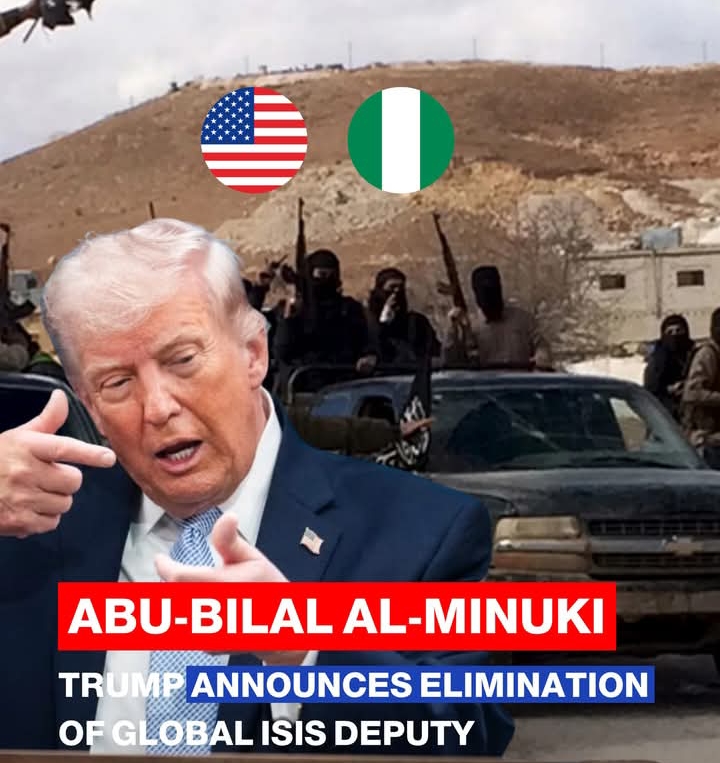
Donald Trump has announced that a joint military operation involving the United States and Nigeria successfully eliminated Abu-Bilal al-Minuki, described as the global second-in-command of ISIS.
According to Trump, the operation was carried out through close coordination between American forces and the Nigerian Armed Forces in what he called a “meticulously planned and very complex mission.”
He stated that al-Minuki had been hiding in Africa while continuing to play a major operational role within the extremist organization.
Trump praised the partnership with Nigeria and claimed the operation dealt a significant blow to ISIS’s international network.
He also said intelligence sources had closely tracked the militant leader’s movements before the raid was launched.
Abu-Bilal al-Minuki, also identified in reports as Abu Bakr ibn Muhammad ibn Ali al-Mainuki, had previously been designated a global terrorist by U.S. authorities in 2023 due to his alleged role in coordinating extremist activities across the Sahel region and within the Islamic State West Africa Province (ISWAP).
Security analysts say the development could mark a major moment in ongoing counterterrorism operations across West Africa, where ISIS-linked groups and insurgent movements have expanded influence in recent years.
Nigeria has faced prolonged security challenges from extremist factions operating in the northeast and parts of the wider Sahel corridor.
While full operational details have not yet been publicly released, reports indicate the mission highlights growing military cooperation between Washington and Abuja in confronting regional terror threats.
The announcement has already sparked international attention, with many observers viewing the operation as a symbolic victory in the global fight against terrorism.
However, analysts caution that extremist networks often reorganize quickly following leadership losses, meaning broader security challenges across the region are likely to remain ongoing.

BREAKING:Trump Announces Joint U.S.-Nigeria Operation That Killed ISIS Deputy Leader Abu-Bilal al-Minuki.

JUST BREAKING: Millions of Americans Will NOT Receive a Social Security Payment on Wednesday, May 20, 2026. Full details

Unfortunately, no one has answered this question: Are you willing to pray for our military? But if you are, please click the link below and say Amen!

Just In: January 17, 2020 became one of those strangely quiet moments in modern American history that looked ordinary on television but carried the weight of an era already beginning to change. Read full

BREAKING: Donald Trump Says Xi Jinping Offered to Help Reopen the Strait of Hormuz Amid Explosive Iran Tensions. Read more

Just In: STUNNING SCENES From Temple of Heaven Are Captivating the World — Beijing’s Ancient Wonder Takes Center Stage

BREAKING: Xi Jinping Reportedly Told Donald Trump “Whatever You Need” to Help End the Iran Conflict — Global Shockwaves Follow

POLITICAL EARTHQUAKE: Calls to Remove Zohran Mamdani Explode as Massive Petition Movement Shakes New York City

BREAKING: Iran Declares China Could Replace the United States as the World’s Dominant Superpower. Full details here!!

BREAKING: Donald Trump Tells Xi Jinping the U.S. and China Will Have a “Fantastic Future Together” During High-Stakes Beijing Talks

JUST IN something happened in Beijing that gave me chills I was not expecting. Air Force One touched down in China. Read more
