
NEWS
BREAKING: Mexican President Claudia Sheinbaum Condemns U.S. Military Action in Venezuela as a Violation of International Law

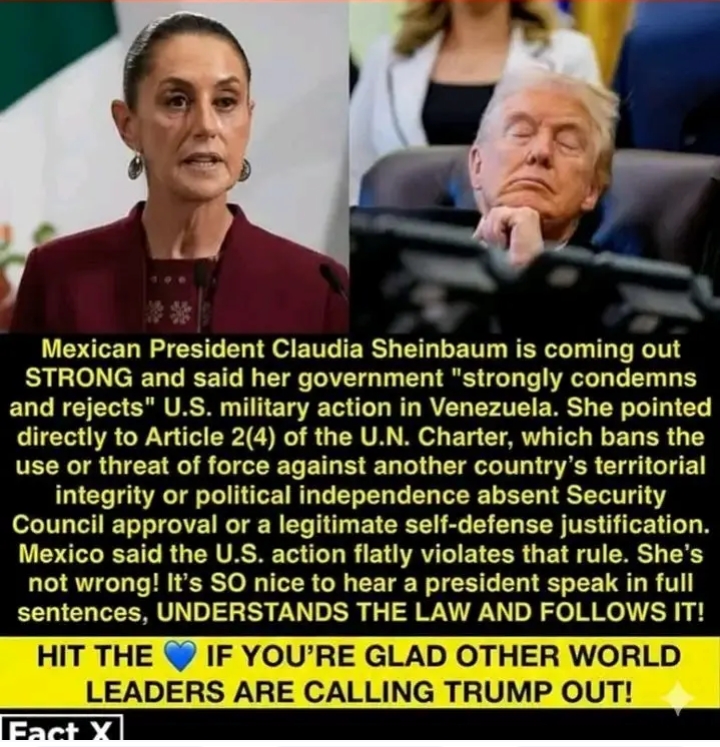
In a forceful and highly visible reaction to recent developments in Venezuela, Mexican President Claudia Sheinbaum has publicly condemned the United States’ military intervention in Venezuela, calling it a clear breach of international law, a threat to regional stability, and a dangerous precedent for global diplomatic norms.
The U.S. Military Operation That Sparked Outrage
On January 3, 2026, U.S. forces conducted a bold military operation in Caracas that resulted in the capture of Venezuelan President Nicolás Maduro and his wife, Cilia Flores, who were subsequently brought to the United States to face federal charges.
The operation — one of the most dramatic examples of U.S. military force in Latin America in decades — was described by President Trump as a “successful mission,” though global responses have been sharply divided.
Mexico’s Strong Rejection
President Sheinbaum — speaking from Mexico City — issued a prepared statement underscoring Mexico’s longstanding foreign-policy principles of non-intervention and respect for sovereignty, both of which are deeply rooted in the country’s constitution and diplomatic tradition.
She stated that:
Mexico “strongly condemns and rejects” the unilateral military action by the United States.
Such actions constitute “a violation of Article 2 of the United Nations Charter,” which prohibits the use of force against the territorial integrity or political independence of any nation without Security Council authorization.
Military intervention never brings democracy, stability, or well-being to the people — only they can decide their own future.
Sheinbaum emphasized that Mexico views Latin America and the Caribbean as a zone of peace, where disputes should be resolved through dialogue and multilateral diplomacy, not force.
A Broader Diplomatic Concern
Sheinbaum’s comments go beyond Mexico’s bilateral relationship with the United States. She urged the United Nations and other multilateral institutions to intervene diplomatically and help prevent further bloodshed or escalation.
Her stance reflects growing unease among several nations about the legality and long-term implications of unilateral military interventions without U.N. approval
Regional and Global Context
Mexico is not alone in its criticism.
Countries like Brazil, Colombia, Chile and several European and global powers have similarly decried the U.S. action as contrary to international legal norms and the U.N. Charter.
These reactions highlight a broader divide between nations that advocate for a rules-based global order and those that justify the operation as a necessary measure against alleged criminal and security threats.
What This Means for Mexico–U.S. Relations
Despite her harsh critique of Washington’s actions in Venezuela, President Sheinbaum also affirmed that Mexico seeks cooperation, not subordination, in its ties with the United States — particularly on issues like drug trafficking and border security.
She firmly rejected any notion of U.S. military intervention on Mexican soil, underscoring Mexico’s sovereignty and self-determination.
Bottom Line
Claudia Sheinbaum’s statement marks one of the clearest rebukes from a major regional leader to the U.S. military operation in Venezuela, framing it as not just a geopolitical flashpoint but a legal and ethical crossroads for the international community.
Her stance reinforces Mexico’s historical commitment to sovereign equality and peaceful dispute resolution — even in the face of assertive U.S. foreign policy.

JUST IN: Donald Trump said Iran has formally agreed they will never have a Nuclear Weapon.

Trump is defunding the TSA until Congress restricts vote by mail.

NEWS POLL: President Trump’s approval rating dipped to 41% in March, and 59% of registered voters now disapprove of him — the highest disapproval of either of his terms.

Speaker Mike Johnson has the right idea. While hardworking Americans endure endless TSA lines stretching through airport terminals, the vote tally poster should be enlarged and displayed prominently in every single one.

Breaking News: Senator Cory Booker just let the truth slip out. While railing against the SAVE America Act, he warned that requiring proof of U.S. citizenship for federal voter registration would shrink the voter rolls by 5 to 10 percent.

Just In : Trump HUMILIATED as Security Guards DRAG Him Out of Mueller Funeral Live On Camera. see what happens next

Breaking News: Trump Drops Hammer on Iran: 15 Non-Negotiable Demands to End the Middle East Mess see the full details

Breaking News: Fox News Reports Update Involving Former President Joe Biden

BREAKING: Trump Reportedly Fell While Boarding Air Force One as Doctor Allegedly Hints at a Hidden Diagnosis “HE HAS FALLEN AGAIN!”click here to see what happens next

Breaking News: EXPLOSIVE: Trump Goes BALLISTIC After Pope Leo XIV Exposes His 1970 Wharton IQ Test LIVE — “Genius?” Trump Fires Back! Click here

Just In : Florida is taking a firm stand to protect our American way of life. House Bill 1471, now heading to Governor Ron DeSantis for signature, explicitly bans Sharia law and any foreign or religious legal codes from overriding our courts and Constitution.
