
NEWS
Breaking News: Trump Announces Defamation Lawsuit After Michigan Ford Plant Incident

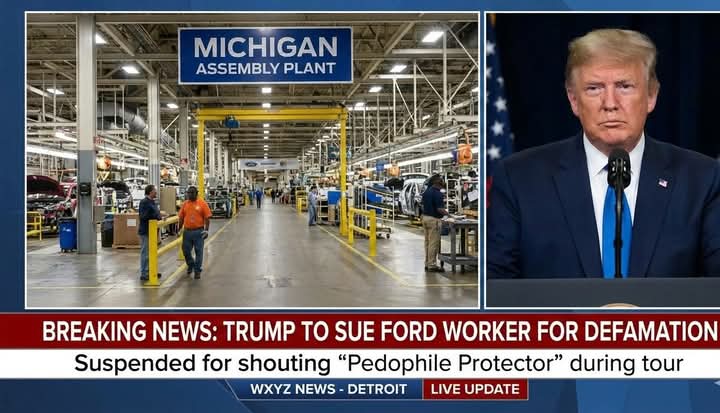
President Donald Trump has announced plans to sue a Ford Motor Company employee in Michigan for defamation following a tense incident during a recent factory tour, escalating what began as a brief verbal confrontation into a high-profile legal and political dispute.
According to statements attributed to the president and his allies, the incident occurred while Trump was touring a Ford manufacturing plant, where a worker allegedly shouted “Pedophile Protector” in his direction.
The remark, captured by witnesses and widely circulated in political commentary afterward, immediately drew attention for both its severity and its setting—inside a major American manufacturing facility during a presidential visit.
In the days following the incident, Ford officials confirmed that the employee involved was suspended pending internal review, citing company policies on workplace conduct and professionalism, particularly during official events.
The company has emphasized that the suspension does not constitute a final determination and that it is following established human resources procedures.
President Trump, however, has framed the episode as more than a workplace issue. In an update released by his team, Trump declared his intention to pursue a defamation lawsuit against the employee, arguing that the accusation was not only false but deliberately harmful.
He contends that the statement amounted to character assassination made in a public and highly visible forum, damaging his reputation.
Legal experts note that defamation cases involving public figures face a high bar.
Under U.S. law, Trump would need to demonstrate that the statement was made with “actual malice”—that is, with knowledge that it was false or with reckless disregard for the truth.
Supporters of the president argue that the nature of the accusation meets that threshold, while critics counter that the lawsuit could raise serious free speech concerns, especially when political expression is involved.
The incident has quickly become a flashpoint in the broader national debate over political speech, workplace conduct, and accountability.
Trump supporters have praised the lawsuit threat as a firm stand against what they describe as reckless and defamatory rhetoric.
Opponents, meanwhile, argue that pursuing legal action against an individual worker risks chilling dissent and blurring the line between personal grievance and presidential power.
Ford Motor Company has so far declined to comment on the potential lawsuit, reiterating only that it seeks to maintain a respectful and safe work environment for all employees, regardless of political views.
As the situation unfolds, the case is likely to draw intense scrutiny—not only for its legal implications but also for what it reveals about the increasingly fraught intersection of politics, free expression, and corporate workplaces in a deeply polarized America.

FAIRNESS FIGHT: The International Olympic Committee announcing a groundbreaking change to protect female athletes and women’s sports as a whole — a ban on biological males competing in women’s events.

Breaking News: Trump Administration Moves to Add President’s Signature to U.S. Currency in Unprecedented Shift

Afternoon Update | America… right now… in the middle of this afternoon… while most of us are on lunch break… Karoline Leavitt just finished facing every camera and every difficult question in the world.click the link below

President Trump’s signature will be added to future U.S. paper currency, the Treasury Department announced Thursday

Breaking News: First $100 Bills Bearing Trump and Bessent Signatures Set for June Release click the link below

Just In : U.S. INTERCEPTED UKRAINE MESSAGES OF PLOT TO ROUTE MONEY TO BIDEN CAMPAIGN

Just In : Here’s the Average Social Security Benefit at Ages 62 to 80 — What You Can Expect at Every Stage

BREAKING: U.S President Donald Trump Has Just Been Confirmed… See More

Just In: “NO ONE UNDERSTOOD WHY Donald Trump PAUSED HIS SPEECH… UNTIL THE NEXT MORNING.”CLICK. THE LINK BELOW

REALITY CHECK IN WASHINGTON: A tense exchange has sparked fresh debate over the true cost—and purpose—of recent escalation.

Breaking News:Millions of Americans Receive Social Security Payments Today — Here’s Who Qualifies for March 25 Disbursement
