
NEWS
BREAKING NEWS:Clinton Refuse to Testify in House Epstein Investigation — A Political Standoff.

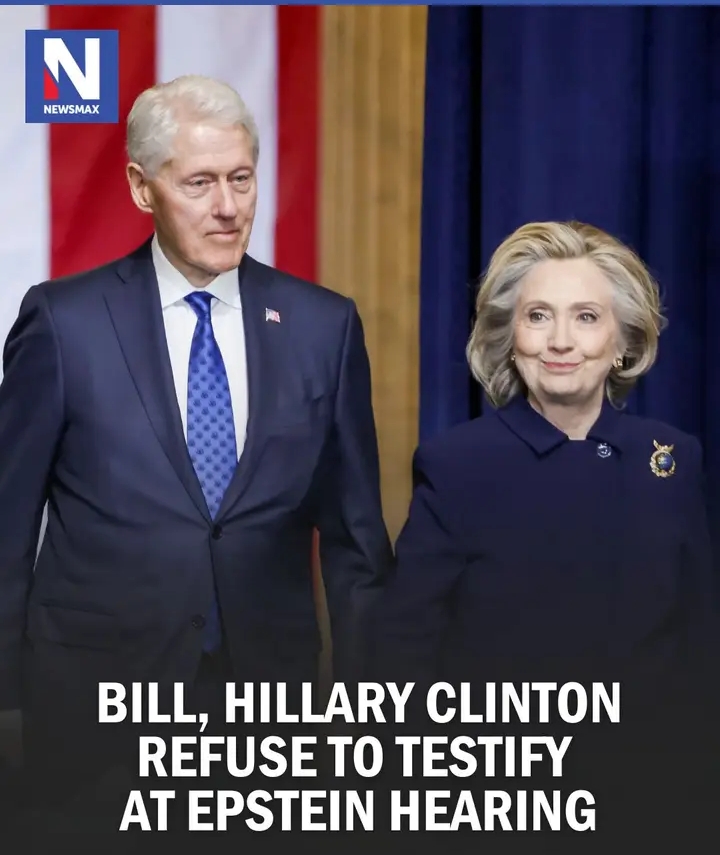
On Tuesday, January 13, 2026, former President Bill Clinton and his wife, former Secretary of State Hillary Clinton, declined to testify before the Republican-led House Oversight Committee in its investigation into the late financier Jeffrey Epstein.
The move set up a high-stakes clash with House Republicans, who are intensifying scrutiny over Epstein’s elite networks and what various Washington figures knew about his criminal activities.
Why the Clinton Declined to Testify.
In a public letter to Representative James Comer — chair of the House Oversight Committee — the Clinton labeled the subpoenas “invalid and legally unenforceable” and rejected the committee’s demands as politically motivated.
They argued they had already provided written statements and that the investigation was designed to **target them unfairly.
Both Bill and Hillary Clinton emphasized they had no direct knowledge of Epstein’s crimes and denied any wrongdoing.
They said they were defending their principles in the face of what they described as a partisan pursuit.
Committee Reaction — Contempt Proceedings Loom.
House Republicans responded sharply. Chairman Comer announced plans to initiate contempt of Congress proceedings, particularly against Bill Clinton for failing to appear at a scheduled deposition.
Such proceedings could lead to a House vote and potential referral to the Justice Department for prosecution, though convictions are rare.
The committee has also threatened similar actions against Hillary Clinton if she continues to resist testifying.
What the Inquiry Seeks.
The Oversight Committee’s investigation aims to collect testimony and documents related to Epstein’s connections to powerful individuals.
Epstein, a wealthy financier, was arrested in 2019 on federal sex-trafficking charges and later died in custody.
His circle included prominent figures from business, politics and academia, and Republicans argue the public deserves a full accounting.
Clinton’s relationship with Epstein has been part of public scrutiny for years; he flew on Epstein’s private plane multiple times and was photographed with him, though he has consistently denied any involvement in Epstein’s criminal conduct.
Political Context and Reactions.
The refusal to testify intensifies existing partisan tensions in Washington.
Republicans assert that compelling testimony — even from former presidents — is essential for oversight and accountability.
Democrats argue the investigation is being used to embarrass political opponents rather than to advance a genuine inquiry.
Legal experts note that congressional power to compel testimony from former presidents is not absolute and that contempt processes are complex, rarely used, and often end in negotiated outcomes or court challenges.
Broader Scrutiny Over Epstein Connections.
This confrontation comes amid a broader congressional push to release more documents tied to Epstein’s network, including materials involving other high-profile figures.
Lawmakers have also subpoenaed other associates and the executors of Epstein’s estate, underscoring the breadth of the inquiry.
Bottom Line:The Clinton’s refusal to testify in the House Epstein investigation has escalated into a major political flashpoint, raising questions about congressional authority, elite accountability and the highly charged nature of modern American politics.
The unfolding contempt proceedings could drag the matter into federal court and further polarize an already divided Capitol Hill.

FAIRNESS FIGHT: The International Olympic Committee announcing a groundbreaking change to protect female athletes and women’s sports as a whole — a ban on biological males competing in women’s events.

Breaking News: Trump Administration Moves to Add President’s Signature to U.S. Currency in Unprecedented Shift

Afternoon Update | America… right now… in the middle of this afternoon… while most of us are on lunch break… Karoline Leavitt just finished facing every camera and every difficult question in the world.click the link below

President Trump’s signature will be added to future U.S. paper currency, the Treasury Department announced Thursday

Breaking News: First $100 Bills Bearing Trump and Bessent Signatures Set for June Release click the link below

Just In : U.S. INTERCEPTED UKRAINE MESSAGES OF PLOT TO ROUTE MONEY TO BIDEN CAMPAIGN

Just In : Here’s the Average Social Security Benefit at Ages 62 to 80 — What You Can Expect at Every Stage

BREAKING: U.S President Donald Trump Has Just Been Confirmed… See More

Just In: “NO ONE UNDERSTOOD WHY Donald Trump PAUSED HIS SPEECH… UNTIL THE NEXT MORNING.”CLICK. THE LINK BELOW

REALITY CHECK IN WASHINGTON: A tense exchange has sparked fresh debate over the true cost—and purpose—of recent escalation.

Breaking News:Millions of Americans Receive Social Security Payments Today — Here’s Who Qualifies for March 25 Disbursement
