
NEWS
BREAKING NEWS:Tense Standoff at the United Nations: U.S. and Iran Trade Barbs Amid Rising Global Alarm.

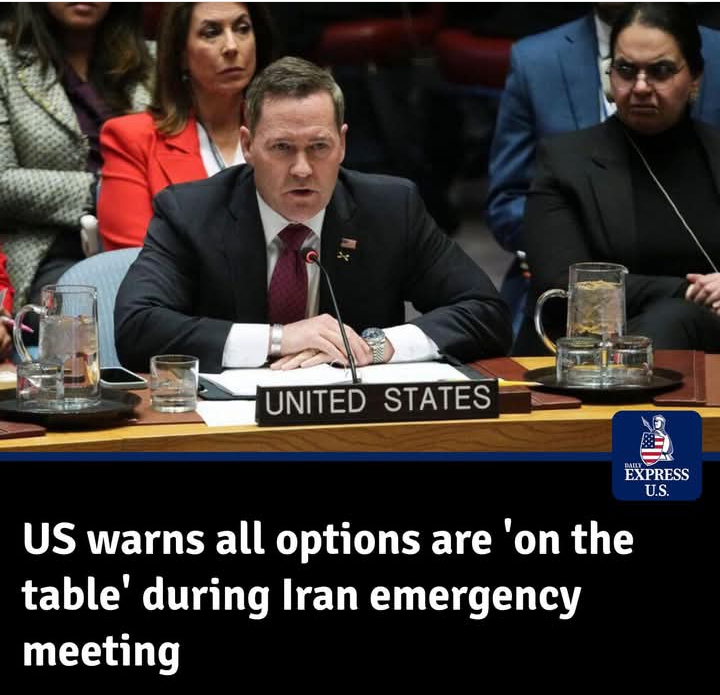
In what many diplomats described as one of the most charged moments at the United Nations in years, representatives of the United States and Iran faced off at an emergency U.N. Security Council session on January 15, 2026, over the violent crackdown on nationwide protests in Iran and broader geopolitical tensions.
A Security Council Under Stress.
The session was convened at the request of the United States to address what Washington describes as a brutal repression of demonstrators in Iran, where recent uprisings have reportedly led to thousands of deaths and widespread arrests.
At the podium, U.S. Ambassador to the United Nations Mike Waltz delivered a stark message, saying that“all options are on the table” regarding the international community’s response to the Iranian government’s actions, a phrase often understood in diplomatic circles as leaving room for military, economic, or other forms of pressure.
Waltz also reiterated support for the Iranian protest movement and stressed that President Donald Trump is prepared to take decisive action if necessary, framing the situation as a moral imperative to halt the bloodshed.
Iran’s Response: Defiance and Warning.
Iranian diplomats at the U.N. responded with equally forceful rhetoric.
Iran’s Deputy Permanent Representative to the United Nations, Gholamhossein Darzi, rejected accusations of human rights abuses and interference, accusing the United States of spreading misinformation and attempting to justify foreign intervention.
Darzi emphasized that Iran did not seek confrontation but made clear that any act of aggression — direct or indirect — “will be met with a decisive, proportionate, and lawful response”under international law, citing Article 51 of the U.N. Charter.
International Reactions and Diplomatic Discomfort.
The meeting quickly revealed deep divisions among U.N. member states.
While some Western countries backed the U.S. call for accountability and expressed solidarity with Iranian protesters, others — including Russia and China — urged restraint and criticized the U.S. for interfering in what they termed Iran’s internal affairs.
Several Arab states also engaged in frantic diplomacy behind the scenes, urging major powers to avoid military escalation that could destabilize an already volatile Middle East.
Meanwhile, U.N. Secretary-General António Guterres and senior U.N. officials called for diplomacy and calm, urging all parties to refrain from actions that could spark broader conflict.
Why This Matters: High Stakes at Global Crossroads.
This confrontation at the United Nations comes amid widespread anti-government protests across Iran, driven initially by economic distress and evolving into one of the deadliest internal crises the country has seen in decades.
With the diplomatic spotlight on Tehran’s response to domestic unrest, the Security Council session underscored how internal national crises can quickly escalate into global diplomatic flashpoints — especially when world powers use international forums to press their strategic interests.
The powerful language exchanged in New York reflects not just concern for human rights but also deep mistrust between the U.S. and Iran and fear of regional escalation.
Looking Ahead.
As Iran continues to navigate internal pressures, and as global powers weigh their diplomatic, economic, and military options, the U.N. remains a critical venue for international debate — even as its ability to forge consensus on highly polarized issues is tested.
Whether the United Nations can move beyond the tense standoff toward meaningful action or de-escalation remains a central question for world leaders in the coming days and weeks.

FAIRNESS FIGHT: The International Olympic Committee announcing a groundbreaking change to protect female athletes and women’s sports as a whole — a ban on biological males competing in women’s events.

Breaking News: Trump Administration Moves to Add President’s Signature to U.S. Currency in Unprecedented Shift

Afternoon Update | America… right now… in the middle of this afternoon… while most of us are on lunch break… Karoline Leavitt just finished facing every camera and every difficult question in the world.click the link below

President Trump’s signature will be added to future U.S. paper currency, the Treasury Department announced Thursday

Breaking News: First $100 Bills Bearing Trump and Bessent Signatures Set for June Release click the link below

Just In : U.S. INTERCEPTED UKRAINE MESSAGES OF PLOT TO ROUTE MONEY TO BIDEN CAMPAIGN

Just In : Here’s the Average Social Security Benefit at Ages 62 to 80 — What You Can Expect at Every Stage

BREAKING: U.S President Donald Trump Has Just Been Confirmed… See More

Just In: “NO ONE UNDERSTOOD WHY Donald Trump PAUSED HIS SPEECH… UNTIL THE NEXT MORNING.”CLICK. THE LINK BELOW

REALITY CHECK IN WASHINGTON: A tense exchange has sparked fresh debate over the true cost—and purpose—of recent escalation.

Breaking News:Millions of Americans Receive Social Security Payments Today — Here’s Who Qualifies for March 25 Disbursement
