
NEWS
BREAKING NEWS:Trump on Fraud and Citizenship: A Controversial New Policy Proposal.

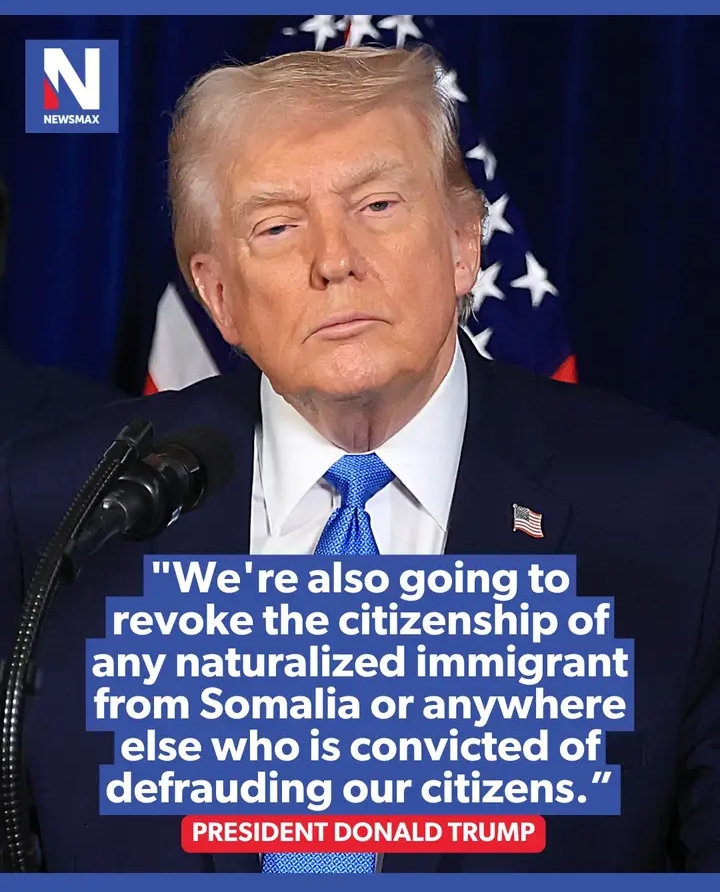
U.S. President Donald Trump sparked intense debate on Tuesday, January 13, 2026, when he announced that his administration intends to revoke the citizenship of naturalized immigrants convicted of defrauding American citizens.
Speaking at the Detroit Economic Club, Trump specifically mentioned immigrants from Somalia — but clarified that the measure would apply to naturalized individuals from any country convicted of fraud against U.S. citizens.
“We’re also going to revoke the citizenship of any naturalized immigrant from Somalia or anywhere else who is convicted of defrauding our citizens,”
Trump said during his remarks.
What Trump Announced.
According to news reports, the president described the policy as part of a broader effort to crack down on immigration fraud.
Though Somali immigrants were singled out in the speech, officials emphasized that the proposal would not be limited to any single nationality.
The plan is being framed by the administration as a way to protect Americans from fraud and preserve the integrity of the naturalization system.
Legal and Practical Context.
Revoking (or “denaturalizing”) citizenship in the United States is not a simple executive action.
U.S. law allows citizenship to be revoked only through court proceedings and under narrow circumstances — such as when citizenship was obtained through fraud, misrepresentation, or concealment of material facts during the naturalization process.
Denaturalization requires legal action in federal court, where the government must prove that citizenship was unlawfully obtained.
United States, affirm that the government cannot strip citizenship for immaterial falsehoods; the falsehood must have been significant to the naturalization outcome.
Supreme Court precedents, including Afroyim v. Rusk and Schneider v. Rusk, reinforce citizens’ constitutional protections and limit when citizenship can be revoked.
Policy Shift and Administrative Actions.
This announcement fits a broader trend within the Trump administration toward expanding de naturalization efforts:
Government agencies have been auditing cases involving Somali U.S. citizens to identify potential fraud leading to de naturalization.
Internal guidance has reportedly pushed for a significant increase in de naturalization referrals, far beyond historical norms.
A June 2025 Justice Department memo emphasized prioritizing cases involving fraud or other serious abuses — a stance critics argue could create a two-tiered system of citizenship.
Criticism and Legal Concerns.
Civil rights advocates, legal experts, and immigrant communities have raised strong objections:
Due process concerns: Legal scholars argue that expanding de naturalization risks violating constitutional protections if individuals lack adequate legal representation or if standards are loosened.
Targeting specific communities:Critics say the focus on Somali immigrants, particularly in Minnesota, appears politically motivated and risks stigmatizing a community rather than addressing actual fraud.
Historical rarity: De Naturalization cases have historically been rare, typically involving serious fraud in the citizenship application itself or egregious criminal conduct.
Political and Social Impact.
Trump’s rhetoric and policy direction have already stirred controversy:
Some local leaders and immigrant advocates decry the approach as discriminatory and harmful to community relations.
Supporters of the policy emphasize the importance of maintaining the integrity of U.S. citizenship and penalizing serious abuse of public trust.
Conclusion.
President Trump’s announcement represents a significant escalation in U.S. immigration and citizenship enforcement policy.
By proposing to revoke citizenship for naturalized immigrants convicted of fraud, the administration is pushing the boundaries of de naturalization law and setting up a likely legal and constitutional battle in the months ahead.
Whether this policy can be implemented as described — and withstand judicial scrutiny — remains an open question as critics and supporters alike mobilize around the broader debate on immigration, fraud, and national identity.

FAIRNESS FIGHT: The International Olympic Committee announcing a groundbreaking change to protect female athletes and women’s sports as a whole — a ban on biological males competing in women’s events.

Breaking News: Trump Administration Moves to Add President’s Signature to U.S. Currency in Unprecedented Shift

Afternoon Update | America… right now… in the middle of this afternoon… while most of us are on lunch break… Karoline Leavitt just finished facing every camera and every difficult question in the world.click the link below

President Trump’s signature will be added to future U.S. paper currency, the Treasury Department announced Thursday

Breaking News: First $100 Bills Bearing Trump and Bessent Signatures Set for June Release click the link below

Just In : U.S. INTERCEPTED UKRAINE MESSAGES OF PLOT TO ROUTE MONEY TO BIDEN CAMPAIGN

Just In : Here’s the Average Social Security Benefit at Ages 62 to 80 — What You Can Expect at Every Stage

BREAKING: U.S President Donald Trump Has Just Been Confirmed… See More

Just In: “NO ONE UNDERSTOOD WHY Donald Trump PAUSED HIS SPEECH… UNTIL THE NEXT MORNING.”CLICK. THE LINK BELOW

REALITY CHECK IN WASHINGTON: A tense exchange has sparked fresh debate over the true cost—and purpose—of recent escalation.

Breaking News:Millions of Americans Receive Social Security Payments Today — Here’s Who Qualifies for March 25 Disbursement
