
CELEBRITY
Breaking News:Ukraine 2022. Venezuela 2026. Starlink Returns to the Front Lines as Conflict Shuts Down a Nation.

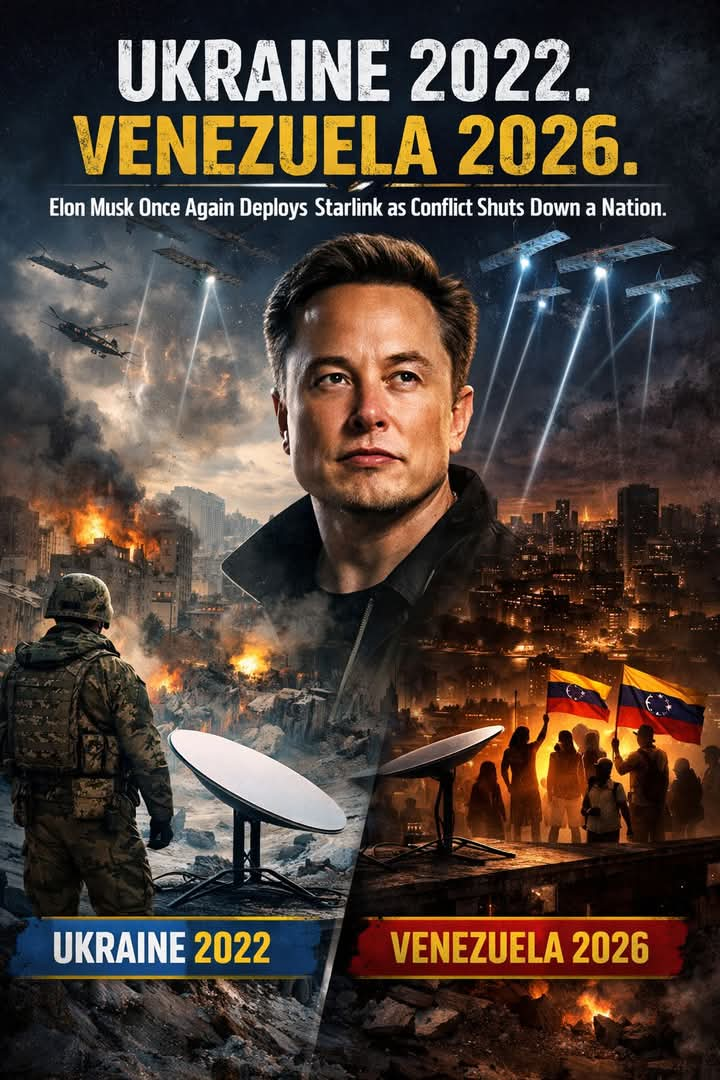
Breaking News:Ukraine 2022. Venezuela 2026. Starlink Returns to the Front Lines as Conflict Shuts Down a Nation.
When Russian tanks rolled into Ukraine in 2022, one unexpected actor emerged as a critical lifeline: Elon Musk’s Starlink.
As traditional communications collapsed under cyberattacks and physical destruction, the satellite internet network kept Ukraine connected—linking civilians, hospitals, journalists, and the military to the outside world.
Now, four years later, history appears to be echoing.
As reports circulate that conflict and political upheaval have crippled Venezuela’s communications infrastructure, Starlink has once again been deployed to restore connectivity.
The parallels are impossible to ignore—and they raise a troubling, unavoidable question:
Is tech neutrality officially dead?**
When a Network Becomes a Lifeline
In modern conflicts, controlling information can be as decisive as controlling territory.
Power grids fail. Cell towers go dark. Governments restrict or lose access to the internet.
In those moments, whoever restores connectivity doesn’t just reconnect people—they shape outcomes.
That’s what made Starlink’s role in Ukraine so consequential.
It wasn’t just technology; it became strategic infrastructure blurring the line between civilian aid and military utility.
Venezuela now appears to be the latest case study.
As state systems reportedly faltered, Starlink terminals began appearing again—offering a parallel network beyond the control of local authorities.
From Neutral Tool to Geopolitical Actor?
Starlink is owned by **SpaceX**, a private company.
But when its services are deployed during conflicts, neutrality becomes complicated.
Supporters argue:
* Connectivity is a human necessity
* Cutting off communication punishes civilians
* Technology should remain apolitical
Critics counter:
* Restoring internet access can benefit one side over another
* Communication networks can support intelligence, logistics, and coordination
* A single billionaire should not wield de facto influence over national conflicts
In Ukraine, these concerns became public when Musk himself acknowledged setting limits on Starlink’s military use.
Venezuela now revives the same debate—on a new continent, under different political conditions, but with the same underlying tension.
A Pattern Is Emerging
Ukraine in 2022.
Venezuela in 2026.
Two very different conflicts.
One common thread.
When states fail—or are deliberately disconnected—**private technology steps in often faster and more effectively than governments or international organizations.
That speed saves lives, but it also concentrates power in unprecedented ways.
Never before has a single company been able to:
* Restore national-scale connectivity
* Override state-level shutdowns
* Influence the information environment of a sovereign nation
This is not science fiction anymore. It’s the new battlefield.
The End of Tech Neutrality?
The idea that technology is neutral has always been fragile.
But Starlink’s repeated role in conflict zones may mark a turning point.
When access to satellites can:
* Enable resistance
* Undermine governments
* Shape global narratives
…neutrality becomes a choice, not a default.
And choices have consequences.
What This Means Going Forward
As conflicts increasingly move beyond tanks and troops into data, networks, and orbit the world faces urgent questions:
* Who decides when technology intervenes?
* Who sets the limits?
* What accountability exists when private infrastructure affects public sovereignty?
Ukraine showed what’s possible. Venezuela may show what’s next.
One thing is clear:
The future of war will not just be fought on the ground.
It will be fought in the sky—one satellite connection at a time.

Just In: Trump Signs Sweeping Executive Order to Tighten U.S. Election Security. See what happens next

2 minutes ago! Iran’s newest nuclear missile was launched, see what happened!

Just In : Israeli police have violently dispersed citizens demonstrating against the recently approved and widely condemned death penalty for Palestinian prisoners, deploying water cannons to forcefully clear the crowds.

Breaking News:Trump Signs New Executive Order in Oval Office During Live Broadcas full details here

10 Minutes Ago, the First Air Combat Between a Russian MiG-29 and a US F-16 Took Place—Look What Happened

Just In : DeSantis Approves Bill to Rename Palm Beach Airport After Donald Trump check the link below

Just In :According to Arab media reports, Iran has shot down 146 MQ-9 Reaper drones during the ongoing war. Tap the link below

Just In : Social Security Payments Set for April 1: Here’s Who Will Receive Benefits This Wednesday. Tap the link below

Ukraine Drones DESTROY $130 MILLION Russian Ammo Train in Just 10 Minutes – With Cheap Homemade FPVs! Mind-blowing footage shows Ukrainian operators launching just 12 cheap homemade drones worth only $60,000 to completely obliterate a massive $130 million Russian military ammunition train in occupied Zaporizhzhia.

Happy Birthday to Melania Trump! Born in 1970, Melania Trump is a Slovenian-American former First Lady known for her background in modeling and her time in public life.

Just In: Millions of Americans to Receive Social Security Payments on April 1, 2026 — Eligibility Details Revealed
