
NEWS
BREAKING: Putin Allegedly Issues World War III Warning to U.S. Over Seized Oil Tanker

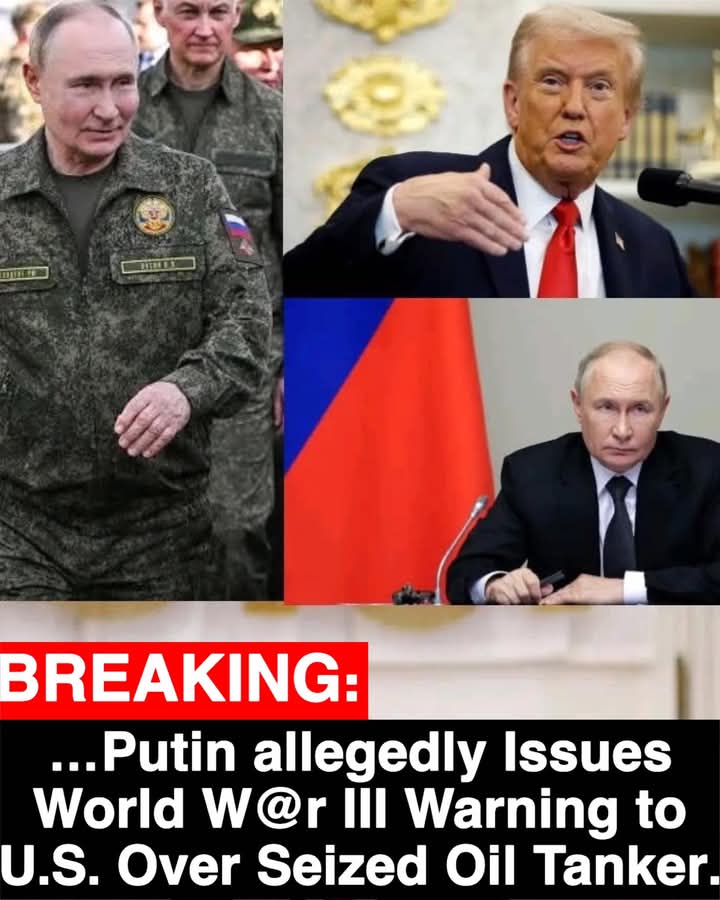
BREAKING: Putin Allegedly Issues World War III Warning to U.S. Over Seized Oil Tanker
Global tensions surged overnight following reports that Russian President Vladimir Putin issued a stark warning to the United States after the seizure of an oil tanker allegedly linked to Russian interests.
According to multiple unconfirmed accounts circulating online and in diplomatic circles, the Kremlin has demanded the immediate release of the vessel, warning that failure to do so could dangerously escalate the standoff.
The Alleged Warning
Sources familiar with the situation claim Putin framed the tanker seizure as a direct provocation, cautioning that continued U.S. action could push relations toward a catastrophic breaking point.
In the most alarming language attributed to the Russian leader, the dispute was reportedly described as one that could spiral into World War III if not resolved swiftly.
While no official transcript has been released and the Kremlin has not publicly confirmed the wording, the reports alone were enough to trigger widespread concern among analysts and international observers.
The Tanker at the Center of the Crisis
The incident stems from a U.S. seizure of an oil tanker suspected of violating sanctions, part of Washington’s broader effort to clamp down on so-called “shadow fleet” operations used to move sanctioned oil through complex maritime networks.
Moscow has condemned such seizures as illegal and politically motivated, accusing the U.S. of acting as “global enforcer” beyond international law.
Russia argues the tanker was operating legitimately, while U.S. officials maintain the action was lawful and necessary to enforce sanctions tied to national security concerns.
High-Stakes Brinkmanship
Even as officials on both sides stop short of confirming direct military threats, experts warn that the rhetoric itself is dangerous.
“When leaders invoke global war—even rhetorically—it raises the risk of miscalculation,” said one foreign policy analyst.
“Naval encounters, sanctions enforcement, and military signaling are colliding in a very volatile way.”
The tanker dispute comes amid already strained U.S.–Russia relations, shaped by ongoing conflicts, sanctions, and rival military posturing across multiple regions.
Washington’s Response
The U.S. government has not publicly acknowledged receiving a formal warning framed in such dramatic terms.
Pentagon and State Department officials have reiterated that American forces will continue to enforce sanctions and protect maritime security, while also emphasizing a desire to avoid unnecessary escalation.
Diplomatic back channels are believed to be active, aimed at preventing the situation from deteriorating further.
Global Reaction and What Comes Next
International observers and allies are watching closely, wary that a dispute over a single vessel could become a symbolic flashpoint for much larger geopolitical rivalries.
Markets, shipping firms, and insurers are also monitoring developments, concerned about the implications for global energy flows and maritime safety.
For now, the situation remains tense but unresolved.
Whether the alleged warning leads to negotiation, de-escalation, or further confrontation will depend on actions taken in the coming days—not just words.
What is clear is this: a tanker seizure has once again exposed how fragile the balance is between sanctions enforcement and open conflict, and how quickly global rhetoric can shift from diplomacy to the language of war.

JUST BREAKING: Some Retirees to Receive Over $5,000 Monthly in Social Security by 2026 — Eligibility Criteria Revealed

¡Esta es la extraordinaria valentía de Irán 🇮🇷! 🔥 9:00 am: “Toda una civilización terminará esta noche”, dijo Trump. 9:10 a. m.: La gente común de Irán ha formado una cadena humana en el puente blanco. 🔥🔥 Si no tienen miedo a morir, no pueden ser derrotados. ¡Qué coraje increíble! 🔥

Pro-Iranian accounts on Twitter are flooding the platform tonight with AI-generated videos mocking Trump, including one showing him stepping off Air Force One waving a white flag after announcing a ceasefire deal critics say was so bad he appeared to negotiate with himself.

A major political shockwave just hit Washington as 24 members of Congress declare an EMERGENCY and demand the UNPRECEDENTED removal of President Trump from office.

BREAKING: Trump’s Shocking Revelation Sparks Viral Frenzy and Raises Questions About His Political Future

Is “getting the job done” more important than having a “nice” president?

Just In :Trump Sends Clear Message to Iran as B-52 Bombers Lift Off from UK Bases. See what happens next

Breaking News:Trump Suspends Planned U.S. Strikes on Iran for Two Weeks Amid Diplomatic Push. Full details here
Today I witnessed something because of Trump that I will never forget for the rest of my life. And that is exactly why I want to show you Trump’s real face today. Click here for full details

At a Monday press conference, Trump brought up past comments by North Korea’s Kim Jong Un about Joe Biden while discussing US troop deployment in South Korea.

Breaking Claim Sparks Concern: Viral Report Alleges Attack on U.S. Warships Near Strait of Hormuz. See what happens next
