
NEWS
BREAKING:America Enforces Its Borders: Law, Security, and the Immigration Debate.

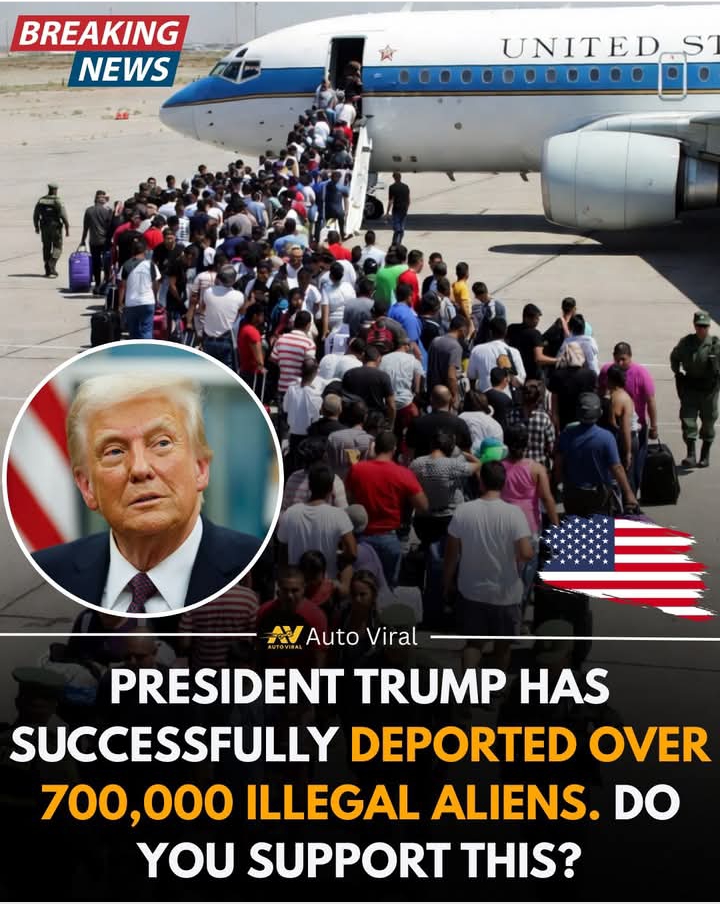
During President Donald Trump’s administration, immigration enforcement became one of the most defining and controversial aspects of national policy.
According to official statements, more than 700,000 individuals living in the United States without legal status were deported during his time in office.
For supporters of strict border control, these figures represent a firm commitment to upholding the rule of law and restoring integrity to the nation’s immigration system.
For critics, they highlight the profound human cost of aggressive enforcement and the urgent need for comprehensive reform.
Advocates of strong immigration enforcement argue that a nation without secure borders cannot effectively govern itself.
From this perspective, deportations are not about hostility toward immigrants, but about ensuring that laws passed by Congress are enforced fairly and consistently.
Supporters believe that when immigration laws are ignored, it undermines respect for the legal system as a whole.
Enforcing those laws, they say, sends a clear message that legal entry matters and that the United States remains a country governed by rules, not exceptions.
Public safety is another central argument advanced by proponents.
They contend that removing individuals who have entered or remained in the country unlawfully—particularly those with criminal records—helps protect communities and reduces the strain on law enforcement agencies.
In addition, supporters emphasize that immigration enforcement helps safeguard public resources, such as schools, healthcare systems, and social services, ensuring that they are available to citizens and legal residents who are entitled to them.
Border security also featured prominently in the broader enforcement strategy.
The Trump administration framed deportations as part of a larger effort to deter illegal crossings and human trafficking, arguing that clear consequences would discourage dangerous journeys and exploitation by smuggling networks.
From this viewpoint, strict enforcement is seen not only as a matter of sovereignty, but also as a deterrent that could save lives in the long term.
On the other hand, critics of mass deportations argue that the numbers tell only part of the story.
They point to families separated, long-established community members removed, and children left facing uncertainty.
Many deported individuals, critics note, had lived in the United States for years, worked, paid taxes, and contributed to their local economies.
For these observers, enforcement policies often lacked sufficient compassion and failed to distinguish adequately between serious criminals and nonviolent individuals seeking better opportunities.
Human rights advocates also stress that focusing heavily on deportations without addressing systemic issues leaves the underlying challenges unresolved.
They argue that the U.S. immigration system is outdated, overly complex, and ill-suited to modern economic and humanitarian realities.
Without meaningful reform—such as clearer pathways to legal status, updated visa programs, and more efficient asylum processing—enforcement alone may perpetuate cycles of fear and instability.
Ultimately, the deportation figures from the Trump administration underscore a broader national debate that continues to shape American politics.
Immigration sits at the intersection of security, legality, economic need, and human dignity.
While some prioritize strict enforcement as essential to national sovereignty and public safety, others call for a more balanced approach that pairs law enforcement with compassion and reform.
As the United States moves forward, the challenge remains the same: how to manage immigration in a way that protects borders, respects the rule of law, and upholds the country’s long-standing values as a nation of opportunity.
The debate sparked by these deportation numbers is not merely about policy, but about the kind of country America strives to be.

Afternoon Update | America… right now… in the middle of this afternoon… while most of us are on lunch break… Karoline Leavitt just finished facing every camera and every difficult question in the world.click the link below

President Trump’s signature will be added to future U.S. paper currency, the Treasury Department announced Thursday

Breaking News: First $100 Bills Bearing Trump and Bessent Signatures Set for June Release click the link below

Just In : U.S. INTERCEPTED UKRAINE MESSAGES OF PLOT TO ROUTE MONEY TO BIDEN CAMPAIGN

Just In : Here’s the Average Social Security Benefit at Ages 62 to 80 — What You Can Expect at Every Stage

BREAKING: U.S President Donald Trump Has Just Been Confirmed… See More

Just In: “NO ONE UNDERSTOOD WHY Donald Trump PAUSED HIS SPEECH… UNTIL THE NEXT MORNING.”CLICK. THE LINK BELOW

REALITY CHECK IN WASHINGTON: A tense exchange has sparked fresh debate over the true cost—and purpose—of recent escalation.

Breaking News:Millions of Americans Receive Social Security Payments Today — Here’s Who Qualifies for March 25 Disbursement

News Update: Social Security Payments Scheduled for March 25, 2026 — Who Qualifies and What to Expect

BREAKING: President Trump just ended the Cabinet meeting with a VERY bad warning for useless American “allies”
