
NEWS
BREAKING:Egypt and Jordan Refuse to Host U.S. Operations Against Iran, Signaling Shift in Regional Strategy. For more story, click the link below. No

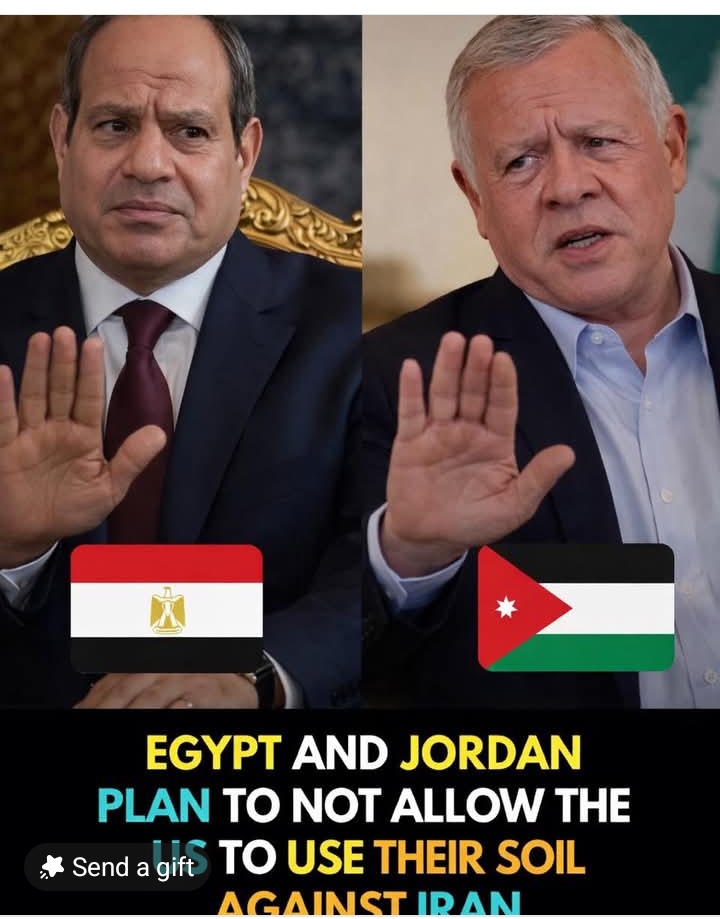
Egypt and Jordan have reportedly taken a firm stance against allowing their territories to be used as launch points for any United States military operations targeting Iran, a move that could significantly complicate Washington’s strategic planning in the Middle East.
The decision marks a notable moment in regional diplomacy, as both nations have long been considered key partners in supporting U.S. military coordination and security efforts across the region.
For decades, Egypt and Jordan have played important roles in facilitating American military logistics, including granting airspace access, hosting joint exercises, and supporting regional security initiatives.
Their geographic position has made them valuable strategic partners for Western operations in the Middle East.
However, the reported refusal to support potential strikes on Iran suggests a recalibration of priorities by both Cairo and Amman.
Analysts believe the decision reflects growing concerns among Arab leaders about the risks of being drawn into a wider regional conflict.
With tensions already high across the Middle East, both governments appear determined to avoid actions that could escalate hostilities or provoke retaliatory measures.
By denying the use of their territory for offensive operations, Egypt and Jordan are signaling that maintaining domestic stability and regional balance is now a top priority.
For U.S. military planners, the stance presents clear logistical challenges.
Without access to bases or operational facilities in these strategically located countries, American forces may need to rely more heavily on aircraft carriers, naval strike groups, or bases located farther away in the Gulf region.
Such adjustments could complicate operational coordination and potentially slow response times during critical moments.
The development also carries diplomatic implications. Washington has been working to build international support for its campaign known as “Operation Epic Fury,” aimed at countering Iranian influence and potential threats in the region.
If key partners like Egypt and Jordan distance themselves from direct participation, sustaining a cohesive coalition may become more difficult.
Beyond the immediate military implications, the move could reflect a broader shift in Middle Eastern geopolitics.
Many governments in the region are increasingly cautious about becoming entangled in great-power confrontations.
Instead, they appear to be prioritizing national stability, economic interests, and diplomatic balance.
As tensions between the United States and Iran continue to evolve, Egypt and Jordan’s position may influence how other regional actors respond.
For now, their message is clear: avoiding escalation and preserving internal stability outweigh the risks of deeper involvement in a potential regional conflict.
The coming weeks may reveal whether other nations adopt a similar approach of cautious neutrality as the situation unfolds. 🌍⚖️

Just In: Millions of Americans to Receive Social Security Payments on April 1, 2026 — Eligibility Details Revealed

Just In: New York Governor ERUPTS in Fury After Citigroup Announces Massive Move of 11,000 Jobs OUT of New York! York.Click the link to read the full explosive story, In a devastating

Governor Of California Goes BERSERK As Playboy LEAVES California For Miami After 70+ Years

Just In: FLORIDA MAN RISING: Vice President JD Vance remains the clear frontrunner in a hypothetical 2028 election, but Secretary of State Marco Rubio is on the rise, finishing second in the Republican nomination straw poll at CPAC.

U.S. F-15 First Strike — Cartel Drug Lab Wiped Off the Map in Seconds see what happens next

Just 6 Minutes Ago! Millions of US Troops Knelt and Surrendered—Look What Happened!

JUST IN : Here’s Who Will NOT Receive a Social Security Payment on Wednesday April 1 2006

Just 1 Minute Ago! 100,000 US Troops Surrendered and Fled—Look What Happened!

Just In: Donald Trump SLAMS Pope Leo XIV: “Sit down — you’re just a religious figure, mind your own business!” — But Pope Leo XIV’s response stunned the audience.full details

BREAKING: White House Press Secretary Karoline Leavitt said Iran will no longer have the ability to threaten the United States, signaling strong confidence from the administration about the impact of ongoing operations.

White No Kings protester tries to explain why there aren’t many Black people there… and it goes off the rails: She says:w
