
NEWS
BREAKING:Flames Over Prince Sultan: Strategic Shockwaves After a Devastating Air Base Strike.

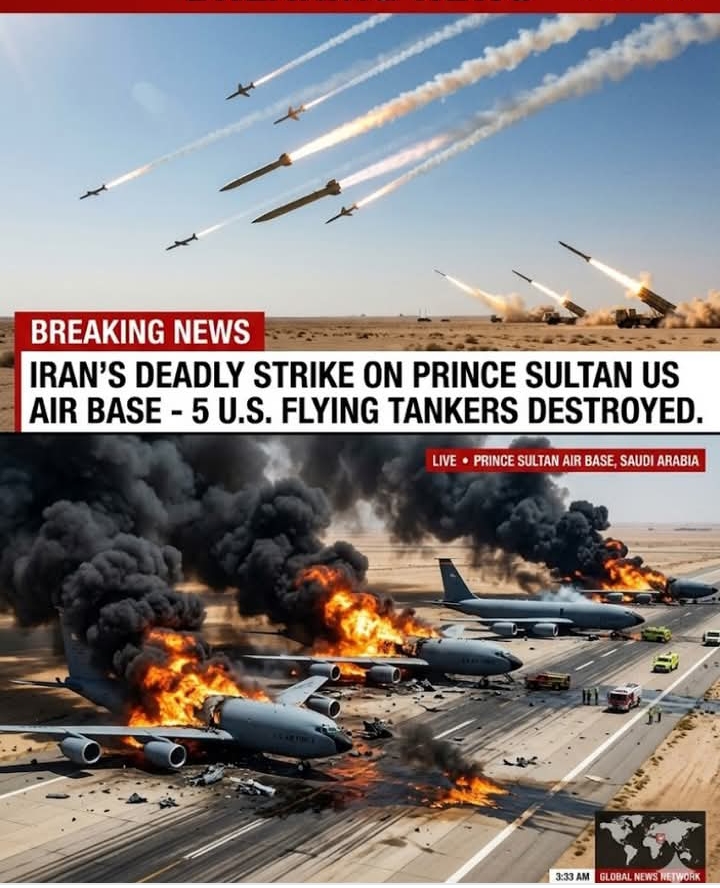
In a dramatic escalation of tensions in the Middle East, reports have emerged of a large-scale strike targeting Prince Sultan Air Base in Saudi Arabia—one of the United States’ most critical military hubs in the region.
The alleged attack, attributed to Iranian forces, marks a significant moment in the unfolding conflict and raises urgent questions about air defense vulnerabilities, regional stability, and the future of U.S. military operations in the Gulf.
According to early accounts, the strike involved a coordinated barrage of ballistic missiles and unmanned aerial systems.
Despite layered Saudi and U.S. air defenses, several projectiles reportedly penetrated protective measures and struck key areas of the base.
Among the most consequential losses were five KC-135 Strata Tanker aircraft—vital assets used for mid-air refueling, enabling extended-range operations for U.S. and allied aircraft.
Eyewitness descriptions paint a chaotic scene: massive explosions lighting up the desert night, fires engulfing aircraft on the tarmac, and plumes of smoke rising high above the installation.
Emergency crews reportedly battled intense flames fueled by aviation fuel and secondary detonations, while efforts to secure the base and assess damage unfolded under high alert conditions.
The strategic implications of such a strike are considerable.
Aerial refueling tankers are force multipliers, allowing combat aircraft to project power across vast distances without returning to base.
Their destruction could temporarily disrupt operational tempo, limit sortie ranges, and force a reassessment of logistics and basing strategies in the region.
At the same time, the incident underscores the evolving nature of modern warfare.
The combination of precision missiles and relatively low-cost drones presents a complex challenge for even advanced defense systems.
Saturation tactics—launching multiple threats simultaneously—can overwhelm interception capabilities, increasing the likelihood that some projectiles reach their targets.
While officials have yet to release a full assessment or confirm details publicly, analysts suggest that this event—if verified—would represent one of the most consequential direct strikes against U.S. military infrastructure in recent years.
It may also prompt a broader response, whether through military, diplomatic, or economic channels.
Beyond the immediate damage, the strike highlights a deeper reality: the growing volatility of the region and the risks of escalation when advanced military technologies are deployed in active conflict zones.
As the situation develops, the international community will be watching closely—not only for confirmation of facts, but for signs of what comes next.
Today I witnessed something because of Trump that I will never forget for the rest of my life. And that is exactly why I want to show you Trump’s real face today. Click here for full details

At a Monday press conference, Trump brought up past comments by North Korea’s Kim Jong Un about Joe Biden while discussing US troop deployment in South Korea.

Breaking Claim Sparks Concern: Viral Report Alleges Attack on U.S. Warships Near Strait of Hormuz. See what happens next

Trump’s Playful Jab at Melania Steals the Show with Heartland Egg Farmers President Donald Trump turned on the charm and humor Monday during an outdoor event with egg farmers and their families, playfully introducing First Lady Melania Trump as the glamorous outsider who left Hollywood behind for real America.

BREAKING: Donald Trump is in the Hospital as we speak, though its not confirmed of his conditions.

BREAKING NEWS:Trump’s Stark Remark on Iran Raises Concerns Over Escalation.

JUSTIN:Defense Secretary Hegseth Issues Stark Warning to Iran Amid Rising Tensions. Click for complete story.

JUSTIN:Trump Remarks About Son at Investment Summit Draw Public Attention 🇺🇸.

BREAKING:VP Vance Commends U.S. Military After Daring Rescue of Downed Airman in Hostile Territory.

BREAKING:High-Risk Rescue Mission Highlights U.S. Commitment to Service Members, Sparks Debate on Leadership Style.

According to multiple reports, Donald Trump said Monday that the U.S. could “take out” Iran in one night and suggested that “might be tomorrow night,” escalating fears of a wider war as his deadline over the Strait of Hormuz nears.
