
NEWS
BREAKING:Human Rights Watch Accuses Israel of Using White Phosphorus in Lebanese Village. Click the link for more story. My

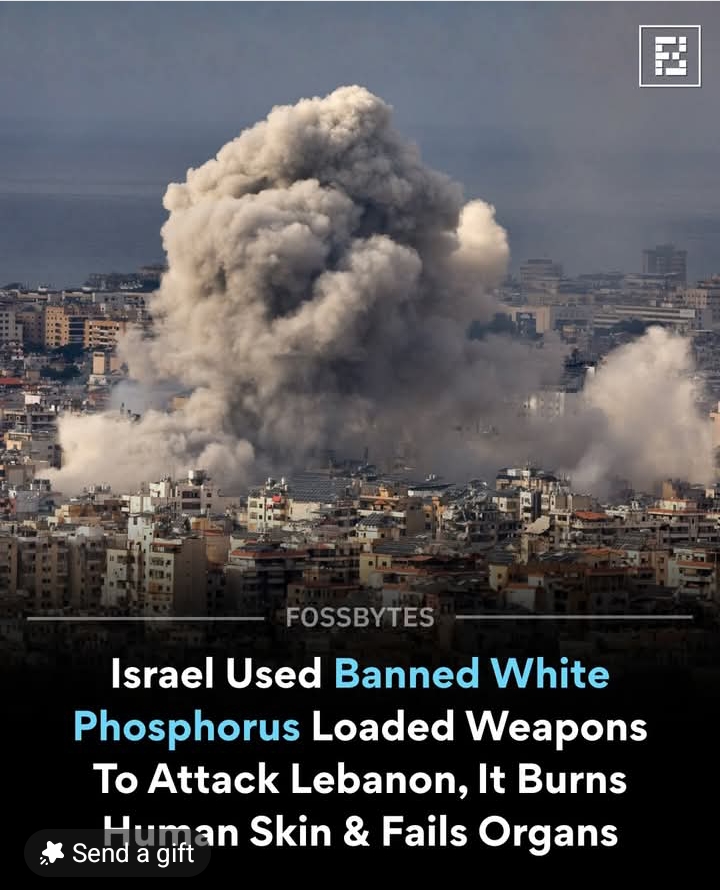
The human rights organization Human Rights Watch has confirmed that Israeli forces allegedly used white phosphorus munitions in residential areas of southern Lebanon, raising serious concerns about violations of international humanitarian law.
The reported incident took place on March 3 in the village of Yohmor, where civilians and homes were said to have been affected by the controversial weapon.
According to Human Rights Watch, investigators verified seven photographs showing white phosphorus artillery shells exploding in mid-air over populated areas of the village.
The images reportedly reveal distinctive smoke patterns associated with airburst white phosphorus munitions, which dispersed burning particles across the surrounding area.
At least two residential homes and several pieces of civilian property were set ablaze as a result of the strikes.
White phosphorus is a chemical substance that ignites when exposed to oxygen and burns at extremely high temperatures.
When used in populated areas, it can cause severe burns, respiratory damage, and long-term injuries.
Victims exposed to the substance often suffer lifelong physical harm, and in some cases, the burns can be fatal.
Human Rights Watch stated that its analysis identified the weapons as M825-series 155mm artillery projectiles.
These shells are designed to release white phosphorus in the air, creating thick smoke clouds commonly used for battlefield illumination or smoke screens.
However, when deployed over civilian communities, the burning fragments can fall indiscriminately onto homes, streets, and other structures.
Under international humanitarian law, the use of incendiary weapons such as white phosphorus in densely populated areas is widely regarded as unlawful because of the high risk to civilians.
Human Rights Watch argues that the use of airburst white phosphorus in Yohmor was indiscriminate and endangered the local population.
The organization has called on Israel’s major allies—including the United States, United Kingdom, and Germany—to take action in response to the findings.
Specifically, Human Rights Watch urged these governments to suspend military equipment sales to Israel and consider sanctions against officials responsible for authorizing the alleged attacks.
The broader conflict has also taken a heavy toll on civilians in Lebanon. Reports indicate that more than 500,000 people have been displaced from their homes due to ongoing Israeli military operations.
Authorities and humanitarian groups say at least 394 people have been killed and around 1,000 others injured during the attacks.
The allegations are likely to intensify international scrutiny of Israel’s military conduct in the region and add further pressure on its allies to respond.
As the conflict continues, humanitarian organizations are warning that the risk to civilians remains high, particularly in areas where fighting is occurring close to populated communities.

Just In: Millions of Americans to Receive Social Security Payments on April 1, 2026 — Eligibility Details Revealed

Just In: New York Governor ERUPTS in Fury After Citigroup Announces Massive Move of 11,000 Jobs OUT of New York! York.Click the link to read the full explosive story, In a devastating

Governor Of California Goes BERSERK As Playboy LEAVES California For Miami After 70+ Years

Just In: FLORIDA MAN RISING: Vice President JD Vance remains the clear frontrunner in a hypothetical 2028 election, but Secretary of State Marco Rubio is on the rise, finishing second in the Republican nomination straw poll at CPAC.

U.S. F-15 First Strike — Cartel Drug Lab Wiped Off the Map in Seconds see what happens next

Just 6 Minutes Ago! Millions of US Troops Knelt and Surrendered—Look What Happened!

JUST IN : Here’s Who Will NOT Receive a Social Security Payment on Wednesday April 1 2006

Just 1 Minute Ago! 100,000 US Troops Surrendered and Fled—Look What Happened!

Just In: Donald Trump SLAMS Pope Leo XIV: “Sit down — you’re just a religious figure, mind your own business!” — But Pope Leo XIV’s response stunned the audience.full details

BREAKING: White House Press Secretary Karoline Leavitt said Iran will no longer have the ability to threaten the United States, signaling strong confidence from the administration about the impact of ongoing operations.

White No Kings protester tries to explain why there aren’t many Black people there… and it goes off the rails: She says:w
