
NEWS
BREAKING:Trump Mocks U.K. Support in Middle East Tensions, Jabs Starmer as “Great Beratín”.

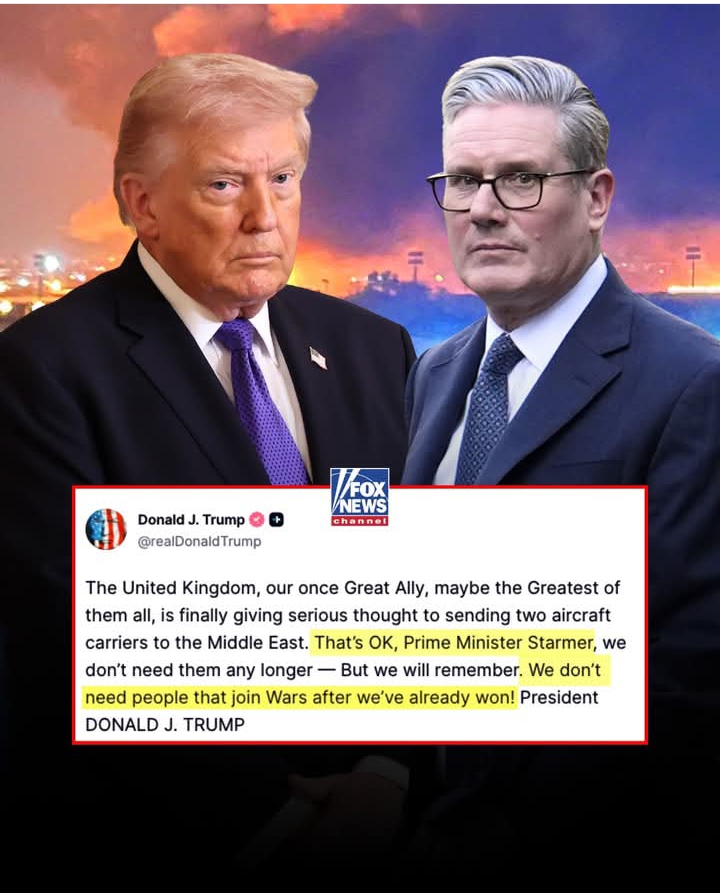
President Donald Trump has sparked fresh diplomatic tension after taking a swipe at Keir Starmer, dismissing the United Kingdom’s potential military support and claiming he has little interest in help from countries that “join wars after we’ve already won.”
The remarks came as tensions in the Middle East continue to rise, prompting discussions among Western allies about potential military deployments in the region.
According to reports, the UK Ministry of Defence recently placed one of the country’s two aircraft carriers on advanced readiness, signaling that it could be mobilized if the situation in the Middle East escalates further.
Responding to the development, Trump used a mocking tone toward Britain and its leadership, referring to the country as “Great Beratín” while criticizing what he suggested was a pattern of late involvement in conflicts led by the United States.
“I’m not interested in help from people who join wars after we’ve already won,” Trump said in his statement, appearing to downplay the strategic value of British participation in potential military operations.
The comments quickly stirred reactions among political observers and defense analysts, given the historically close military relationship between the United States and the United Kingdom.
The two countries have long maintained one of the world’s strongest defense partnerships, often working together in major conflicts and international security operations through alliances such as NATO.
The U.K.’s decision to prepare an aircraft carrier for possible deployment reflects growing concern among Western governments about instability in the Middle East and the potential for wider conflict.
Britain operates two modern aircraft carriers, including the flagship HMS Queen Elizabeth, which are central to the country’s naval power projection strategy.
Although the British government has not confirmed a specific deployment timeline, officials say the readiness move is a precautionary step intended to ensure the United Kingdom can respond quickly if necessary.
Trump’s remarks, however, may complicate diplomatic coordination between Washington and London at a time when Western allies are typically expected to present a united front in international security matters.
Analysts note that public criticism between allied leaders is unusual during periods of military tension, particularly between leaders of countries with such deep historical cooperation.
Whether the rhetoric signals a deeper policy divide or simply reflects political messaging remains to be seen.
For now, the exchange highlights the delicate balance between alliance politics and national rhetoric as Western nations weigh their responses to the evolving situation in the Middle East.

Just In: Millions of Americans to Receive Social Security Payments on April 1, 2026 — Eligibility Details Revealed

Just In: New York Governor ERUPTS in Fury After Citigroup Announces Massive Move of 11,000 Jobs OUT of New York! York.Click the link to read the full explosive story, In a devastating

Governor Of California Goes BERSERK As Playboy LEAVES California For Miami After 70+ Years

Just In: FLORIDA MAN RISING: Vice President JD Vance remains the clear frontrunner in a hypothetical 2028 election, but Secretary of State Marco Rubio is on the rise, finishing second in the Republican nomination straw poll at CPAC.

U.S. F-15 First Strike — Cartel Drug Lab Wiped Off the Map in Seconds see what happens next

Just 6 Minutes Ago! Millions of US Troops Knelt and Surrendered—Look What Happened!

JUST IN : Here’s Who Will NOT Receive a Social Security Payment on Wednesday April 1 2006

Just 1 Minute Ago! 100,000 US Troops Surrendered and Fled—Look What Happened!

Just In: Donald Trump SLAMS Pope Leo XIV: “Sit down — you’re just a religious figure, mind your own business!” — But Pope Leo XIV’s response stunned the audience.full details

BREAKING: White House Press Secretary Karoline Leavitt said Iran will no longer have the ability to threaten the United States, signaling strong confidence from the administration about the impact of ongoing operations.

White No Kings protester tries to explain why there aren’t many Black people there… and it goes off the rails: She says:w
