
NEWS
Just In: INTO LAW: Trump Signs Whole Milk for Healthy Kids Act, Expanding Milk Options in Schools

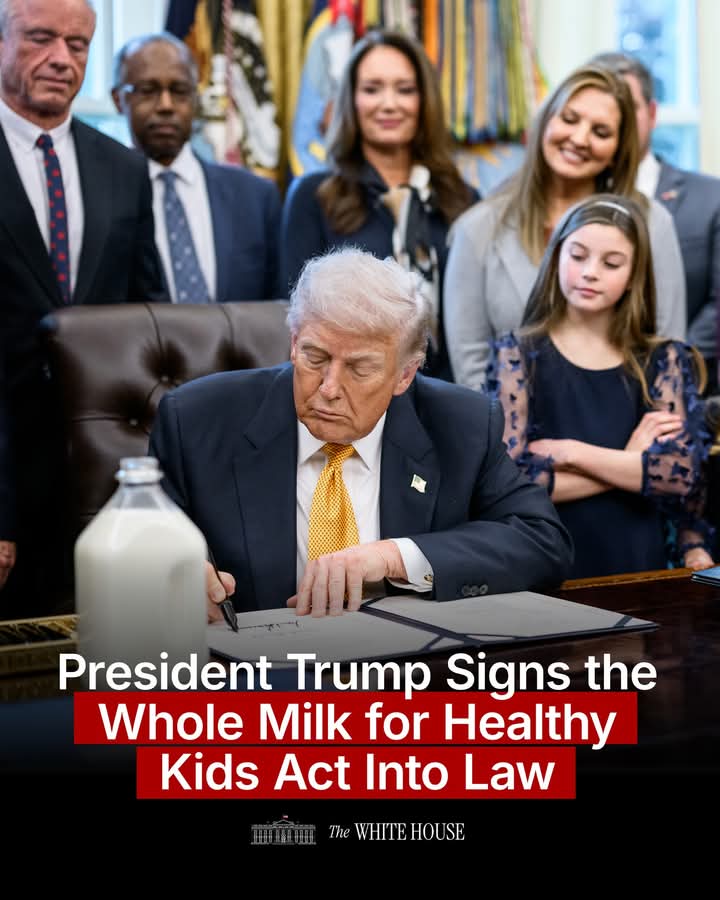
President Donald J. Trump has signed the Whole Milk for Healthy Kids Act into law, a move supporters say will expand nutrition options for millions of children across the United States by restoring access to whole and reduced-fat milk in school meal programs.
The legislation marks a notable shift in federal school nutrition policy, allowing schools greater flexibility in offering milk choices that include **whole and 2% milk, alongside existing low-fat and fat-free options.
Backers of the bill argue that the change reflects evolving nutritional science and responds to concerns about declining milk consumption among students.
A Push for Better Nutrition and Choice
Speaking after signing the bill, Trump framed the measure as part of a broader effort to improve child health outcomes and strengthen American agriculture.
“Kids deserve real nutrition, not one-size-fits-all rules,” Trump said.
“This law gives schools the freedom to serve high-quality milk that children actually want to drink.”
Supporters say whole milk provides essential nutrients such as calcium, vitamin D, protein, and healthy fats that are important for childhood growth and brain development.
They also argue that stricter fat limits introduced in previous years contributed to lower participation in school milk programs, leading some students to skip milk altogether.
Support From Farmers and Schools
Dairy farmers and agricultural groups welcomed the legislation, calling it a win for both students and rural economies.
They say increased milk consumption in schools could help stabilize the dairy industry while reinforcing the role of American-produced foods in federal nutrition programs.
School administrators have also expressed support, noting that the expanded options could reduce waste and improve student satisfaction.
“When kids actually drink the milk they’re served, everyone benefits,” said one school nutrition director.
“Choice matters.”
Critics Raise Health Questions
Not everyone supports the change.
Some public health advocates caution that whole milk contains higher levels of saturated fat and worry the policy could conflict with long-standing dietary guidelines aimed at reducing childhood obesity and heart disease risk.
Supporters of the law counter that overall diet quality matters more than isolated nutrients and argue that children who avoid milk entirely may miss out on critical vitamins and minerals.
Part of a Broader Health Message
The administration has promoted the law under the slogan “Make America Healthy Again,” framing it as a common-sense correction to overly rigid regulations.
Officials say the policy empowers parents, schools, and communities rather than mandating uniform standards from Washington.
What Happens Next
With the bill now law, the U.S. Department of Agriculture will move to update school meal guidelines, allowing schools to begin offering expanded milk options in accordance with the new rules.
As implementation rolls out nationwide, the impact will be closely watched by educators, health experts, and families alike.
Whether the policy leads to improved nutrition outcomes or renewed debate over dietary standards, one thing is clear: milk is back at the center of America’s school lunch conversation. 🥛🐄

FAIRNESS FIGHT: The International Olympic Committee announcing a groundbreaking change to protect female athletes and women’s sports as a whole — a ban on biological males competing in women’s events.

Breaking News: Trump Administration Moves to Add President’s Signature to U.S. Currency in Unprecedented Shift

Afternoon Update | America… right now… in the middle of this afternoon… while most of us are on lunch break… Karoline Leavitt just finished facing every camera and every difficult question in the world.click the link below

President Trump’s signature will be added to future U.S. paper currency, the Treasury Department announced Thursday

Breaking News: First $100 Bills Bearing Trump and Bessent Signatures Set for June Release click the link below

Just In : U.S. INTERCEPTED UKRAINE MESSAGES OF PLOT TO ROUTE MONEY TO BIDEN CAMPAIGN

Just In : Here’s the Average Social Security Benefit at Ages 62 to 80 — What You Can Expect at Every Stage

BREAKING: U.S President Donald Trump Has Just Been Confirmed… See More

Just In: “NO ONE UNDERSTOOD WHY Donald Trump PAUSED HIS SPEECH… UNTIL THE NEXT MORNING.”CLICK. THE LINK BELOW

REALITY CHECK IN WASHINGTON: A tense exchange has sparked fresh debate over the true cost—and purpose—of recent escalation.

Breaking News:Millions of Americans Receive Social Security Payments Today — Here’s Who Qualifies for March 25 Disbursement
