
NEWS
JUST IN: “IS IT FOR SALE”: Trump’s Unusual Pursuit of Greenland.

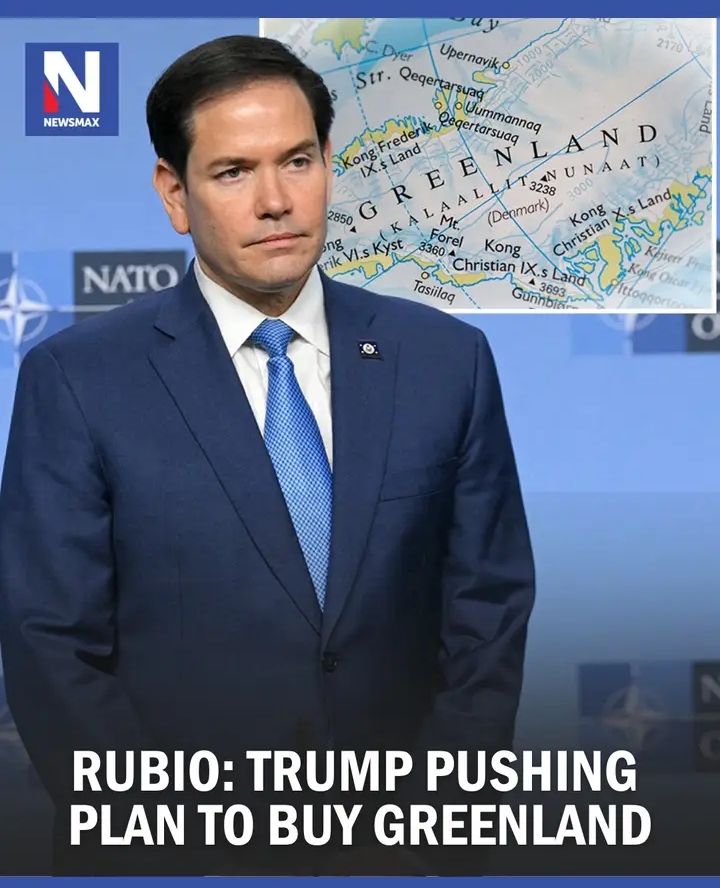
In a development rattling Western capitals, U.S. Secretary of State Marco Rubio told lawmakers this week that President Donald Trump aims to acquire Greenland — ideally through purchase rather than an invasion.
Rubio’s remarks came during a classified briefing on Capitol Hill, where he sought to reassure legislators that discussions about military action are not a signal of imminent force.
Instead, the administration’s preference, Rubio said, is to negotiate a deal to buy the vast Arctic territory from Denmark.
Rubio’s comments underscore a revived Trump-era ambition that first surfaced in 2019 and has persisted into his second term. While unconventional, the idea of buying the island — a self-governing part of the Kingdom of Denmark — reflects the administration’s broader geopolitical calculus in the Arctic.
Why Greenland? Strategic Stakes and Great Power Competition
Greenland is not just a frozen expanse of ice. It holds significant strategic and economic values:
Its geographic position offers control of Arctic sea routes and early warning radar coverage vital to U.S. defense.
It sits near Russia and China’s expanding Arctic interests, a key concern for U.S. policymakers.
Vast untapped mineral resources, including rare earths crucial for high-tech and defense industries, make it attractive to global powers.
Trump and his advisers argue that securing Greenland could help the U.S. deter rivals in the Arctic and protect Western interests.
Rubio has repeatedly framed the initiative as serving U.S. national security, not mere expansionism.
Purchase vs. Military Action: What’s on the Table.
While Rubio emphasized the preference for negotiation — namely a purchase or diplomatic arrangement — the broader administration has publicly stated that using military force remains “always an option.”
The White House, via press statements, reiterated that all tools available to the presidency are under consideration for achieving the goal of controlling Greenland.
This dual messaging — “we want to buy it” paired with “military force isn’t off the table” — has alarmed allies and lawmakers alike.
Backlash from Denmark, Greenland, and NATO Allies.
Almost immediately, Greenland’s leaders and Denmark’s government rejected the premise that the island is for sale. Danish Prime Minister Mette Frederiksen has warned that any attempt to annex or coerce Greenland would violate international norms and NATO commitments.
Greenland’s own government insists, unequivocally, that **“it is not for sale.”
European partners — including France, Britain, Germany, Italy, Spain, Canada, and others — have rallied in support of Denmark’s sovereignty, issuing joint statements underscoring that decisions over Greenland’s future are for the island’s people and Denmark, not the United States, to decide.
Even within the United States, lawmakers from both parties have expressed concern that threatening an ally could jeopardize NATO unity and undermine trust.
Legal and Practical Barriers to Any Transfer
Beyond political resistance, international law sharply limits the ability of one state to buy the territory of another without sovereign consent.
Greenland’s autonomous government and Denmark would have to agree to any sale — something they have repeatedly refused.
Moreover, the 1953 Greenland Self-Government Act gives Greenlander the right to choose independence.
This means that any large-scale change in status would likely require not just Danish approval, but Greenland consent through democratic processes.
Geopolitical Ripples and Future Prospects.
Trump’s push has broader implications:
U.S.–European Relations: The controversy could strain relations between Washington and NATO allies at a time when unity on global threats — from Russia to China — is considered crucial.
Arctic Diplomacy: Other Arctic nations are watching closely, as the region becomes a focal point of strategic competition.
Domestic U.S. Politics: Trump’s focus on territorial acquisition — especially when paired with energetic opposition from allies — is likely to fuel debate within the U.S. about national priorities and foreign policy strategy.
Conclusion: A Bold Idea Meets Political Reality
President Trump’s ambition to acquire Greenland — framed by Secretary Rubio as a purchase rather than a military conquest — reflects a dramatic blend of realpolitik and geopolitical posturing. While the U.S. administration portrays the initiative as driven by national security concerns, the firm opposition of Denmark, Greenland, and NATO partners suggests that any transfer of sovereignty is unlikely.
For now, the idea remains a striking example of how Arctic strategy is becoming a central terrain in 21st-century great power competition — even if Greenland itself continues to insist, plainly and persistently: “We are not for sale.”
If you’d like, I can also provide a brief summary with key points, or historical context on U.S.–Greenland relations.

GUEST OF HONOR: Erika Kirk will attend Tuesday night’s State of the Union as one of President Trump’s special guests, the White House confirmed.

HAPPENING NOW: president Donald Trump’ Enters House Chamber to Deliver Address to Congress

President Trump Welcomes U.S. Men’s Hockey Champions to the Oval Offic

For years I saw President Trump as a strong leader who got results—lower taxes, secure borders, America First policies that actually worked.

Trump Administration Confirms New Legislation Aimed at Putting More Money in Americans’ Pockets

Breaking News: Several States to Send Local Stimulus Checks on Wednesday, Feb. 25: What Payments Are Going Out and Who Qualifies

61% of Americans And 30% of Republicans Say Trump Is Losing It

Breaking News: Nation Prepares for President Trump’s State of the Union Address Tomorrow Night

President Donald J. Trump signs a proclamation declaring February 22, 2026, as National Angel Family Day.

Breaking News: $1,500,000,000 Cartel Network Exposed in Minneapolis — 3.25 Tons Seized, 2 Judges Arrested

FBI & ICE STORM Pennsylvania Judge’s Ranch — Secret Tunnel Found & 89 Missing Cases Linked
