
NEWS
Just In :Trump’s “51st State” Remark Ignites Firestorm: Is North America Entering a New Geopolitical Era? . Read the full story

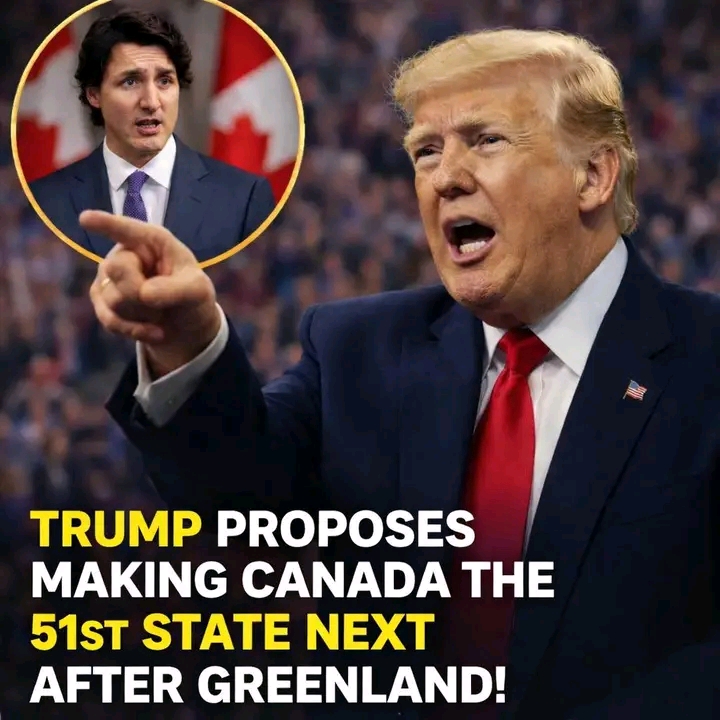
When Donald Trump revived talk of U.S. territorial expansion—this time floating the idea of Canada hypothetically becoming America’s “51st state”—it wasn’t just another headline-grabbing moment. It was a spark thrown into an already tense geopolitical landscape.
The comment, reminiscent of his past push to acquire Greenland, has reignited debate over how rhetoric at the highest levels shapes international relationships.
Supporters frame it as strategic bravado—a signal of strength in an era of global competition.
Critics see something more volatile: language that touches on sovereignty in a region defined by partnership and mutual respect.
A Relationship Too Big to Ignore
The bond between the United States and Canada is not symbolic—it’s structural.
The two nations share one of the most integrated economic and defense relationships in the world.
From joint military coordination under North American Aerospace Defense Command (NORAD) to alliance commitments through NATO, their cooperation is foundational to North American security.
Trade flows between the two countries total hundreds of billions annually.
Supply chains are intertwined. Energy grids are connected.
Families, businesses, and defense operations operate across the border with a level of coordination rarely seen elsewhere.
In that context, even hypothetical expansionist language carries weight.
The China Factor
Complicating matters further is Ottawa’s evolving relationship with China.
As Canada expands trade and investment ties with Beijing, policymakers in Washington are watching closely.
The U.S.-China rivalry has reshaped global politics, and alliances are increasingly viewed through the lens of strategic competition.
For some in Washington, deeper Canadian engagement with China raises concerns about influence and alignment.
For others, it reflects Canada’s independent foreign policy priorities in a multipolar world.
Rhetoric vs. Reality
Is talk of expansion a serious policy direction or political theater designed to energize a base and dominate headlines?
History suggests bold geopolitical statements often serve dual purposes: domestic messaging and international signaling.
Yet in an interconnected region like North America, the line between symbolism and strategy can blur quickly.
Diplomacy relies not only on treaties and trade deals but also on tone.
When sovereignty becomes part of campaign-season discourse, it can introduce friction even if no formal policy shift follows.
A Defining Moment for North America?
The broader question isn’t whether Canada will become the 51st state.
It won’t.
The real issue is how rhetoric shapes perception and how perception influences trust among allies navigating a rapidly changing world.
As global power dynamics shift and economic alliances evolve, North America stands at a crossroads.
The continent’s future will be shaped not only by trade agreements and defense pacts but also by the narratives leaders choose to amplify.
Whether this moment fades as political spectacle or signals deeper recalibration, one thing is clear: in today’s hyperconnected world, words travel fast—and they matter more than ever.

WAIT… Today I am forced by my own heart to tell you something about President Trump’s Because these two photos just broke something open inside me. And I cannot keep it to myself. Click the link below

Something unusual is happening across the U.S… and it’s getting harder to ignore.

Seattle Mayor ADMITS “I Have Zero Experience” As The City Collapses Into Total Chaos

Breaking News: White House Confirms Passing of Beloved Former President, Nation Mourns a Historic Legacy. Tap for the full details

Duty Calls Current Status of Barron Trump (March 2026):No Military Service: As of March 2026, Barron Trump has not enlisted in the U.S. Military.

Starbucks CEO Brian Niccol Responds to NEW YORK After Shutting Down 42 Locations in the City – “We Had No Choice!” Tap the link to read exactly what the CEO said to New York

Just In : Israel STRIKES BACK – over 800 IDF air sorties, 16,000 munitions, and 5,000 terror targets exposed.read the full details

Trump really didn’t expect that his move to strike Iran would end up impacting his own country

Well… the experts are saying it out loud now. On CNN this morning: Iran would win.

Just In: Trump Signs Sweeping Executive Order to Tighten U.S. Election Security. See what happens next

2 minutes ago! Iran’s newest nuclear missile was launched, see what happened!
