
NEWS
Just in:Iraq Likely Boosting Air Defenses

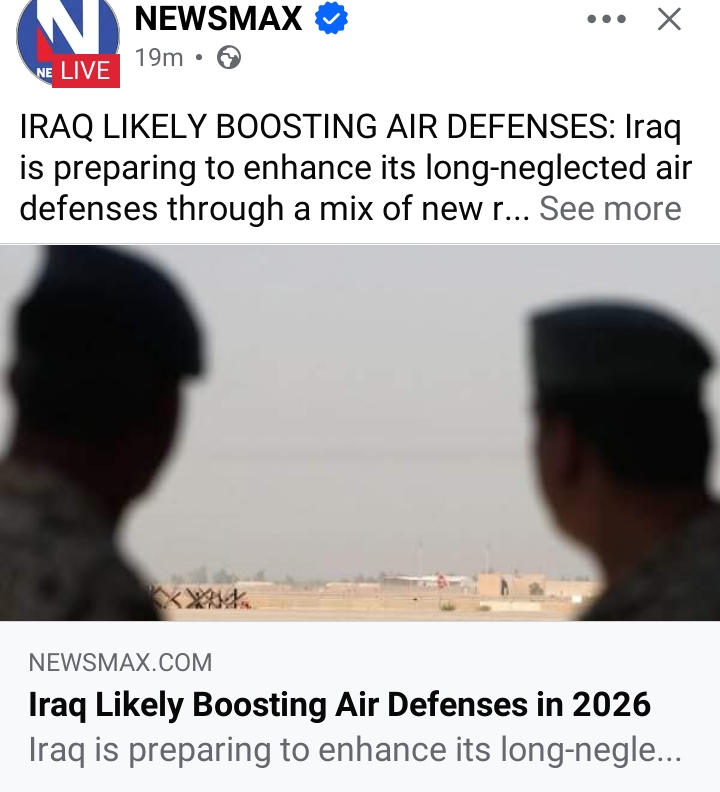
Just in:Iraq Likely Boosting Air Defenses
Iraq appears to be taking renewed steps to strengthen its long-neglected air defense capabilities, signaling a significant shift in its national security posture. After decades of conflict, sanctions, and reliance on foreign military support, Baghdad is now reportedly preparing to modernize its air defenses through a combination of new radar systems, surface-to-air missile platforms, and interceptor aircraft. This move reflects growing concerns over airspace sovereignty, regional instability, and the evolving nature of aerial threats.
### A Longstanding Capability Gap
Since the 2003 invasion and the subsequent dismantling of much of its military infrastructure, Iraq has struggled to maintain effective control over its airspace. For years, the country relied heavily on coalition forces—particularly the United States—for aerial surveillance, early warning, and air defense. While this arrangement provided short-term security, it left Iraq with limited independent capability to detect or respond to unauthorized incursions, drone activity, or missile threats.
The absence of a layered air defense system has been increasingly exposed in recent years. Repeated violations of Iraqi airspace by state and non-state actors, along with the growing use of unmanned aerial vehicles (UAVs) and precision-guided munitions across the region, have underscored the vulnerability of Iraq’s skies.
### Components of the Modernization Effort
Iraq’s reported plans focus on three core elements: radar coverage, surface-to-air missiles (SAMs), and interceptor aircraft.
**Radar systems** form the backbone of any air defense network. By expanding and modernizing radar coverage, Iraq would significantly improve its ability to monitor low- and high-altitude threats, including drones and cruise missiles. Enhanced radar capability would also reduce dependence on foreign intelligence-sharing arrangements.
**Surface-to-air missile systems** are expected to provide point and area defense for critical infrastructure such as government facilities, military bases, and energy assets. Even limited SAM deployments could act as a deterrent, raising the cost of airspace violations and improving Iraq’s ability to respond to hostile actions.
**Interceptor aircraft** would complement ground-based defenses by providing rapid-response options against intruding aircraft or UAVs. While Iraq already operates a modest air force, upgrades or acquisitions aimed at interception roles would help close gaps between detection and engagement.
### Strategic and Political Motivations
The push to enhance air defenses is driven by both security and political considerations. From a strategic perspective, Iraq sits at the crossroads of multiple regional rivalries. Conflicts involving neighboring states and armed groups have increasingly spilled into Iraqi territory, making airspace control a national priority.
Politically, improving air defenses aligns with Iraq’s broader goal of asserting sovereignty and reducing reliance on external powers. Successive Iraqi governments have emphasized the importance of rebuilding national institutions, including the armed forces, in a way that reflects independent decision-making while maintaining balanced relations with global and regional partners.
### Challenges Ahead
Despite the apparent momentum, Iraq faces significant challenges in implementing a comprehensive air defense upgrade. Financial constraints remain a key issue, particularly given competing domestic priorities such as economic development, public services, and post-conflict reconstruction.
Integration is another major hurdle. Air defense systems require trained personnel, secure command-and-control networks, and sustained maintenance. Without careful planning, new equipment risks becoming underutilized or ineffective. Additionally, Iraq must navigate complex diplomatic considerations when selecting suppliers, as defense purchases can carry geopolitical implications.
### Implications for Regional Security
If successfully implemented, Iraq’s air defense modernization could modestly alter the regional security landscape. While it is unlikely to rival the sophisticated systems fielded by major regional powers, even incremental improvements would enhance deterrence and reduce Iraq’s exposure to external pressure.
More broadly, the effort reflects a trend among Middle Eastern states to adapt to a security environment increasingly defined by drones, missiles, and asymmetric aerial threats. For Iraq, strengthening air defenses is not only about military capability—it is also a statement of intent to reclaim control over its skies and its future.
—
If you’d like, I can also:
* Shorten this for a newspaper column
* Rewrite it in a more academic or policy-brief style
* Adapt it for a student essay or magazine feature

GUEST OF HONOR: Erika Kirk will attend Tuesday night’s State of the Union as one of President Trump’s special guests, the White House confirmed.

HAPPENING NOW: president Donald Trump’ Enters House Chamber to Deliver Address to Congress

President Trump Welcomes U.S. Men’s Hockey Champions to the Oval Offic

For years I saw President Trump as a strong leader who got results—lower taxes, secure borders, America First policies that actually worked.

Trump Administration Confirms New Legislation Aimed at Putting More Money in Americans’ Pockets

Breaking News: Several States to Send Local Stimulus Checks on Wednesday, Feb. 25: What Payments Are Going Out and Who Qualifies

61% of Americans And 30% of Republicans Say Trump Is Losing It

Breaking News: Nation Prepares for President Trump’s State of the Union Address Tomorrow Night

President Donald J. Trump signs a proclamation declaring February 22, 2026, as National Angel Family Day.

Breaking News: $1,500,000,000 Cartel Network Exposed in Minneapolis — 3.25 Tons Seized, 2 Judges Arrested

FBI & ICE STORM Pennsylvania Judge’s Ranch — Secret Tunnel Found & 89 Missing Cases Linked
