
NEWS
Just in:Leavitt Defends Seizure Amid Concerns Over Sanctioned Oil Tanker.

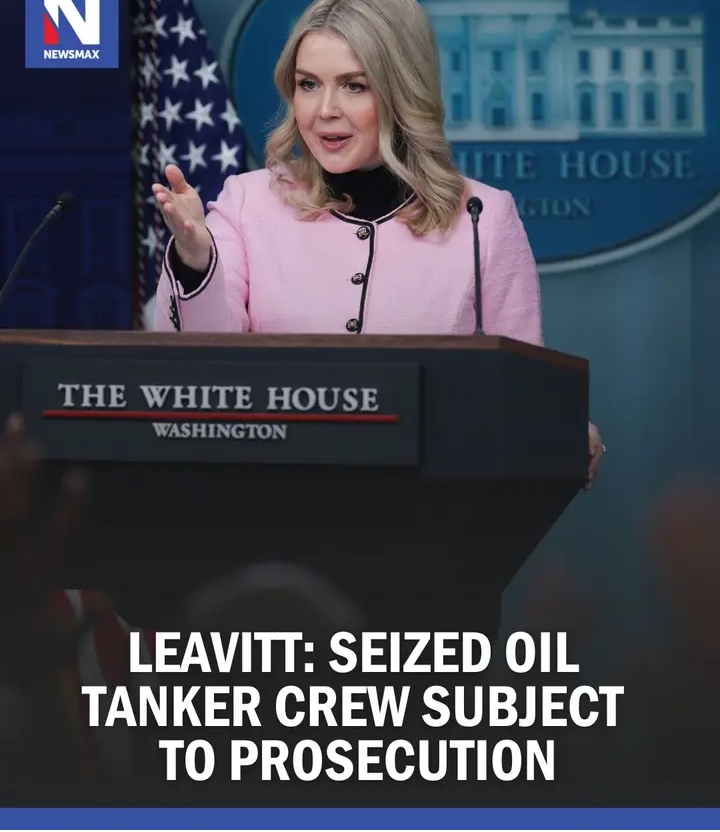
White House Press Secretary Karoline Leavitt on Monday defended the seizure of the oil tanker Bella I, shifting the focus away from reports that a Russian submarine had been tracking the vessel and instead emphasizing its alleged role in sanctions evasion.
During a press briefing, Leavitt was asked to address media reports suggesting that a Russian submarine had followed the Bella I while it was operating in international waters.
Rather than confirming or denying those reports, she redirected attention to the tanker’s ownership and activities, describing the vessel as part of a so-called “Venezuelan shadow fleet.”
According to Leavitt, the Bella I was operating under U.S. sanctions imposed on Venezuela’s oil sector.
She stated that such vessels are frequently used to transport oil in ways designed to evade international restrictions, often through opaque ownership structures, falsified documentation, or disabled tracking systems.
These practices, she argued, undermine the effectiveness of sanctions intended to pressure sanctioned governments to change behavior.
“The tanker was not an innocent commercial vessel,” Leavitt said, stressing that enforcement actions were taken in line with U.S. law and international norms.
She added that members of the crew could face prosecution if investigations confirm violations of sanctions or other maritime regulations.
The comments come amid heightened scrutiny of “shadow fleets,” a term used by U.S. and European officials to describe networks of aging tankers that operate outside standard regulatory frameworks.
Such fleets have been linked not only to Venezuela, but also to sanctioned oil exports from countries like Iran and Russia. Western governments argue that these operations pose environmental risks, weaken maritime safety standards, and facilitate illicit trade.
Leavitt’s remarks also reflect broader geopolitical tensions, particularly as reports of Russian naval activity near commercial shipping have raised concerns among U.S. allies.
By pivoting away from the submarine issue, the White House appeared intent on keeping the focus on sanctions enforcement rather than potential military escalation.
The administration has repeatedly stated that it will continue to aggressively enforce sanctions on illicit oil trading networks.
Leavitt reiterated that position, saying the seizure of the Bella I was part of a wider effort to uphold international law and prevent sanctioned regimes from profiting through covert maritime operations.
As investigations continue, the case underscores the complex intersection of energy security, sanctions policy, and great-power competition playing out on the world’s oceans.

JUST IN: Donald Trump said Iran has formally agreed they will never have a Nuclear Weapon.

Trump is defunding the TSA until Congress restricts vote by mail.

NEWS POLL: President Trump’s approval rating dipped to 41% in March, and 59% of registered voters now disapprove of him — the highest disapproval of either of his terms.

Speaker Mike Johnson has the right idea. While hardworking Americans endure endless TSA lines stretching through airport terminals, the vote tally poster should be enlarged and displayed prominently in every single one.

Breaking News: Senator Cory Booker just let the truth slip out. While railing against the SAVE America Act, he warned that requiring proof of U.S. citizenship for federal voter registration would shrink the voter rolls by 5 to 10 percent.

Just In : Trump HUMILIATED as Security Guards DRAG Him Out of Mueller Funeral Live On Camera. see what happens next

Breaking News: Trump Drops Hammer on Iran: 15 Non-Negotiable Demands to End the Middle East Mess see the full details

Breaking News: Fox News Reports Update Involving Former President Joe Biden

BREAKING: Trump Reportedly Fell While Boarding Air Force One as Doctor Allegedly Hints at a Hidden Diagnosis “HE HAS FALLEN AGAIN!”click here to see what happens next

Breaking News: EXPLOSIVE: Trump Goes BALLISTIC After Pope Leo XIV Exposes His 1970 Wharton IQ Test LIVE — “Genius?” Trump Fires Back! Click here

Just In : Florida is taking a firm stand to protect our American way of life. House Bill 1471, now heading to Governor Ron DeSantis for signature, explicitly bans Sharia law and any foreign or religious legal codes from overriding our courts and Constitution.
