
NEWS
Rising Tensions: Rubio and Netanyahu Discuss Possible U.S. Military Action as Iran Protests Intensify.

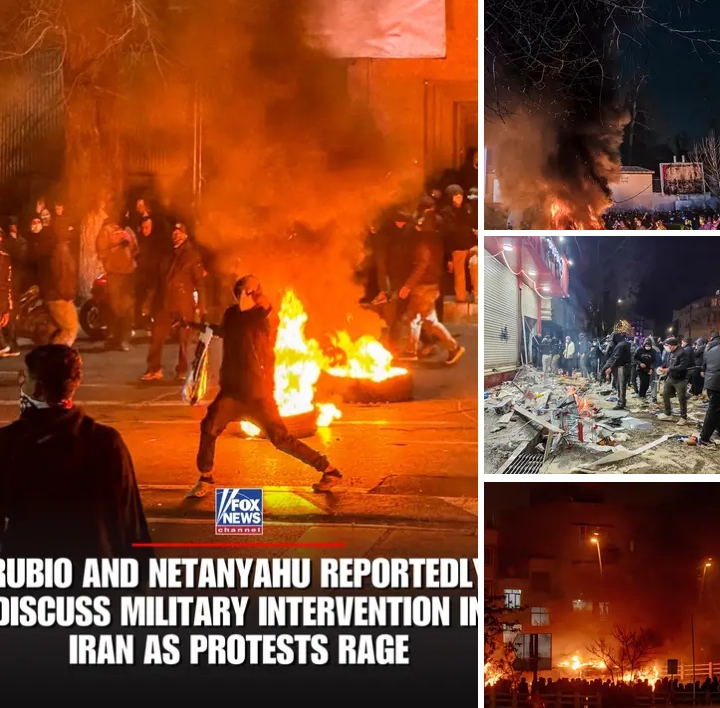
Geopolitical tensions in the Middle East are escalating amid reports that U.S. Secretary of State Marco Rubio and Israeli Prime Minister Benjamin Netanyahu have held discussions regarding the possibility of American military intervention in Iran.
The reported talks come as anti-regime protests inside Iran enter their second week, signaling one of the most sustained waves of public unrest the country has seen in recent years.
According to sources familiar with the matter, the conversation centered on Iran’s internal instability and the broader regional implications should the protests continue to grow.
Demonstrations have reportedly spread across multiple cities, fueled by long-standing grievances over economic hardship, political repression, and limits on personal freedoms.
Despite efforts by Iranian authorities to contain the unrest, videos and eyewitness accounts suggest that public anger remains strong.
For Israel, Iran’s internal turmoil is closely tied to national security concerns.
Tehran’s nuclear ambitions, support for proxy groups across the region, and repeated threats against Israel have long made Iran a central focus of Israeli strategic planning.
Prime Minister Netanyahu has consistently warned that a weakened but unpredictable Iranian regime could either accelerate its nuclear program or lash out beyond its borders to reassert control.
Secretary of State Rubio, known for his hawkish stance on Iran, has previously argued that the United States must maintain credible military options alongside diplomatic and economic pressure.
In the reported discussion, the focus was not only on Iran’s domestic situation but also on potential scenarios that could emerge if the regime responds to protests with increased violence or external aggression.
While no official announcement has been made regarding imminent military action, the mere fact that such options are reportedly being discussed underscores the seriousness with which Washington and Jerusalem are viewing current developments.
U.S. officials have publicly stated that they support the Iranian people’s right to peaceful protest, while simultaneously warning Tehran against further repression.
Analysts caution that military intervention would carry enormous risks.
Iran possesses significant defensive capabilities and influence through allied militias across the Middle East, raising the prospect of a wider regional conflict.
Others argue that heightened pressure—military or otherwise—could further destabilize the regime at a moment when it is already facing unprecedented internal dissent.
The White House has so far emphasized restraint, signaling that diplomacy and international coordination remain preferred tools.
However, the ongoing protests and the reported high-level discussions suggest that contingency planning is underway should the situation deteriorate rapidly.
As anti-regime demonstrations continue and global attention remains fixed on Tehran, the coming days may prove decisive.
Whether Iran’s leadership chooses reform, repression, or confrontation could shape not only the country’s future but also the balance of power across the Middle East.

JUST BREAKING: Some Retirees to Receive Over $5,000 Monthly in Social Security by 2026 — Eligibility Criteria Revealed

¡Esta es la extraordinaria valentía de Irán 🇮🇷! 🔥 9:00 am: “Toda una civilización terminará esta noche”, dijo Trump. 9:10 a. m.: La gente común de Irán ha formado una cadena humana en el puente blanco. 🔥🔥 Si no tienen miedo a morir, no pueden ser derrotados. ¡Qué coraje increíble! 🔥

Pro-Iranian accounts on Twitter are flooding the platform tonight with AI-generated videos mocking Trump, including one showing him stepping off Air Force One waving a white flag after announcing a ceasefire deal critics say was so bad he appeared to negotiate with himself.

A major political shockwave just hit Washington as 24 members of Congress declare an EMERGENCY and demand the UNPRECEDENTED removal of President Trump from office.

BREAKING: Trump’s Shocking Revelation Sparks Viral Frenzy and Raises Questions About His Political Future

Is “getting the job done” more important than having a “nice” president?

Just In :Trump Sends Clear Message to Iran as B-52 Bombers Lift Off from UK Bases. See what happens next

Breaking News:Trump Suspends Planned U.S. Strikes on Iran for Two Weeks Amid Diplomatic Push. Full details here
Today I witnessed something because of Trump that I will never forget for the rest of my life. And that is exactly why I want to show you Trump’s real face today. Click here for full details

At a Monday press conference, Trump brought up past comments by North Korea’s Kim Jong Un about Joe Biden while discussing US troop deployment in South Korea.

Breaking Claim Sparks Concern: Viral Report Alleges Attack on U.S. Warships Near Strait of Hormuz. See what happens next
