
NEWS
The United States and Venezuela are two of the most significant players in the global oil industry, yet their circumstances are strikingly different.

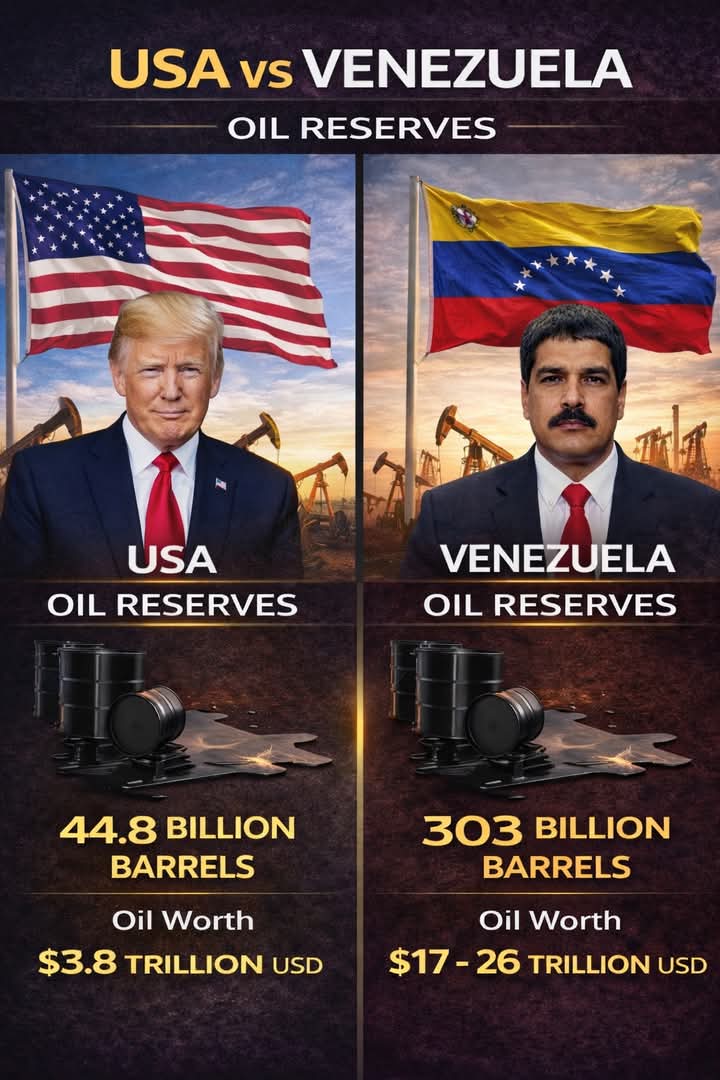
The United States holds approximately 44.8 billion barrels of proven oil reserves, including both commercial stocks and government strategic reserves.
At current market prices, these reserves are worth around $3.8 trillion USD, highlighting the immense economic and strategic importance of U.S. energy resources.
These reserves also provide the United States with a significant cushion against global energy disruptions, allowing it to manage supply and stabilize prices during crises.
Venezuela, by contrast, possesses the largest proven oil reserves in the world, estimated at 303 billion barrels, nearly seven times more than the United States.
These reserves, primarily concentrated in the Orinoco Belt, are mostly heavy crude, which is more challenging and expensive to refine. Despite this, the potential value of Venezuela’s oil ranges between $17 trillion and $26 trillion USD, depending on global prices.
This underscores the enormous theoretical wealth Venezuela could derive from its resources.
However, decades of economic mismanagement, political instability, underinvestment, and international sanctions have severely limited the country’s oil production, meaning that it has been unable to fully capitalize on this massive resource.
Recent developments have heightened tensions between the United States and Venezuela.
In early 2026, the U.S. conducted a military operation that resulted in the capture of President Nicolás Maduro, citing concerns over security and alleged illicit activities.
This unprecedented move sparked a geopolitical crisis, with Venezuela denouncing it as an illegal violation of sovereignty and mobilizing military forces in response.
In parallel, the United States has taken steps to exert influence over Venezuelan oil infrastructure, including actions that restrict certain oil shipments and apply economic pressure, further escalating the standoff.
These events illustrate how oil reserves are not just economic assets but also tools of geopolitical leverage.
The United States relies on its reserves for energy security and international influence, while Venezuela’s enormous but underutilized oil resources have made it both a target and a participant in global strategic calculations.
The ongoing tensions reflect a broader struggle over control of energy resources, sovereignty, and regional power dynamics.
The situation also underscores the fragility of energy-dependent economies and the complex interplay between natural resources and international politics.
While the United States enjoys relative stability and effective resource management, Venezuela’s potential remains constrained by internal and external challenges.
The value of oil in both nations demonstrates how the commodity continues to shape global politics and economic strategies, making energy a central focus of international relations.

JUST BREAKING: Some Retirees to Receive Over $5,000 Monthly in Social Security by 2026 — Eligibility Criteria Revealed

¡Esta es la extraordinaria valentía de Irán 🇮🇷! 🔥 9:00 am: “Toda una civilización terminará esta noche”, dijo Trump. 9:10 a. m.: La gente común de Irán ha formado una cadena humana en el puente blanco. 🔥🔥 Si no tienen miedo a morir, no pueden ser derrotados. ¡Qué coraje increíble! 🔥

Pro-Iranian accounts on Twitter are flooding the platform tonight with AI-generated videos mocking Trump, including one showing him stepping off Air Force One waving a white flag after announcing a ceasefire deal critics say was so bad he appeared to negotiate with himself.

A major political shockwave just hit Washington as 24 members of Congress declare an EMERGENCY and demand the UNPRECEDENTED removal of President Trump from office.

BREAKING: Trump’s Shocking Revelation Sparks Viral Frenzy and Raises Questions About His Political Future

Is “getting the job done” more important than having a “nice” president?

Just In :Trump Sends Clear Message to Iran as B-52 Bombers Lift Off from UK Bases. See what happens next

Breaking News:Trump Suspends Planned U.S. Strikes on Iran for Two Weeks Amid Diplomatic Push. Full details here
Today I witnessed something because of Trump that I will never forget for the rest of my life. And that is exactly why I want to show you Trump’s real face today. Click here for full details

At a Monday press conference, Trump brought up past comments by North Korea’s Kim Jong Un about Joe Biden while discussing US troop deployment in South Korea.

Breaking Claim Sparks Concern: Viral Report Alleges Attack on U.S. Warships Near Strait of Hormuz. See what happens next
