
NEWS
Will Donald Trump’s Presidency Be Remembered as Once-in-a-Generation?

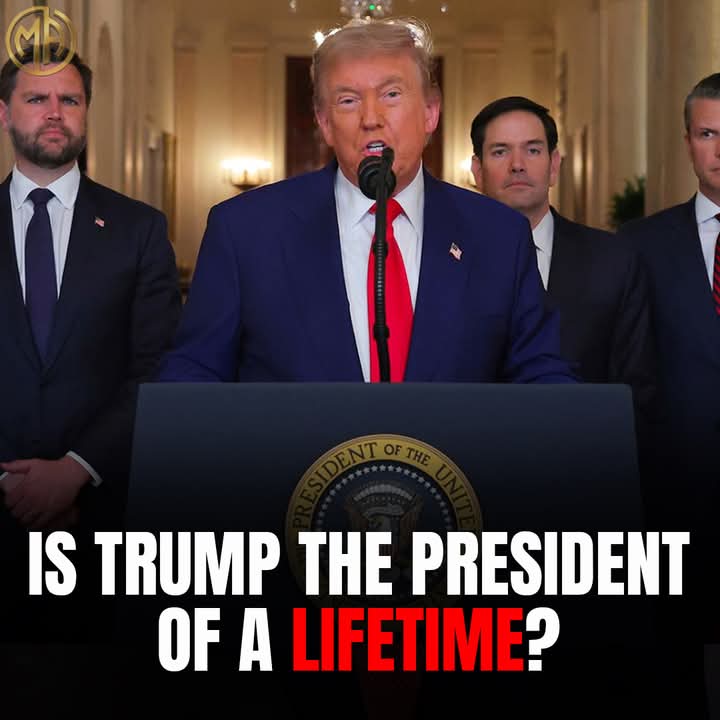
Standing at a podium flanked by aides, Donald Trump projects the unmistakable image of executive authority.
The scene is familiar: the seal, the microphones, the disciplined choreography of power.
Yet the question posed by the image lingers far beyond the moment—will his presidency ultimately be remembered as once-in-a-generation?
Few modern leaders have reshaped the American political landscape as dramatically.
Trump’s rise to the White House disrupted long-standing political norms, redefining campaign strategy, media engagement, and voter mobilization.
His 2016 victory challenged conventional assumptions about electability and coalition-building, signaling a populist surge that continues to reverberate through both major parties.
Throughout his tenure, Trump pursued an “America First” agenda, focusing on tax reform, deregulation, conservative judicial appointments, and a recalibration of international trade relationships.
Supporters argue that these policies strengthened the domestic economy, reshaped the federal judiciary for decades, and reasserted national sovereignty on the global stage.
His appointments to the Supreme Court alone ensure a long-lasting imprint on American jurisprudence.
Critics, however, contend that his leadership style deepened political polarization and strained democratic norms.
From contentious media battles to two impeachment proceedings, Trump’s presidency unfolded in a climate of near-constant controversy.
The events surrounding the 2020 election and its aftermath further intensified debates about institutional resilience and the boundaries of executive influence.
Yet history rarely renders immediate verdicts.
The legacies of presidents often evolve as new contexts emerge.
Just as assessments of past leaders have shifted with time, Trump’s place in history will likely be shaped not only by the policies he enacted but also by the political movement he galvanized.
His influence within the Republican Party remains potent, and his approach to governance continues to inform broader national debates on immigration, trade, national identity, and the scope of federal power.
The image of Trump at the podium captures more than a single speech—it symbolizes a presidency that challenged conventions and commanded attention.
Whether viewed as transformative or tumultuous, his time in office undeniably altered the trajectory of American politics.
In the end, the question is less about whether his presidency was consequential and more about how that consequence will be measured.
Was it a singular disruption, or the beginning of a lasting realignment? The answer will be written not only by historians, but by the generations who live with its outcomes.

BREAKING:UK Grants U.S. Limited Access to Bases for Hormuz Operations Amid Rising Energy Crisis. Click the link for full detail.

BREAKING:Immigration, Power, and Pressure: Trump’s Airport Enforcement Threat Raises New Questions.

BREAKING:Viral Claim of U.S. Aircraft Carrier Downing Sparks Alarm — But Evidence Remains Unverified.

SHOCKING:Trump Issues 48-Hour Ultimatum to Iran, Threatens Strikes on Power Plants Over Hormuz Crisis.

BREAKING:U.S. Admiral’s Early Exit Sparks Controversy Over Deadly Caribbean Military Strikes.

BREAKING:Israel Confirms Killing of Iran’s Intelligence Minister Esmaeil Khatib in Targeted Airstrikes.

Breaking News: POLITICAL EARTHQUAKE: 47 REPUBLICANS BREAK RANKS AS TRUMP IMPEACHMENT SURGES TO 212 VOTES

Update: Simulation Chaos: Viral ARMA 3 Scenario Falsely Claims Destruction of U.S. Warships in Strait of Hormuz

Breaking News: Trump Breaks Down in Tears, Urges World to Stop Iran’s Attacks March 20, 2026

NEWSJust In: 2 Mins Ago! Sign from GOD? Biggest Tragedy JUST Happened in The USA! The World is Shocked and Scared Read the full story here:

Just In: 2 Mins! End Is Near? Biggest Tragedy JUST Happened in the USA! The Whole World is Shocked and Scared It happened fast—too fast for anyone to fully process,FULL DETAILS ABOUT BIGGEST TRAGEDY IN THE LINK BELOW
