
NEWS
What It Would Mean If the United Nations Suspended the United States Under Article 5

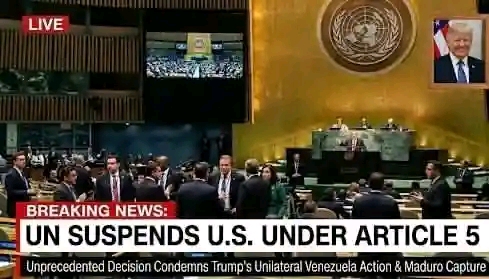
What It Would Mean If the United Nations Suspended the United States Under Article 5
This article is a speculative analysis, exploring the implications of a hypothetical and unprecedented international event.
If the United Nations were to suspend the United States under Article 5 following condemnation of a unilateral military intervention in Venezuela and the capture of President Nicolás Maduro, the decision would mark a seismic shift in the global political order.
Such an action—unthinkable under existing international norms—would fundamentally alter how power, sovereignty, and accountability are understood in the international system.
An Unprecedented Break with History
The United States has long been one of the principal architects, funders, and enforcers of the post–World War II international order.
A UN suspension of the U.S. would therefore represent not merely a disciplinary measure against a member state, but a symbolic rupture with decades of institutional precedent.
It would suggest that no nation, regardless of its power or historical role, is beyond formal censure when perceived to have violated international law.
In practical terms, such a suspension would challenge the assumption that the UN operates primarily within the constraints imposed by its most powerful members.
It would signal a dramatic reassertion of multilateral authority over unilateral action.
Redefining Sovereignty and Intervention
At the heart of this hypothetical crisis lies the issue of unilateral military intervention.
If the UN condemned a U.S. action in Venezuela as unlawful—and went so far as to suspend the country—it would strengthen the principle that regime change imposed by force is incompatible with international law, even when justified under claims of humanitarian necessity or national security.
This would set a powerful precedent.
States might become far more cautious about intervening militarily without explicit international authorization, knowing that consequences could extend beyond diplomatic criticism to formal institutional penalties.
Global Power Dynamics in Flux.
The suspension of the United States would inevitably accelerate shifts already underway in global power structures.
Rival powers and emerging blocs could view the decision as evidence of a weakening U.S.-led order and an opportunity to advocate for alternative models of governance and security.
At the same time, allies of the United States would face difficult choices.
Some might distance themselves to preserve their own standing within international institutions, while others could challenge the legitimacy of the UN’s action, potentially leading to fragmentation within global alliances.
Domestic Consequences for the United States.
Internally, such a decision would likely spark intense political debate.
Supporters of the intervention might frame the UN’s move as an overreach or an attack on national sovereignty, while critics would point to it as proof of the costs of unilateral foreign policy decisions.
The suspension could also fuel broader discussions about America’s role in the world: whether it should continue to act as a global enforcer, or recalibrate toward deeper cooperation and restraint within multilateral frameworks.
The Future of the United Nations Itself.
Ironically, the UN would also be placing itself under scrutiny.
Suspending one of its most powerful members would raise questions about enforcement, legitimacy, and long-term viability.
Could the organization withstand potential funding cuts, political backlash, or disengagement by major powers? Or would such bold action ultimately strengthen its credibility as a guardian of international law?
Conclusion
In this speculative scenario, a UN suspension of the United States would represent far more than a response to a single military action.
It would redefine the boundaries of power, test the resilience of global institutions, and force a reckoning with the principles that underpin the international system.
Whether such a moment would lead to a more lawful and cooperative world—or a more divided and unstable one—would depend entirely on how nations chose to respond to a world where even the most powerful are no longer untouchable.

Just In : Jimmy Kimmel Deeply Offended and Demands Apology After Aaron Rodgers Jokes He’s on the Epstein List

Breàking News: In Honor of the King and Queen of the United Kingdom, who have just left the White House, soon headed back to their wonderful Country, I will be removing full details here!!

Just In : A FATHER. HIS CHILDREN. AND A MOMENT THAT DARED TO INTERRUPT THE SPOTLIGHT. The tension rose without

Just In : KEVIN HASSETT: IRAN’S ECONOMY IS “COMPLETELY ON THE ROPES” WITH HYPERINFLATION AND FOOD SHORTAGES AS TRUMP’S PRESSURE MOUNTS

Just In : Maxine Waters: “President of the United States is a killer. Full details here!!

Breaking News: “Total Shutdown: May 1 Protest Movement Urges Americans to Boycott Work, Spending, and Social Media”

Breaking News: Oprah Winfrey on George Floyd: “His family and friends say he was a gentle giant. His death has now shown us he had a giant soul. Read more

Just In: A Bond Forged Through Centuries: The King’s Powerful Tribute to a ‘Truly Unique’ Alliance in U.S. Congress”. Full details

Kathy Griffin: “I do not think that Donald won in a free and fair election. Something about it doesn’t smell right.” Full details here!!

Breaking News: Molly Ringwald Sparks Backlash with Controversial Remark About Trump Supporters. See what happens next

Just In : CNN Just ADMITTED Democrats Could LOSE California — For the First Time in 16 YEARS. Hit the link below
