
NEWS
BREAKING NEWS:Muslim-Majority Powers Join Trump-Led “Board of Peace,” Signaling a New Power Shift in Global Diplomacy. Full story below.

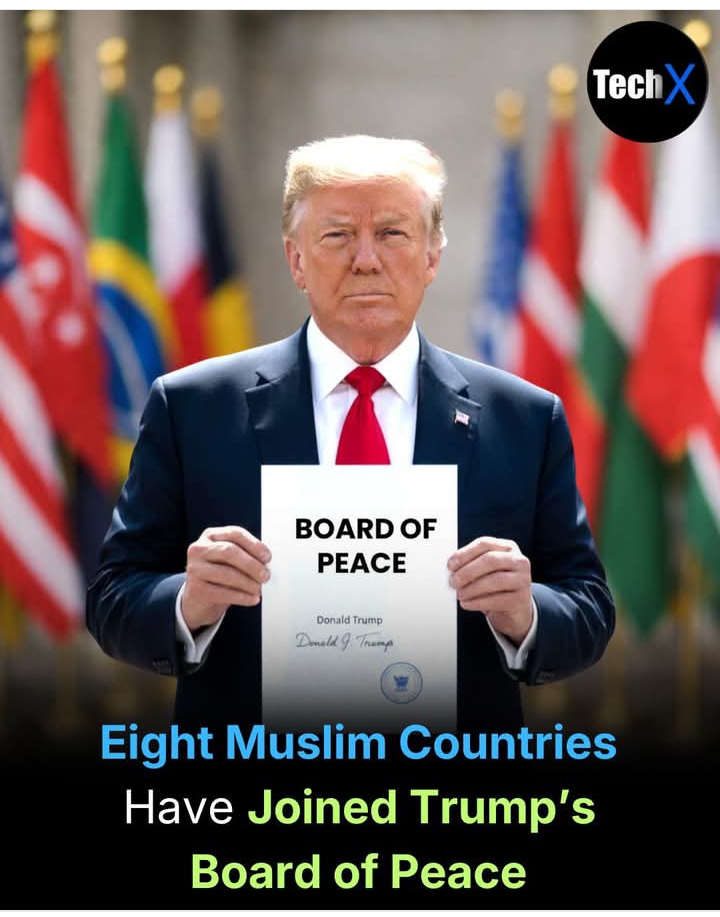
In a move that could reshape international conflict management, eight major Muslim-majority nations—Saudi Arabia, Turkey, Egypt, Jordan, Indonesia, Pakistan, Qatar, and the United Arab Emirates—have agreed to participate in former U.S. President Donald Trump’s newly established “Board of Peace.”
The decision marks a notable shift in diplomatic alignment and reflects growing experimentation with alternative frameworks for global governance.
Formed under a United Nations mandate, the Board of Peace is tasked with overseeing the administration of Gaza through 2027, a role traditionally reserved for UN agencies or multilateral coalitions.
Beyond Gaza, the council is also being positioned as a broader platform for mediating and resolving international conflicts, particularly in regions where existing mechanisms have struggled to deliver lasting stability.
One of the most striking features of the initiative is its leadership structure.
Donald Trump has been named chair for life, a departure from the rotational or consensus-based leadership models that define most international bodies.
Permanent membership also comes with a steep financial commitment: a reported $1 billion entry fee, intended to fund reconstruction, security coordination, and diplomatic operations.
Supporters of the initiative argue that the board represents a pragmatic response to years of diplomatic gridlock.
By bringing together influential regional actors with financial and political leverage, proponents say the council could act faster and more decisively than traditional UN structures, particularly in crisis zones like Gaza.
However, the initiative has not been universally welcomed.
Several countries, including Slovenia, have declined to join, warning that the Board of Peace could undermine the authority of existing UN institutions and set a precedent for parallel power structures that dilute international consensus.
Critics also question the long-term implications of a lifetime chairmanship and the exclusivity created by high financial barriers to entry.
Despite the controversy, the participation of key Middle Eastern and Muslim-majority nations underscores a broader trend: a growing willingness among states to explore independent or hybrid frameworks for stability outside long-established multilateral systems.
Whether the Board of Peace will complement or compete with existing institutions remains to be seen, but its formation already signals a potential recalibration of power and influence in global diplomacy.
As the Gaza mandate unfolds and the board’s wider ambitions take shape, the world will be watching closely to see whether this unconventional experiment can deliver tangible results—or further complicate an already fragile international order.

HIS HAND WAS TREMBLING” — THE MOMENT Donald Trump AND Melania Trump FROZE 80,000 PEOPLE IN SILENCE

BREAKING:“The President Who Never Sleeps?” Pilot’s 30-Year Claim Reveals a Different Side of Donald Trump.

Just In: The betrayal cuts deep—watching career Democrats like Pelosi whisper with their next generation while America burns.

AOC warned the South that “the North” is about to pull up.

When Donald Trump was five years old, his father Fred would wake him at dawn on Saturdays, hand him a paper bag with a bologna sandwich, and drive him to a construction site in Brooklyn. Full story

Faith Is Our Foundation”: JD Vance Calls for National Renewal Through Prayer at ‘Rededicate 250’ Event.

SPEAKER JOHNSON DEFENDS ‘IN GOD WE TRUST’ AND NATIONAL REDEDICATION AGAINST SEPARATION CRITICS

BREAKING: Lindsey Graham Warns Republicans — Opposing Donald Trump Could End Political Careers

Just In : Gates made the comments during an interview regarding his book How to Avoid a Climate Disaster.

Just In : Trump and Netanyahu Hold Urgent 30-Minute Call as Intel Warns Iran May Be Buying Time for War. See what happens next

BREAKING NEWS:Trump Issues Stark New Warning to Iran as Regional Tensions Escalate.
