
NEWS
BREAKING:Trump Draws a Red Line on Iraq: Strategic Leverage or Risky вмешательство?

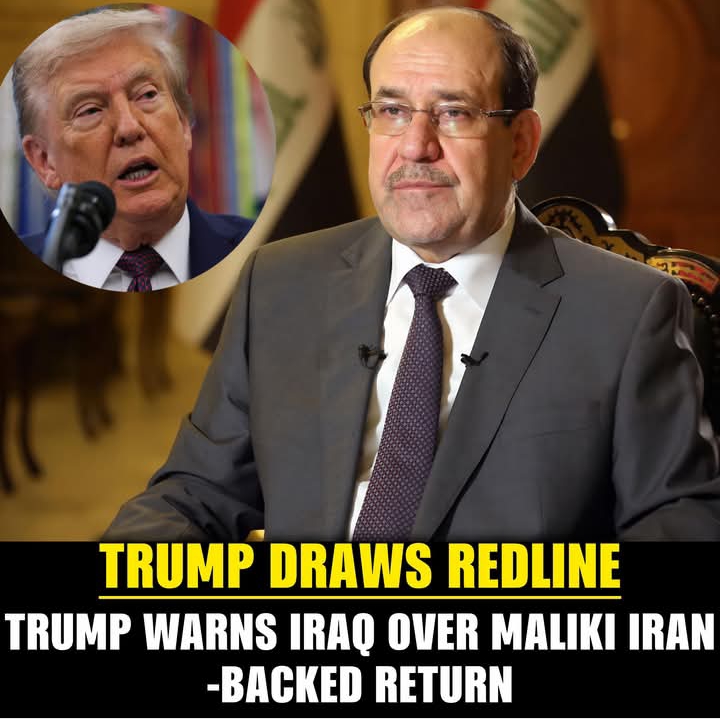
U.S. President Donald Trump has signaled a hardening stance toward Iraq’s political future, warning that American assistance could be curtailed if former Prime Minister Nouri al-Maliki returns to power with the backing of Iran-aligned factions.
The message underscores Washington’s growing concern about Tehran’s influence in Baghdad—and raises a familiar question in Middle Eastern geopolitics: where does strategic pressure end and destabilizing interference begin?
Trump’s warning comes amid shifting alliances and renewed jockeying for power within Iraq’s fragmented political system.
Al-Maliki, who served as prime minister from 2006 to 2014, remains a polarizing figure.
Supporters credit him with steering the country through a period of intense sectarian violence; critics argue his tenure centralized power, marginalized rivals, and contributed to conditions that enabled the rise of ISIS.
His perceived closeness to Iran has long troubled U.S. policymakers.
From Washington’s perspective, leverage matters.
The United States provides Iraq with military assistance, intelligence cooperation, and economic support aimed at counterterrorism and state stabilization.
By signaling that this support is not unconditional, the Trump administration is attempting to shape outcomes without deploying troops or escalating militarily.
Advocates of this approach argue it is a pragmatic tool: incentives and disincentives can deter the consolidation of power by actors aligned with Iran, preserve Iraq’s sovereignty from external domination, and protect U.S. interests in regional stability.
Critics, however, see risks. Conditioning aid on political outcomes can inflame nationalist sentiment, weaken reformist actors caught between rival powers, and inadvertently push Baghdad closer to Tehran.
Iraq’s political ecosystem is complex, with coalitions spanning sectarian and ideological lines; external pressure may harden positions rather than encourage compromise.
There is also the question of precedent—whether overt signals from Washington undermine Iraq’s democratic processes by appearing to favor or veto particular leaders.
Regionally, the stakes are high. Iraq sits at the crossroads of U.S.-Iran competition, Gulf security concerns, and ongoing counterterrorism efforts.
A sharp reduction in U.S. assistance could affect Iraq’s ability to secure its borders, manage militias, and sustain economic recovery.
Conversely, continued unconditional support could be interpreted as acquiescence to deeper Iranian influence, unsettling U.S. allies and recalibrating regional balances.
Ultimately, Trump’s warning reflects a broader strategy of using economic and political leverage to shape outcomes without direct intervention.
Whether this approach promotes stability or backfires depends on execution: clarity of conditions, coordination with allies, respect for Iraqi institutions, and an off-ramp that rewards inclusive governance rather than punishes it.
As Iraq navigates its next political chapter, the debate remains open.
Is this firm diplomacy a necessary guardrail against external domination—or a gamble that risks unintended consequences in a fragile state?
The answer will hinge not on rhetoric, but on facts on the ground and the choices made in Baghdad as much as in Washington.

HIS HAND WAS TREMBLING” — THE MOMENT Donald Trump AND Melania Trump FROZE 80,000 PEOPLE IN SILENCE

BREAKING:“The President Who Never Sleeps?” Pilot’s 30-Year Claim Reveals a Different Side of Donald Trump.

Just In: The betrayal cuts deep—watching career Democrats like Pelosi whisper with their next generation while America burns.

AOC warned the South that “the North” is about to pull up.

When Donald Trump was five years old, his father Fred would wake him at dawn on Saturdays, hand him a paper bag with a bologna sandwich, and drive him to a construction site in Brooklyn. Full story

Faith Is Our Foundation”: JD Vance Calls for National Renewal Through Prayer at ‘Rededicate 250’ Event.

SPEAKER JOHNSON DEFENDS ‘IN GOD WE TRUST’ AND NATIONAL REDEDICATION AGAINST SEPARATION CRITICS

BREAKING: Lindsey Graham Warns Republicans — Opposing Donald Trump Could End Political Careers

Just In : Gates made the comments during an interview regarding his book How to Avoid a Climate Disaster.

Just In : Trump and Netanyahu Hold Urgent 30-Minute Call as Intel Warns Iran May Be Buying Time for War. See what happens next

BREAKING NEWS:Trump Issues Stark New Warning to Iran as Regional Tensions Escalate.
