
NEWS
Breaking News: Nuclear War Fears Rise Worldwide as U.S.–Israel Strikes on Iran Escalate; North Korea Condemns Attack

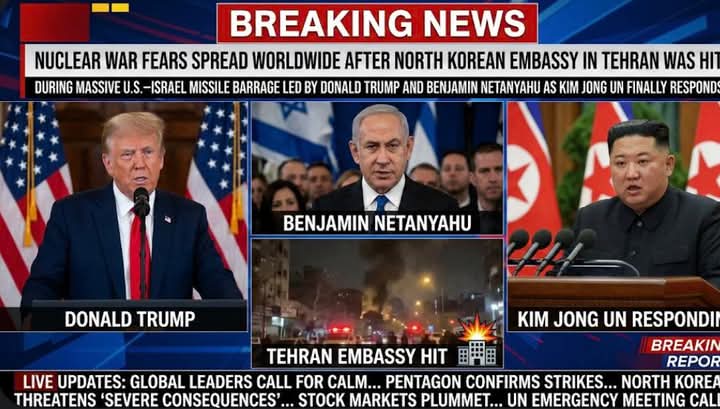
Global fears of a wider war—and even the possibility of nuclear escalation—have intensified following massive airstrikes on Iran reportedly carried out by forces from the United States and Israel.
The military campaign, supported by U.S. President Donald Trump and Israeli Prime Minister Benjamin Netanyahu, has dramatically increased tensions across the Middle East.
According to multiple reports, the strikes targeted key Iranian military and infrastructure sites in and around Tehran, marking one of the most intense attacks on Iran in recent years.
The operation is part of a broader confrontation between Iran and the U.S.–Israel alliance that has already resulted in significant casualties and widespread destruction.
Heavy Casualties and Regional Instability
The ongoing bombardment has reportedly caused more than a thousand deaths in Iran, while retaliatory missile and drone strikes by Iranian forces have targeted U.S. bases and Israeli positions throughout the region.
The conflict has also disrupted air travel, oil markets, and infrastructure across the Gulf states.
Regional tensions have intensified further after Iranian leaders vowed to resist external pressure.
The crisis has deepened following the reported death of Iran’s Supreme Leader, Ali Khamenei, in an earlier strike, creating uncertainty over the country’s leadership and future military strategy.
North Korea Responds
The government of North Korea has condemned the U.S.–Israel offensive, describing it as a violation of sovereignty and international law.
In a statement attributed to a foreign ministry spokesperson, Pyongyang accused Washington of destabilizing global security and warned that aggressive military actions could further threaten world peace.
While North Korean leader Kim Jong Un has not personally announced direct military involvement, analysts say Pyongyang’s statement signals political support for Iran and strong opposition to U.S. influence in the region.
Rising Fears of Nuclear Escalation
The growing conflict has sparked widespread fears that the situation could spiral into a broader confrontation involving multiple global powers.
Security experts warn that if additional countries become involved, the crisis could escalate into a larger international conflict.
Diplomatic leaders and global organizations are urging restraint and immediate dialogue to prevent further escalation. However, with military operations continuing and retaliatory strikes ongoing, the world remains on edge.
As tensions continue to mount, many fear that the unfolding crisis could mark the beginning of a dangerous new phase in global geopolitics—one where regional conflict risks triggering a much larger and potentially catastrophic war.

In a moment that feels both timeless and deeply symbolic, a new chapter of royal legacy quietly unfolds. Standing side by side, Prince William and Prince George offer a rare glimpse into a bond shaped not only by family, but by history itself.

Just In: KAMALA’S CHARLOTTESVILLE HOAX EXPLODES: SHE SLAMMED TRUMP FOR “FINE PEOPLE” WHILE COZYING UP TO THE SPLC THAT FUNDED THE RIOT

Just In : CHIEFS KINGDOM: FROM STRUGGLE FRANCHISE TO NFL STANDARD The Kansas City Chiefs are not a “success story that happened overnight.” This is a franchise with more than 60 years of history (since the 1960 AFL era) — and it took nearly three generations of fans to witness the full transformation.

The Future of the Monarchy: A New Era Begins? Click the link below for full details

Just In : Democrats Blow $70 Million for a Pathetic 3-Point Win in Virginia – Trump’s Team Declares Victory

Recent statements from President Trump regarding Iran have drawn significant attention, signaling a more assertive tone in U.S. foreign policy.

BREAKING: President Trump just posted about Obama, saying:

Tim Walz’s arrogant claim exposes the left’s disconnect from reality. See what happens next
Breaking News: Michelle Obama Voices Deep Concern Over Deportations: “It’s Keeping Me Up at Night. Read!!

Breaking: Kristen Stewart Sparks Debate with Claim She May Leave U.S. Over Trump Policies

Democrat Rep. Cohen Slammed for Claiming ICE Shouldn’t Arrest Illegal Immigrants
