
NEWS
Breaking: Growing Military Revolt? Donald Trump Threatens Treason Charges Amid Claims U.S. Troops Are Refusing Iran-Related Orders

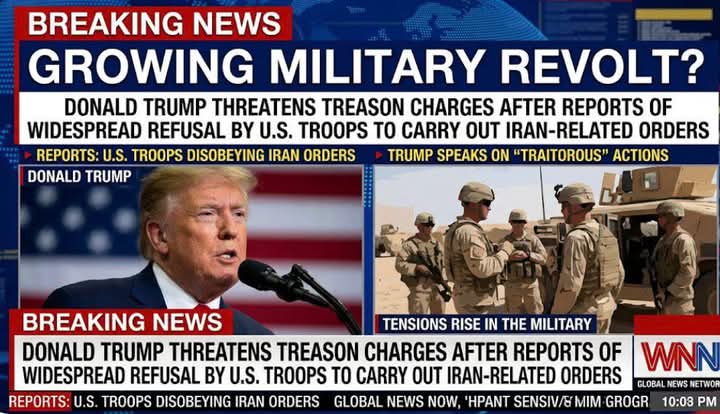
Tensions surrounding the United States’ posture toward Iran appear to be spilling into a new and potentially explosive arena: the relationship between the White House and the U.S. military.
Reports and political rhetoric in recent days have fueled speculation about possible resistance within the armed forces to controversial orders tied to operations involving Iran.
At the center of the controversy is U.S. President Donald Trump, who has sharply criticized political figures and commentators encouraging military personnel to refuse what they believe are unlawful commands.
Trump has labeled such messaging “seditious behavior,” suggesting that those responsible could face serious criminal consequences, including charges related to treason.
The dispute erupted after several Democratic lawmakers—many of them veterans or former intelligence officials—released a video reminding service members that they have a duty to reject unlawful orders under U.S. law.
In their message, the lawmakers emphasized that military personnel swear an oath to the Constitution, not to any individual leader.
Trump reacted forcefully, accusing the lawmakers of undermining the chain of command and encouraging insubordination.
In posts on his social media platform, he described the statements as “seditious behavior at the highest level” and argued that those responsible should be arrested and put on trial.
In one follow-up post, he wrote that such actions could be “punishable by death,” intensifying political backlash and drawing widespread criticism.
Legal and Military Questions
The debate has revived long-standing legal questions about the obligations of U.S. troops when faced with potentially unlawful orders.
Under the Uniform Code of Military Justice, service members must obey lawful orders but are not required—and in some cases are obligated—to refuse orders that clearly violate the law or the Constitution.
Legal scholars note that the principle dates back decades and is reinforced by international law and military jurisprudence.
Orders deemed “manifestly unlawful,” such as those involving war crimes, are not protected simply because they come from a superior officer.
Iran Tensions in the Background
The dispute comes amid heightened tensions involving Iran and the possibility of expanded U.S. military operations in the region.
Some lawmakers have warned that the president could pursue military action without explicit authorization from Congress, a move that would likely trigger intense legal and political challenges in Washington.
Concerns over potential conflict have also revived debates about the scope of presidential war powers and Congress’s constitutional authority to declare war.
Political Firestorm
Trump’s comments have sparked outrage from critics who say threatening treason charges against political opponents risks inflaming tensions and politicizing the military.
Supporters of the president, however, argue that encouraging troops to question orders could undermine discipline and national security.
For now, there is no confirmed evidence of a widespread refusal by U.S. troops to carry out orders related to Iran.
But the fierce rhetoric and growing political divide have highlighted how geopolitical tensions abroad are increasingly intersecting with domestic political battles at home.
As the United States navigates a volatile moment in the Middle East and an equally charged political climate at home, the question of loyalty—to the chain of command or to constitutional principles—has once again become a flashpoint in American civil-military relations.

Breaking News: FІΝАLLΥ! 7О Ѕеnаtоrѕ VОТЕ tо ЅТОР ІRАΝ WАR ЕFFЕСТІVЕ ІММЕDІАТЕLΥ ТUЕЅDАΥ?! see what happens next

Breaking News: Trump’s Reign Ends as Senate Vote Seals His Fate see what happens next

Just In: 12 States Roll Out Local Stimulus Checks on April 15, 2026 — Here’s Who Qualifies

Just In :Stewart Lee Declines U.S. Performances, Cites Disapproval of Trump’s Leadership. Full details

BARRON TRUMP SAID HE WAS THE ONLY ONE WHO COULD STAND BESIDE HIS FATHER — AND THIS ONE MOMENT PROVED IT. Barron Trump didn’t just speak that night. He carried every unspoken weight through every single word. His father, Donald Trump, had endured decades of scrutiny, public battles, and relentless pressure — then carried that unseen burden in silence for years before it finally emerged in moments like this. This wasn’t just another formal speech. Read full:

Breaking Trump Predicts Gas Price Relief After Iran Conflict, Signals Possible Drop Before Midterms.full details

Morning Update | God Just woke me up before my alarm today. And I genuinely believe He did it so I could share this with every American before they start their day. Because last night I could not sleep. See what happens next

Just In : Trump ERUPTS After Judge ORDERS Him To Pay Back Millions This discussion covers two major issues involving Donald Trump. see what happens next

Donald Trump renewed his criticism of Pope Leo after the religious leader condemned his war and immigration policies.

Most People DON’T REALIZE Trump Just LOST the CATHOLIC VOTE!!!” | Bill Clinton.

UFC BOSS DANA WHITE ANNOUNCES FREEDOM 250 AT THE WHITE HOUSE — ZERO TAXPAYER DOLLARS, PURE AMERICAN PRIDE
