
NEWS
Justin:VENEZUELA GOES DARK — STARLINK GOES LIVE Musk Confirms Free Internet Amid Power Cuts and Political Upheaval

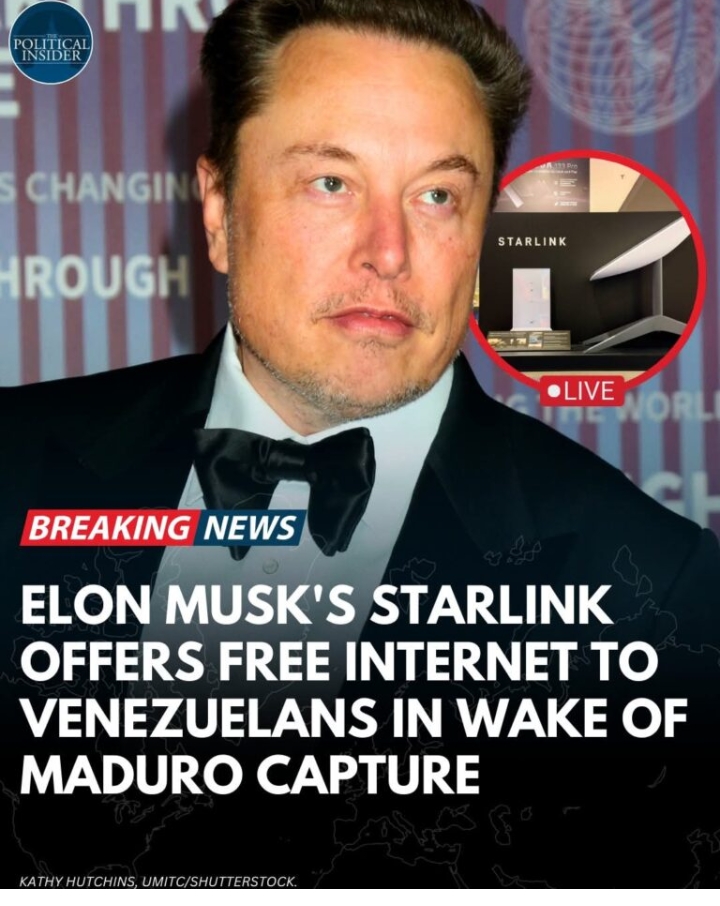
Venezuela, already no stranger to rolling blackouts and intermittent connectivity, has plunged into a new phase of crisis this week.
Following a controversial U.S. military operation that captured President Nicolás Maduro, power grids and telecom networks faltered across the nation, leaving millions in the dark — both literally and digitally.
Into this breach stepped Starlink, the satellite internet constellation owned by Elon Musk’s SpaceX — announcing free broadband internet access across Venezuela until February 3, 2026.
In support of the people of Venezuela signaling the move as an effort to maintain vital online connectivity amid crisis.
Why This Matters: Connectivity in Crisis
For Venezuelans, internet access isn’t just nice to have — it’s a lifeline.
After years of economic collapse, infrastructure failures and rolling blackouts anchored to failings at the Guri hydroelectric plant and a broader energy crisis, Venezuela has faced persistent power cuts and communication blackouts long before this week’s dramatic developments.
When terrestrial networks go down, satellite internet like Starlink’s can bypass damaged infrastructure entirely, connecting phones, businesses, journalists, and families directly to space-based networks — an especially powerful tool in emergencies.
In practical terms:
Service credits are being automatically applied to Starlink accounts, active and inactive, so users with hardware can stay online without paying monthly fees until February.
The offering does not include free hardware — end users still need Starlink receivers to access the service.
Venezuela remains, officially, “coming soon” on Starlink’s global availability map, though connectivity through roaming or pre-existing kits is currently possible for some users.
Lifeline: Why Many See This as Help
Proponents argue that free Starlink:
Restores critical communication when local infrastructure snaps — vital for emergency services, news outlets, families and civic coordination.
Frees information flows, challenging potential digital censorship or isolation during times of political turmoil.
Offers a model of private sector humanitarian support that governments or NGOs sometimes can’t deliver quickly.
In disaster zones, humanitarian cyber-responses historically include similar satellite deployments so first responders and civilians can coordinate relief and broadcast accurate information.
Leverage: Why Critics Are Wary
However, the deployment isn’t without controversy:
Geopolitical timing: The free service comes on the heels of a U.S. military operation that not only captured Maduro but also created a power/communications vacuum — feeding narratives that Starlink is aligning with political interests.
Economic barriers: Even though service is free, the required hardware — which can cost hundreds of dollars — remains out of reach for many Venezuelans facing hyperinflation and poverty.
Data and influence concerns: Some critics warn that reliance on a private, U.S.-based network could give outsized influence over what people see, share or can access online.
Social media threads already reflect fears about surveillance or narrative steering.
Temporary nature: With free service running through early February only, questions loom about what happens next. Will service continue? Who pays? What political strings might be attached?
A Snapshot: The Debate in Real Time
Proponents Say… Critics Say…
The Broader Context
This isn’t the first time Starlink has entered turbulent territory.
The service has been used in war-torn Ukraine, in natural disaster zones, and where governments have attempted to restrict online access.
Each instance raised similar issues: connectivity as humanitarian aid or tech with political weight?
In Venezuela’s case, the debate is more combustible because it unfolds alongside dramatic shifts in leadership, international intervention, and long-standing infrastructure fragility.
Final Thought: Lifeline or Leverage?
The answer may not be binary. Starlink’s deployment in Venezuela is both:
🔹 A lifeline for connectivity in a moment of crisis
🔹 A flashpoint in the broader conversation over how technology, geopolitics, and private enterprise intersect
And as free access ticks toward February, the world will be watching:
Will this signal a new model of digital humanitarianism — or a new frontier in digital influes blackouts and connectivity issues.

JUST BREAKING: Some Retirees to Receive Over $5,000 Monthly in Social Security by 2026 — Eligibility Criteria Revealed

¡Esta es la extraordinaria valentía de Irán 🇮🇷! 🔥 9:00 am: “Toda una civilización terminará esta noche”, dijo Trump. 9:10 a. m.: La gente común de Irán ha formado una cadena humana en el puente blanco. 🔥🔥 Si no tienen miedo a morir, no pueden ser derrotados. ¡Qué coraje increíble! 🔥

Pro-Iranian accounts on Twitter are flooding the platform tonight with AI-generated videos mocking Trump, including one showing him stepping off Air Force One waving a white flag after announcing a ceasefire deal critics say was so bad he appeared to negotiate with himself.

A major political shockwave just hit Washington as 24 members of Congress declare an EMERGENCY and demand the UNPRECEDENTED removal of President Trump from office.

BREAKING: Trump’s Shocking Revelation Sparks Viral Frenzy and Raises Questions About His Political Future

Is “getting the job done” more important than having a “nice” president?

Just In :Trump Sends Clear Message to Iran as B-52 Bombers Lift Off from UK Bases. See what happens next

Breaking News:Trump Suspends Planned U.S. Strikes on Iran for Two Weeks Amid Diplomatic Push. Full details here
Today I witnessed something because of Trump that I will never forget for the rest of my life. And that is exactly why I want to show you Trump’s real face today. Click here for full details

At a Monday press conference, Trump brought up past comments by North Korea’s Kim Jong Un about Joe Biden while discussing US troop deployment in South Korea.

Breaking Claim Sparks Concern: Viral Report Alleges Attack on U.S. Warships Near Strait of Hormuz. See what happens next
