
NEWS
Justin:VENEZUELA GOES DARK — STARLINK GOES LIVE Musk Confirms Free Internet Amid Power Cuts and Political Upheaval

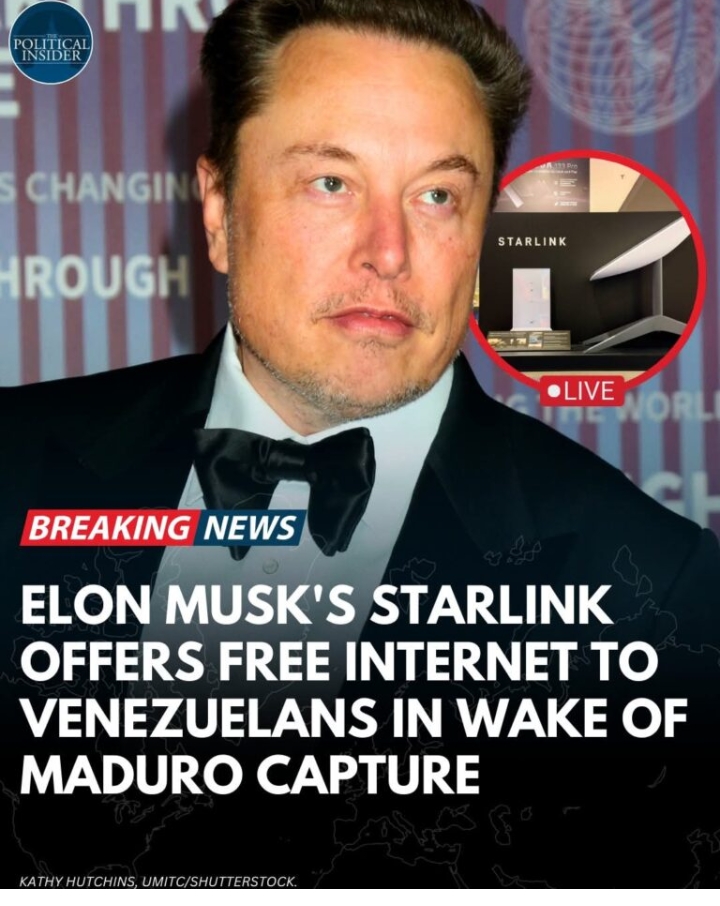
Venezuela, already no stranger to rolling blackouts and intermittent connectivity, has plunged into a new phase of crisis this week.
Following a controversial U.S. military operation that captured President Nicolás Maduro, power grids and telecom networks faltered across the nation, leaving millions in the dark — both literally and digitally.
Into this breach stepped Starlink, the satellite internet constellation owned by Elon Musk’s SpaceX — announcing free broadband internet access across Venezuela until February 3, 2026.
In support of the people of Venezuela signaling the move as an effort to maintain vital online connectivity amid crisis.
Why This Matters: Connectivity in Crisis
For Venezuelans, internet access isn’t just nice to have — it’s a lifeline.
After years of economic collapse, infrastructure failures and rolling blackouts anchored to failings at the Guri hydroelectric plant and a broader energy crisis, Venezuela has faced persistent power cuts and communication blackouts long before this week’s dramatic developments.
When terrestrial networks go down, satellite internet like Starlink’s can bypass damaged infrastructure entirely, connecting phones, businesses, journalists, and families directly to space-based networks — an especially powerful tool in emergencies.
In practical terms:
Service credits are being automatically applied to Starlink accounts, active and inactive, so users with hardware can stay online without paying monthly fees until February.
The offering does not include free hardware — end users still need Starlink receivers to access the service.
Venezuela remains, officially, “coming soon” on Starlink’s global availability map, though connectivity through roaming or pre-existing kits is currently possible for some users.
Lifeline: Why Many See This as Help
Proponents argue that free Starlink:
Restores critical communication when local infrastructure snaps — vital for emergency services, news outlets, families and civic coordination.
Frees information flows, challenging potential digital censorship or isolation during times of political turmoil.
Offers a model of private sector humanitarian support that governments or NGOs sometimes can’t deliver quickly.
In disaster zones, humanitarian cyber-responses historically include similar satellite deployments so first responders and civilians can coordinate relief and broadcast accurate information.
Leverage: Why Critics Are Wary
However, the deployment isn’t without controversy:
Geopolitical timing: The free service comes on the heels of a U.S. military operation that not only captured Maduro but also created a power/communications vacuum — feeding narratives that Starlink is aligning with political interests.
Economic barriers: Even though service is free, the required hardware — which can cost hundreds of dollars — remains out of reach for many Venezuelans facing hyperinflation and poverty.
Data and influence concerns: Some critics warn that reliance on a private, U.S.-based network could give outsized influence over what people see, share or can access online.
Social media threads already reflect fears about surveillance or narrative steering.
Temporary nature: With free service running through early February only, questions loom about what happens next. Will service continue? Who pays? What political strings might be attached?
A Snapshot: The Debate in Real Time
Proponents Say… Critics Say…
The Broader Context
This isn’t the first time Starlink has entered turbulent territory.
The service has been used in war-torn Ukraine, in natural disaster zones, and where governments have attempted to restrict online access.
Each instance raised similar issues: connectivity as humanitarian aid or tech with political weight?
In Venezuela’s case, the debate is more combustible because it unfolds alongside dramatic shifts in leadership, international intervention, and long-standing infrastructure fragility.
Final Thought: Lifeline or Leverage?
The answer may not be binary. Starlink’s deployment in Venezuela is both:
🔹 A lifeline for connectivity in a moment of crisis
🔹 A flashpoint in the broader conversation over how technology, geopolitics, and private enterprise intersect
And as free access ticks toward February, the world will be watching:
Will this signal a new model of digital humanitarianism — or a new frontier in digital influes blackouts and connectivity issues.

HIS HAND WAS TREMBLING” — THE MOMENT Donald Trump AND Melania Trump FROZE 80,000 PEOPLE IN SILENCE

BREAKING:“The President Who Never Sleeps?” Pilot’s 30-Year Claim Reveals a Different Side of Donald Trump.

Just In: The betrayal cuts deep—watching career Democrats like Pelosi whisper with their next generation while America burns.

AOC warned the South that “the North” is about to pull up.

When Donald Trump was five years old, his father Fred would wake him at dawn on Saturdays, hand him a paper bag with a bologna sandwich, and drive him to a construction site in Brooklyn. Full story

Faith Is Our Foundation”: JD Vance Calls for National Renewal Through Prayer at ‘Rededicate 250’ Event.

SPEAKER JOHNSON DEFENDS ‘IN GOD WE TRUST’ AND NATIONAL REDEDICATION AGAINST SEPARATION CRITICS

BREAKING: Lindsey Graham Warns Republicans — Opposing Donald Trump Could End Political Careers

Just In : Gates made the comments during an interview regarding his book How to Avoid a Climate Disaster.

Just In : Trump and Netanyahu Hold Urgent 30-Minute Call as Intel Warns Iran May Be Buying Time for War. See what happens next

BREAKING NEWS:Trump Issues Stark New Warning to Iran as Regional Tensions Escalate.
