
NEWS
BREAKING:Geopolitical Chess in the Middle East: Rising Tensions Among Iran, Turkey, UAE, and Israel. Read more story. Mi

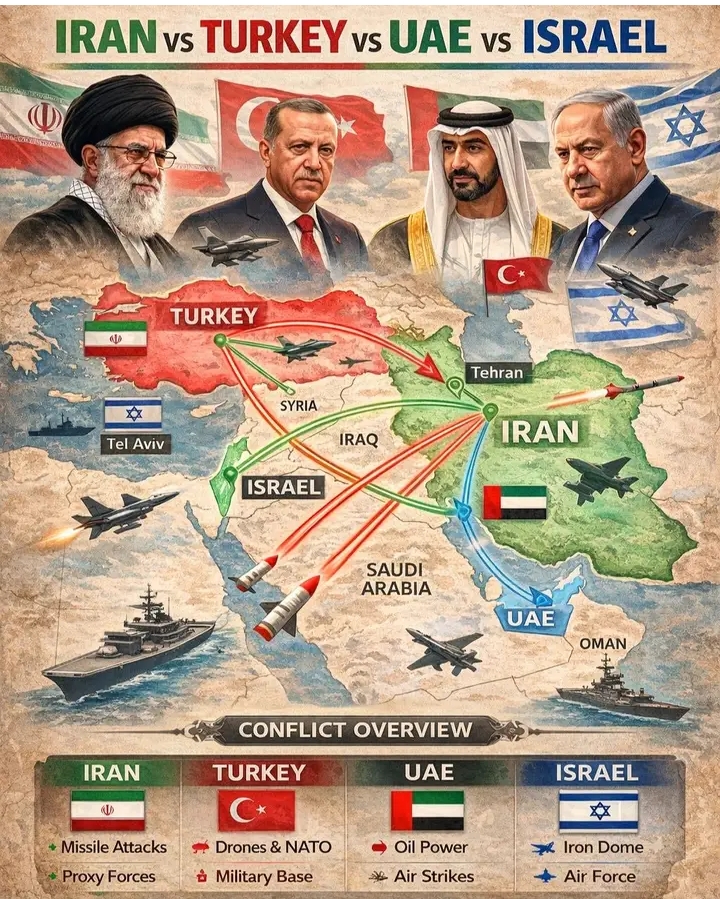
The Middle East is once again at the center of global attention as regional powers maneuver through an increasingly complex geopolitical landscape.
Growing tensions among Iran, Turkey, the United Arab Emirates, and Israelhighlight a strategic contest driven by shifting alliances, military capabilities, and competing national interests.
At the heart of this evolving situation is Iran’s effort to expand its influence across the region.
Tehran has long relied on networks of allied groups and proxy forces to project power beyond its borders.
Through missile programs, drone development, and support for regional partners, Iran seeks to counter its rivals while strengthening its strategic position in the Middle East.
Meanwhile, Turkey has adopted a more assertive foreign policy in recent years.
As a member of North Atlantic Treaty Organization, Ankara balances its Western alliances with independent regional ambitions.
Turkey has invested heavily in drone technology and military modernization, enabling it to play a more prominent role in conflicts and political negotiations across the region.
The United Arab Emirates has also emerged as a significant geopolitical actor.
Known for its economic strength and influence in global energy markets, the UAE has expanded its military capabilities while positioning itself as a key participant in regional security affairs.
Its ability to combine oil wealth with advanced air power and strategic diplomacy has allowed the country to exert influence in various Middle Eastern conflicts.
Israel, for its part, continues to focus on countering threats it perceives from Iran and its allies.
With one of the region’s most advanced militaries, Israel maintains a strong air force and a sophisticated missile defense system, including the well-known Iron Dome, designed to intercept incoming rockets and missiles.
Israeli leaders argue that maintaining a strong deterrent is essential for national security amid rising regional tensions.
Military developments across the region—such as missile deployments, drone activity, and naval operations—underscore the seriousness of the situation.
Analysts often describe the current environment as a strategic “chess game,” where each move by one nation triggers responses from others, gradually reshaping the balance of power.
The interplay between these four influential states illustrates how alliances and rivalries in the Middle East continue to evolve.
While diplomatic engagement remains possible, the region’s stability remains fragile, with the risk of sudden escalation always present.
As global attention remains fixed on the Middle East, understanding the motivations and strategies of these key players will be essential in predicting how the region’s geopolitical contest may unfold in the months and years ahead.

First Lady Melania Trump publicly called out Jimmy Kimmel for using his late night platform to spread division and hate against half the country every single night.

Breaking News: Historic State Visit Begins as Trump Welcomes King Charles III to the White House

BREAKING NEWS: TRUMP URGES REPUBLICANS TO BYPASS DEMOCRAT OBSTRUCTION AND USE BUDGET RECONCILIATION TO END 70-DAY DHS SHUTDOWN

JUST BREAKING: When Your Social Security Payment Arrives in May 2026 — Plus the Top Benefits You Should Know

BREAKING: The Iranian ship Touska, seized by the US Navy, was carrying vital dialysis supplies and medical equipment, according to the Iranian Red Cresce

Melania’s DARK PAST Surfaces as She is OUTED by TOP WITNESS!!!

Jimmy Kimmel said this right before an armed man showed up at the actual White House Correspondents’ Dinner and tried to shoot Trump.

FATHER in WHITE HOUSE How happiness turns into pain in one single moment… I found out yesterday.

Just In : Standing Firm: Why Trump Supporters Aren’t Disappearing—They’re Just Done Arguing

First Lady Melania Trump turns 56 today. Her birthday came just hours after she was evacuated from the Washington Hilton following a shooting at the White House Correspondents’ Dinner

BREAKING: DC police say a suspect armed with a shotgun, handgun and knives was intercepted after breaching a checkpoint near the White House Correspondents’ Dinner, with gunfire exchanged and a Secret Service officer injured but stable.
